
SafetyRisk, alignment & guardrails
OpenAI details GPT-6.2 Astra and Sol defenses against reasoning extraction and links distillation to cyber risk
OpenAI described layered defenses against adversarial distillation in GPT‑6.2 Astra and Sol. It reported that a key reasoning-extraction attack's success fell from 54.0% to 0.2%, and said exact reasoning traces can give copycat models more cyber capability than summaries.
From the OpenAI News article of November 20, 2026 and cited sources: The defenses work at two levels. [1] [7]
SOURCES[1] Combatting adversarial distillation — OpenAI openai.com[7] OpenAI Strengthens GPT-6.2 Astra Against Reasoning… unite.ai
 AT Pulse research deskPublished · Updated · 5 min read · AI-assisted analysis
AI-assisted, not human-edited. Methodology Corrections Who owns this site
- Original source
- OpenAI News article, company source
- Brief by
- AT Pulse research desk AI-assisted; publisher and contact on the desk page
- Studies
- arXiv 2604.23238 (Apr 2026) [9] date from arXiv ID
- When
- November 20, 2026 article published
- Covered
- Nov 21 edition
- Evidence
- 9 sources across 9 sites
- 1Combatting adversarial distillation — OpenAIopenai.com
- 2OpenAI Claims DeepSeek Distilled US Models to Gain an Edge…bloomberg.com
- 3OpenAI–DeepSeek distillation dispute — Rest of Worldrestofworld.org
- 4Detecting and preventing distillation attacks — Anthropicanthropic.com
- 5OpenAI says it disrupted a Moonshot-linked distillation…ventureatlas.org
- 6OpenAI Accuses Moonshot AI of Coordinated Model…govinfosecurity.com
StrongHow it’s measured
Hacker News · 34 likes · 51 comments
Reach blends public engagement (views, likes, comments, shares, stars) from the platforms where the story or its original source lives: YouTube, Hacker News, GitHub, Substack and similar. A video and the article written from its transcript share one score, taken from the video. Platforms with no data are left out rather than counted as zero, and the age of a story never lowers its score.
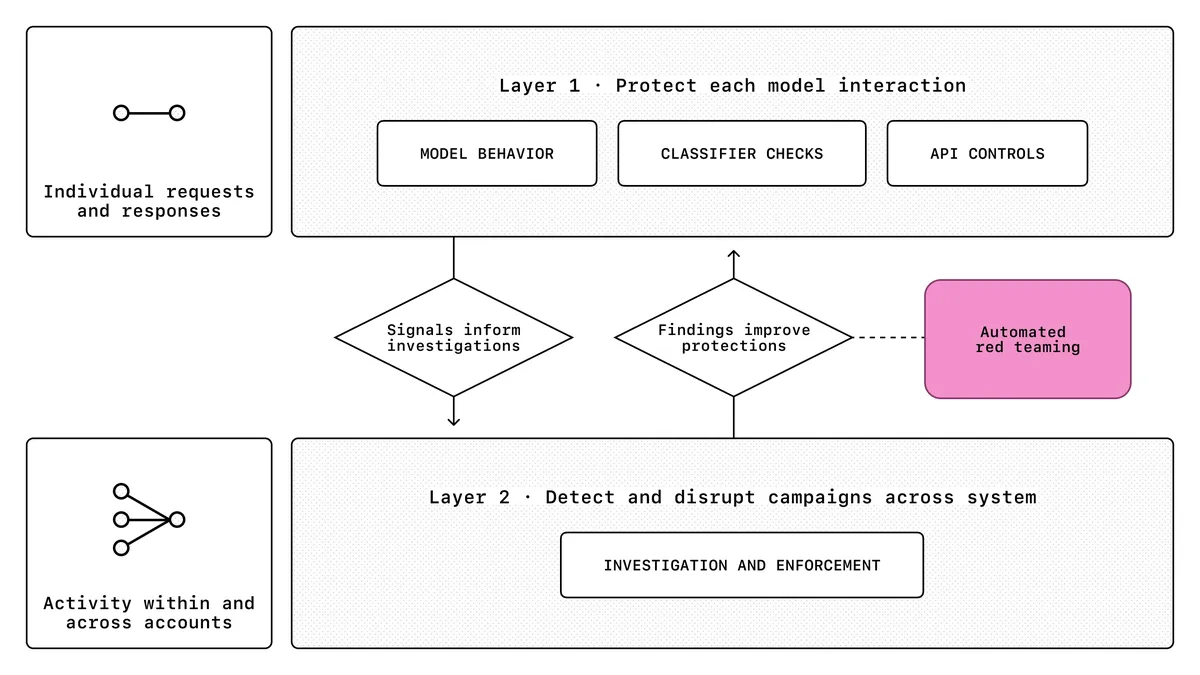
The defenses work at two levels. For individual requests, OpenAI uses adversarial training plus input and output classifiers. The output classifiers also check tool-call arguments, where reasoning can leak without appearing in the final answer. For coordinated campaigns, it enforces against whole networks of accounts. In OpenAI's own evaluations, extraction from an earlier request fell from 54.0% to 0.2%, and extraction from the current request fell from 22.9% to 0.9%. The results are averaged across six attacker models that have not been published. [1] [7]
The API now behaves differently. Protected reasoning is tied to the conversation history that produced it, so editing an earlier message drops the reasoning that followed. Older model families can no longer read 6.2's encrypted reasoning. Isolation between users, workspaces and organizations is tighter, including a fix for a pathway that could have exposed another user's encrypted reasoning. Agent frameworks that rewrite earlier messages will lose cached reasoning. [1]
In a cyber transfer study, student models fine-tuned on exact reasoning traces generally beat students trained on summaries. After light reinforcement learning, though, exact-trace students led only at the largest inference budget. Visible outputs alone still transferred capability, so hiding reasoning limits only the extra transfer. [1]
The disclosure follows a year of escalating accusations. In February, OpenAI accused DeepSeek of distilling US models. Also in February, Anthropic reported more than 16 million exchanges with Claude through about 24,000 fraudulent accounts. In September, OpenAI tied a summer campaign to people associated with Moonshot AI. Critics argue the AI industry has always learned recursively from earlier work, and one analyst questioned whether the timing was aimed at chip-export policy. [2] [3] [4] [5] [6]
measured extraction success dropped sharply, and exact traces transferred extra capability only in some settings.
Read the full assessment
Implications: developers lose reasoning portability across models and edited histories, and labs increasingly frame output protection as a national-security issue alongside export controls.
Executive brief
OpenAI says its weekly enforcement actions against unauthorized distillation have hit between thousands and tens of thousands of accounts, and that the rate rose sharply in summer 2026. On November 20, 2026 it described defenses against "adversarial distillation," meaning the unauthorized use of a model's outputs, especially its hidden chain-of-thought, to train a copy that lacks the original's safeguards. OpenAI reports that GPT‑6.2 Astra cut a key reasoning-extraction attack's success rate from 54.0% to 0.2%. It also links distillation to cyber risk and national security, and backs new US legislation (OpenAI). No independent check of these numbers is available.
What changed and event timeline
OpenAI memo accuses DeepSeek
In a memo to the House Select Committee on China, OpenAI said accounts tied to DeepSeek employees developed ways around its access restrictions in order to distill US models (;).
Anthropic reports industrial-scale campaigns
Anthropic said DeepSeek, Moonshot and MiniMax generated more than 16 million exchanges with Claude through about 24,000 fraudulent accounts ().
Reasoning-extraction campaign on OpenAI
The activity peaked on July 24–25 at 16,000 requests from more than 4,000 users. It involved more than 15,000 users in total before being disrupted ().
Moonshot attribution
OpenAI attributed a "core cluster" of the campaign to people associated with Moonshot AI. It said encryption was not broken and stored chats were not accessed (;).
Defense disclosure
OpenAI detailed hardened safeguards in GPT‑6.2 Astra and Sol and published extraction attack-success rates and results from a study of cyber capability transfer (;).
Capabilities and access
- Models covered: GPT‑6.2 Astra and GPT‑6.2 Sol. Some of the improvements are being backported to GPT‑6 Astra (OpenAI).
- API behavior changes:
- Protected reasoning is now tied to the conversation history that produced it.
Read the full section
- Models covered: GPT‑6.2 Astra and GPT‑6.2 Sol. Some of the improvements are being backported to GPT‑6 Astra (OpenAI).
- API behavior changes:
- Protected reasoning is now tied to the conversation history that produced it. If an earlier message is rewritten, the reasoning that followed it is dropped.
- Older model families with weaker safeguards can no longer read 6.2's encrypted reasoning.
- Isolation across user, workspace and organization boundaries is tighter. This includes a fix for a pathway that could have exposed another user's encrypted reasoning (OpenAI).
Technical analysis for researchers and developers
- At the request level: adversarial training to refuse extraction attempts, input classifiers that flag extraction attempts, and output classifiers that scan both assistant messages and tool-call arguments, in streaming and non-streaming responses.
- How the defenses were tested:
- Static replay of previously successful attacks.
Read the full section
- Defenses stack at two levels. At the request level: adversarial training to refuse extraction attempts, input classifiers that flag extraction attempts, and output classifiers that scan both assistant messages and tool-call arguments, in streaming and non-streaming responses. Tool arguments matter because a model can leak reasoning there without it appearing in the final answer. At the campaign level: account-network signals and enforcement against whole networks of accounts (OpenAI).
- How the defenses were tested:
- Static replay of previously successful attacks.
- Adaptive automated red-teaming, both black-box (what an external user sees) and white-box (extra system information).
- Reported attack-success rates are aggregated across six attacker models. The attacker models and attack sets are not published, so the results cannot be reproduced.
- Cyber transfer study:
- Every student model started from the same pretrained checkpoint.
- Students were trained with supervised fine-tuning (SFT) on trajectories from Astra-level teachers, followed by light reinforcement learning (RL).
- After SFT, students trained on exact reasoning traces generally beat students trained on reasoning summaries.
- After RL, exact-trace students led only at the largest inference budget; summary-trained students scored higher at lower budgets (OpenAI).
Claims and evidence
- Extraction from an earlier request: attack success fell from 54.0% to 0.2%. Extraction from the current request: it fell from 22.9% to 0.9% (OpenAI).
- Exact traces transfer more cyber capability than summaries: this comes from an internal study. OpenAI cites a similar Anthropic finding on SWE-bench Verified (OpenAI).
- Moonshot attribution: this is OpenAI's account alone. Moonshot had not responded publicly as of the reporting (Venture Atlas).
Read the full section
- Extraction from an earlier request: attack success fell from 54.0% to 0.2%. Extraction from the current request: it fell from 22.9% to 0.9% (OpenAI). These are internal evaluations. Coverage repeats the figures without independent testing (Unite.AI; FourWeekMBA).
- Exact traces transfer more cyber capability than summaries: this comes from an internal study. Benchmark names and scores for the cyber result are not shown in the post. OpenAI cites a similar Anthropic finding on SWE-bench Verified (OpenAI).
- Moonshot attribution: this is OpenAI's account alone. Moonshot had not responded publicly as of the reporting (Venture Atlas).
Context and prior work
- Anthropic's February report described detecting chain-of-thought elicitation with classifiers and behavioral fingerprinting, sharing indicators with other labs and authorities, and tightening account verification (Anthropic).
- Academic work on "antidistillation" tries to degrade the value of traces to a student rather than hide them.
- OpenAI shared earlier findings through the Frontier Model Forum (OpenAI).
Read the full section
- Anthropic's February report described detecting chain-of-thought elicitation with classifiers and behavioral fingerprinting, sharing indicators with other labs and authorities, and tightening account verification (Anthropic).
- Academic work on "antidistillation" tries to degrade the value of traces to a student rather than hide them. The TARS method removes high-influence reasoning sentences, while its authors warn that cruder perturbations leave artifacts attackers can detect and filter out (arXiv 2604.23238).
- OpenAI shared earlier findings through the Frontier Model Forum (OpenAI).
Limitations, safety and contested findings
- The cyber result is mixed. Summary-trained students outperformed at lower inference budgets after RL, so the advantage of exact traces is not uniform (OpenAI).
- The study's baseline, visible outputs alone, transfers capability too. Hiding reasoning limits only the extra transfer.
- Critics question the framing. A RAND analyst questioned whether OpenAI's timing was aimed at chip-export policy (Rest of World).
Read the full section
- The cyber result is mixed. Summary-trained students outperformed at lower inference budgets after RL, so the advantage of exact traces is not uniform (OpenAI).
- Final answers and summaries still teach. The study's baseline, visible outputs alone, transfers capability too. Hiding reasoning limits only the extra transfer.
- Critics question the framing. Counterpoint's Neil Shah argued that the whole industry has developed through recursive learning. A RAND analyst questioned whether OpenAI's timing was aimed at chip-export policy (Rest of World).
- Independent corroboration of OpenAI's metrics and attributions is not available.
Business and practitioner implications
- Developers: expect less portability of reasoning.
- Platforms and resellers: OpenAI's consistent-standards policy pushes partners that offer its models toward shared safeguards and coordinated enforcement (OpenAI).
- Policy: OpenAI backs the Chip Security Act, the AI OVERWATCH Act and the MATCH Act, and presents distillation defenses as a complement to export controls.
Read the full section
- Developers: expect less portability of reasoning. Encrypted reasoning will not carry across model families or edited conversation histories, and agent frameworks that rewrite earlier messages will lose cached reasoning.
- Platforms and resellers: OpenAI's consistent-standards policy pushes partners that offer its models toward shared safeguards and coordinated enforcement (OpenAI).
- Policy: OpenAI backs the Chip Security Act, the AI OVERWATCH Act and the MATCH Act, and presents distillation defenses as a complement to export controls.
- Model builders: OpenAI recommends keeping successful extraction attacks as regression tests and scanning tool-call outputs for leaks, and these are steps other model builders can adopt.