
ExitsIPOs, listings & liquidity
Anthropic prices IPO at $83 a share, raising $81.3B; S-1 shows $33.24B nine-month revenue and about 900% net revenue retention
Anthropic raised $81.3B at $83 a share in what CNBC calls the largest IPO on record. Its filing shows $33.24B in nine-month revenue and roughly 900% net retention, alongside $895.4B in purchase commitments and rising compute costs.
From the SaaStr article of November 19, 2026 and cited sources: Revenue for the nine months to September 30 was $33.24B, up about 1,200% year on year, with $17B of it in Q3. [1] [3] [5] [12]
SOURCES[1] SaaStr: Top 10 Metrics in Anthropic's S-1 saastr.com[3] CNBC: Amended S-1, Q3 financials cnbc.com[5] TechCrunch: IPO filing and enterprise strategy techcrunch.com
 AT Pulse research deskPublished · Updated · 5 min read · AI-assisted analysis
AI-assisted, not human-edited. Methodology Corrections Who owns this site
- What happened
- Revenue for the nine months to September 30 was $33.24B, up about 1,200% year on year, with $17B of it in Q3. [1] [3] [5] [12]
- Original source
- SaaStr article, independent perspective
- Brief by
- AT Pulse research desk AI-assisted; publisher and contact on the desk page
- When
- November 19, 2026 article published
- Covered
- Nov 21 edition
- Evidence
- 15 sources across 12 sites
- 1SaaStr: Top 10 Metrics in Anthropic's S-1saastr.com
- 2Linked video: The Top 10 Metrics From Anthropic’s IPO for…youtube.com
- 3CNBC: Amended S-1, Q3 financialscnbc.com
- 4CNBC: IPO raises $81Bcnbc.com
- 5TechCrunch: IPO filing and enterprise strategytechcrunch.com
- 6The Information: 85% margin reality checktheinformation.com
RisingHow it’s measured
YouTube video · 43.3K views · 565 likes
Reach blends public engagement (views, likes, comments, shares, stars) from the platforms where the story or its original source lives: YouTube, Hacker News, GitHub, Substack and similar. A video and the article written from its transcript share one score, taken from the video. Platforms with no data are left out rather than counted as zero, and the age of a story never lowers its score.
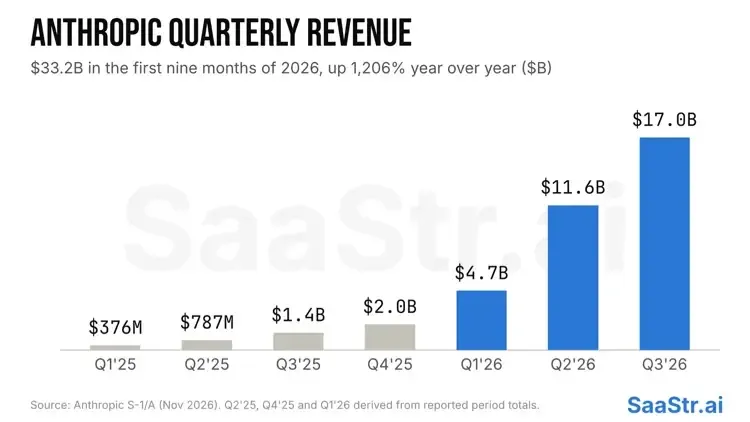
Revenue for the nine months to September 30 was $33.24B, up about 1,200% year on year, with $17B of it in Q3. Net revenue retention of about 900% is the company's own measure. It counts only metered accounts and leaves out Pro and Max subscribers. For comparison, Snowflake reported 158% when it filed. Customers spending $100K or more rose from about 950 to more than 11,900. [1] [3] [5] [12]
The IPO priced at $83, above the $70–78 range. It sold about 980M shares, raised $81.3B and implied a fully diluted valuation of roughly $1.5T. Shares closed their first Nasdaq day at $97.17, about 17% above the offer price. [4] [8] [9]
the filed figures show usage-priced AI revenue growing within existing accounts far faster than seat-priced SaaS, which Lemkin says tops out around 120–130%.
Read the full assessment
Implication: investors are paying for that growth, while fixed compute commitments and reliance on cloud partners are the main risks.
Sources are checked; here is the dossier.
Executive brief
Anthropic's IPO filing reports about 900% net revenue retention. That means customers who were paying in Q3 2025 spent roughly nine times as much in Q3 2026. The figure counts only metered accounts and leaves out Pro and Max subscribers (SaaStr). Revenue for the nine months to September 30 was $33.24B, up about 1,200% year on year. Against that, the company has $895.4B in purchase commitments (CNBC). The IPO priced at $83 a share and raised $81.3B, which CNBC reports is the largest offering on record (CNBC). The metrics are self-reported but appear in the SEC filing. The SaaStr piece is commentary by Jason Lemkin, who also runs a venture fund.
What changed and event timeline
Public S-1 filed
Disclosed 900% NRR, more than 11,900 customers at $100K+, and two-product use by over half of those customers ().
Amended S-1 adds Q3
Q3 revenue was $17B, up 47% on Q2. The nine-month net loss was $104B, most of it a fair-value charge on convertible notes. Purchase commitments total $895.4B ().
Margin debate
The Information reported that the ~85% gross margin leaves out model-development compute (; summary via).
IPO prices above range
$83 a share against a $70–78 range, about 980M shares, $81.3B raised, roughly $1.5T fully diluted valuation (;).
Nasdaq debut as ANT
Shares closed at $97.17, about 17% above the offer price (). SaaStr published its metrics breakdown the same day.
Capabilities and access
- In the linked talk, Anthropic's head of industries, Elenore Dorfman, says demand "went vertical" after the December 2025 launch of Opus 4.6 (00:45).
- Products sold: the Claude Platform (API), the Pro, Max and Team plans, Claude Code and Cowork (TechCrunch).
- Access runs through Anthropic directly and through AWS, Google Cloud and Azure marketplaces.
Read the full section
- In the linked talk, Anthropic's head of industries, Elenore Dorfman, says demand "went vertical" after the December 2025 launch of Opus 4.6 (00:45). The filing summaries reviewed do not cover this.
- Products sold: the Claude Platform (API), the Pro, Max and Team plans, Claude Code and Cowork (TechCrunch).
- Access runs through Anthropic directly and through AWS, Google Cloud and Azure marketplaces. Marketplaces carried 48% of H1 2026 revenue, up from 11% in 2023 (GovInfoSecurity).
Technical analysis for researchers and developers
- Margin depends on how compute is split. Cost of revenue covers only compute for serving customers.
- Usage pricing moves with how people work. Spending fell about 20% over the 2025 year-end holidays (SaaStr).
- How the sales team uses Claude internally. Humans still review and send every customer follow-up (23:45).
Read the full section
- Margin depends on how compute is split. Cost of revenue covers only compute for serving customers. Training compute is booked under R&D. In H1, $2.4B of $8.9B in compute expense went to cost of revenue (FourWeekMBA). Training at scale is therefore not in the 85% figure.
- Usage pricing moves with how people work. Spending fell about 20% over the 2025 year-end holidays (SaaStr).
- How the sales team uses Claude internally. Plugins combine MCP connectors with five "skills": morning brief, call prep, follow-up, competitive intel and asset creation (20:52). Slack is the entry point for deal desk and legal requests, which Claude triages (18:48). Humans still review and send every customer follow-up (23:45).
Claims and evidence
Read the full section
- $33.24B nine-month revenue and $17B in Q3: in the filing (CNBC).
- ~900% NRR: the company's own definition, metered accounts only (SaaStr; ToKnow.ai).
- 85.5% gross margin: not stated in the filing. FourWeekMBA derived it from the footnotes ($4.81B cost against $33.24B revenue).
- $100K+ customers rose from 950 to 11,900: reported in the filing (TechCrunch).
- 54% of new 2026 enterprise logos came through self-serve: an executive's statement only (07:28).
- IPO terms: reported by CNBC and TechCrunch. The reviewed sources do not name the lead underwriters.
Context and prior work
- Snowflake had 158% NRR when it filed and GitLab had 152%. Lemkin argues that seat-priced products top out around 120–130% (SaaStr).
- Revenue was $41M in 2023, $386M in 2024 and $4.585B in 2025 (same source).
- Big Tech dependence was already reported in September from a draft prospectus (The Star/Reuters).
Read the full section
- Snowflake had 158% NRR when it filed and GitLab had 152%. Lemkin argues that seat-priced products top out around 120–130% (SaaStr).
- Revenue was $41M in 2023, $386M in 2024 and $4.585B in 2025 (same source).
- Big Tech dependence was already reported in September from a draft prospectus (The Star/Reuters).
- OpenAI is targeting a 2027 listing (CNBC).
Limitations, safety and contested findings
- The prior-year margin depends on the period. It is 29.4% on a nine-month basis (FourWeekMBA) but about 12% for H1 2025, per Motley Fool.
- Compute is taking a bigger share again.
- Commitments are large and fixed. $437B of the deals are non-cancellable (gHacks).
Read the full section
- The prior-year margin depends on the period. It is 29.4% on a nine-month basis (FourWeekMBA) but about 12% for H1 2025, per Motley Fool. The prospectus warns that margins will fluctuate with the timing of compute spending (Webull/Motley Fool).
- Compute is taking a bigger share again. It rose from 48% of revenue in Q2 to 58% in Q3, and Q3 posted a $567M operating loss (SaaStr).
- Commitments are large and fixed. $437B of the deals are non-cancellable (gHacks).
- Cloud partners are also competitors. The filing flags that they may put their own needs first when allocating capacity (TechCrunch).
- Forecasting is weak. Dorfman says forecast accuracy is "not quite there" yet (13:50).
Business and practitioner implications
- Report NRR separately for usage-priced and seat-priced customers.
- Track inference cost as a share of revenue every quarter.
- Get listed on cloud marketplaces, where enterprises spend committed cloud budgets.
Read the full section
- Report NRR separately for usage-priced and seat-priced customers.
- Track inference cost as a share of revenue every quarter.
- Get listed on cloud marketplaces, where enterprises spend committed cloud budgets.
- Use committed-spend contracts to cushion seasonal dips in usage.
- Track how many top customers buy a second product.
- Lemkin's benchmark is spend as a share of a customer's total expenses, not its IT budget: under $1 per $1,000 among public Fortune 500 customers. He uses this test for his own Fund II investments (SaaStr).
- Anthropic's own sales approach was to build Claude into tools it already used rather than replace them (30:04).
The source trail.
Sources (15)
SaaStr: Top 10 Metrics in Anthropic's S-1
saastr.comLinked video: The Top 10 Metrics From Anthropic’s IPO for B2B Execs: $33 Billion in Nine Months, 900% NRR, and 12x More $100K Customers in a Year
linked video auto captions
www.youtube.com