
ResearchPapers, evidence & method
Michael Tomasello argues language models skip the coordination abilities that human language is built on
Developmental psychologist Michael Tomasello argues large language models begin with language, skipping older abilities such as goals, executive control and shared intentions. Early coordination studies show humans working less fluidly with AI partners, though other tests find LLMs coordinate surprisingly well.
From the Machine Learning Street Talk video of November 19, 2026 and cited sources: Tomasello says LLMs start at the endpoint of human cognition. [1] [3]
SOURCES[1] What a Squirrel Knows That Language Models Skip… youtube.com[3] The Evolution of Agency – MIT Press Bookstore mitpressbookstore.mit.edu
 AT Pulse research deskPublished · Updated · 4 min read · AI-assisted analysis
AI-assisted, not human-edited. Methodology Corrections Who owns this site
- Original source
- Machine Learning Street Talk video, independent perspective
- Brief by
- AT Pulse research desk AI-assisted; publisher and contact on the desk page
- When
- November 19, 2026 video published
- Covered
- Nov 20 edition
- Evidence
- 7 sources across 6 sites; transcript sourced
- 1What a Squirrel Knows That Language Models Skip…youtube.com
- 2Cheng et al., "The Agency Gap," CogSci proceedingsescholarship.org
- 3The Evolution of Agency – MIT Press Bookstoremitpressbookstore.mit.edu
- 4Kling, "Cooperation Requires Large Brains," Econlibeconlib.org
- 5Aharon et al., "Tacit Coordination of Large Language…arxiv.org
- 6Shaozhe Cheng homepagechengshaozhe.github.io
RisingHow it’s measured
YouTube video · 9.3K views · 133 likes
Reach blends public engagement (views, likes, comments, shares, stars) from the platforms where the story or its original source lives: YouTube, Hacker News, GitHub, Substack and similar. A video and the article written from its transcript share one score, taken from the video. Platforms with no data are left out rather than counted as zero, and the age of a story never lowers its score.
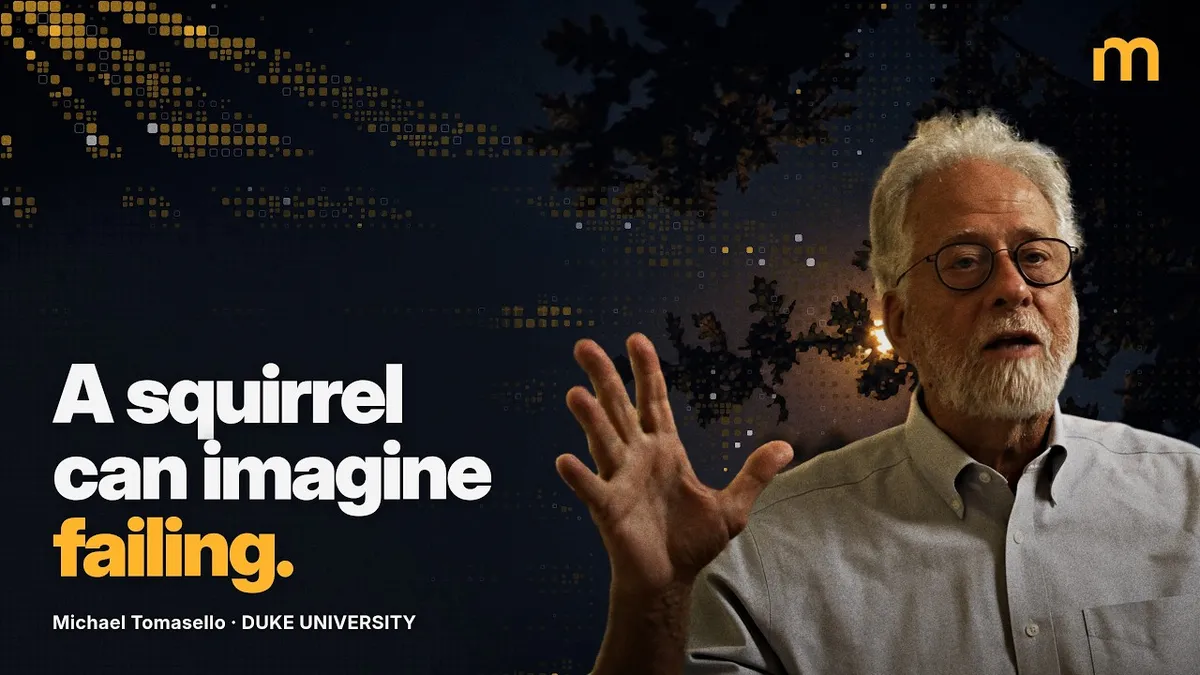
Tomasello says LLMs start at the endpoint of human cognition. In his view, language rests on goal pursuit, executive monitoring, imagined outcomes and shared intentions. He sees the missing piece in current machines as an executive tier that watches action, anticipates mistakes and plans. He also argues that AI, reinforcement learning included, treats learning as the goal when learning only exists to support decisions. [1] [3]
A CogSci 2026 study from Tomasello's group had human–human and human–AI pairs play a non-linguistic coordination game. Human–AI pairs reached good outcomes, but they showed lower commitment and coordinated less efficiently. A separate Hanabi study measured how much meaning a partner's moves carry beyond their literal content. It found gaps of +26.2 points for human pairs, +16.4 for human–AI pairs and −0.6 for AI–AI pairs. [2] [6] [7]
The evidence is mixed. More than 20 LLMs often matched or beat humans at coordinating on focal points without communicating, though they struggled with culturally nuanced cues. Tomasello himself says LLMs handle perspective-taking better than he expected, and he credits the coherence between sentences in their training text. He does not rule out reaching general intelligence through language. [5] [1]
in one coordination game, human–AI pairs succeeded but showed weaker commitment and efficiency. Implication: teams deploying collaborative agents should test them with humans and measure how coordination happens, not only whether it succeeds.
Executive brief
Michael Tomasello, a developmental psychologist who spent two decades running side-by-side experiments on children and great apes, argues that large language models (LLMs) are "starting at the endpoint." In his account, language sits on top of older abilities: goals, executive control, imagining outcomes and shared intentions. LLMs train on the language and skip those foundations (interview, 19:18). His postdoctoral collaborators have now tested part of this claim. In a CogSci 2026 paper, humans reached good outcomes with AI partners, but showed less commitment and coordinated less efficiently than they did with other humans (Cheng et al.). Other recent work finds LLMs coordinate surprisingly well, so the evidence is mixed.
What changed and event timeline
Agency book published
MIT Press published The Evolution of Agency. It describes agency as a feedback-control system and sets out four evolutionary types: goal-directed, intentional, rational and socially normative ().
Economist review
Arnold Kling accepted the shared-agency thesis. He argued that a further stage, formal rules, was needed before large collectives such as cities could form ().
"Agency Gap" at CogSci
Cheng, Gao, Tomasello and Kushnir compared human–human and human–AI pairs in a non-linguistic coordination game. Human pairs showed higher commitment and efficiency (;).
LLMs pass Schelling-style tests
Researchers tested more than 20 LLMs on focal-point games. The models often matched or beat humans at coordinating without communication, but struggled with culturally nuanced salience ().
Convention gap measured in Hanabi
A separate team used the card game Hanabi to measure how far a partner's moves carry meaning beyond their literal content. The gap was +26.2 percentage points for human–human games, +16.4 for human–AI and −0.6 for AI–AI ().
Interview published
Tomasello connects his agency framework to AI and names his postdoc Shaozhe Cheng's work as a bottom-up alternative to training on adult language ().
Capabilities and access
This is commentary, not a model release, and no model or version is evaluated in the interview. The underlying framework is in a 176-page book (MIT Press Bookstore). The Agency Gap paper used AI partners described as reinforcement-learning-based and LLM-based (Cheng homepage). Its abstract does not name specific model versions.
Technical analysis for researchers and developers
- Architecture claim. Tomasello says self-driving cars and drones are structurally similar to agents.
- Learning is a subprocess. He criticises AI, reinforcement learning included, for focusing almost entirely on learning when learning exists to support decisions (18:16).
- The Agency Gap game separates whether a pair succeeds from how it coordinates, tracking commitment and efficiency (eScholarship).
Read the full section
- Architecture claim. Tomasello says self-driving cars and drones are structurally similar to agents. What he thinks is missing is an "executive tier": a layer that monitors perception and action, anticipates mistakes, plans and tests hypotheses using imagined world states (13:01).
- Learning is a subprocess. He criticises AI, reinforcement learning included, for focusing almost entirely on learning when learning exists to support decisions (18:16).
- Evaluation design. The Agency Gap game separates whether a pair succeeds from how it coordinates, tracking commitment and efficiency (eScholarship). The Hanabi metric likewise looks past win rates (arXiv).
Claims and evidence
- Squirrels show "intelligence" is specialised. Tomasello uses this to argue that "general intelligence" is a weak construct (29:50).
- Shared agency is unique to humans. This is his own work, described in the interview.
- The Agency Gap study supports this, but it is co-authored by Tomasello (eScholarship). Independent Hanabi results point the same way (arXiv).
Read the full section
- Squirrels show "intelligence" is specialised. Squirrels remember more cache locations than humans, and birds tell apart more sounds. Tomasello uses this to argue that "general intelligence" is a weak construct (29:50). This is an illustration, not new data.
- Shared agency is unique to humans. In the group's experiments, children kept collaborating until both partners were rewarded, while chimpanzees stopped once they had their own reward (41:55). This is his own work, described in the interview.
- Humans collaborate less well with AI. The Agency Gap study supports this, but it is co-authored by Tomasello (eScholarship). Independent Hanabi results point the same way (arXiv).
- The Turing test is not even close to sufficient for showing agency (01:05:22). This is opinion.
Context and prior work
The framework moves away from stimulus–response thinking. Tomasello says he wrote the book for animal-behaviour researchers and that AI researchers picked it up (05:21). He draws on David Lewis's account of convention as a coordination device and on Schelling's stag-hunt coordination problems (45:40). He rejects the "massive modularity" view of the mind held by the evolutionary psychologists Tooby and Cosmides (25:45).
Limitations, safety and contested findings
- Tomasello says he is not technically expert enough to judge emergent AI agency (17:23).
- He concedes that LLMs handle perspective-taking better than he thought possible. He credits the coherence between sentences in their training text (51:51).
- Evidence conflicts: LLMs often match or beat humans on focal-point coordination tasks (arXiv 2601.22184).
Read the full section
- Tomasello says he is not technically expert enough to judge emergent AI agency (17:23). He does not rule out reaching general intelligence through language (19:38).
- He concedes that LLMs handle perspective-taking better than he thought possible. He credits the coherence between sentences in their training text (51:51).
- Evidence conflicts: LLMs often match or beat humans on focal-point coordination tasks (arXiv 2601.22184).
- No independent replication of the Agency Gap study has been published.
Business and practitioner implications
- Measure the process, not just the outcome. Human–AI teams can succeed while showing weaker commitment and efficiency (eScholarship).
- Explicit monitoring, the ability to abort a plan before acting, and goal-revision layers line up with Tomasello's executive tier (13:40).
- He recommends that some groups build coordination and conventions from the bottom up, alongside work scaling adult language (47:06).
Read the full section
- Measure the process, not just the outcome. Human–AI teams can succeed while showing weaker commitment and efficiency (eScholarship). Evaluate collaborative agents with humans in the loop, not only through AI-to-AI benchmarks (arXiv).
- Agent design. Explicit monitoring, the ability to abort a plan before acting, and goal-revision layers line up with Tomasello's executive tier (13:40).
- Research portfolio. He recommends that some groups build coordination and conventions from the bottom up, alongside work scaling adult language (47:06).