
MacroGrowth, inflation & jobs
Architecture billings index slips to 44.9 in October as firm billings keep falling; only commercial/industrial firms report growth
The AIA/Deltek Architecture Billings Index read 44.9 in October 2026, extending a multiyear stretch of falling billings. Project inquiries grew while new design contracts shrank, and commercial/industrial firms were the only sector above 50. The readings point to slower nonresidential construction into 2027.
From the Calculated Risk article of November 18, 2026 and cited sources: October's index of 44.9 means more architecture firms reported falling billings than rising ones, little changed from September's 44.7. [2] [4] [7]
SOURCES[2] AIA: ABI October 2026 aia.org[4] AIA press: Architecture Billings Decline Further Amid Weak… aia.org[7] Archinect: Architecture billings slide again in October archinect.com
 AT Pulse research deskPublished · Updated · 4 min read · AI-assisted analysis
AI-assisted, not human-edited. Methodology Corrections Who owns this site
- What happened
- October's index of 44.9 means more architecture firms reported falling billings than rising ones, little changed from September's 44.7. [2] [4] [7]
- Original source
- Calculated Risk article, independent perspective
- Brief by
- AT Pulse research desk AI-assisted; publisher and contact on the desk page
- When
- November 18, 2026 article published
- Covered
- Nov 20 edition
- Evidence
- 8 sources across 5 sites
- 1CalculatedRisk: Architecture firm billings continued to…calculatedrisk.substack.com
- 2AIA: ABI October 2026aia.org
- 3Metal Construction News: Increased pessimism about Q4 2026…metalconstructionnews.com
- 4AIA press: Architecture Billings Decline Further Amid Weak…aia.org
- 5AIA: ABI September 2026aia.org
- 6AIA/Deltek ABI overviewaia.org
RisingHow it’s measured
Substack · 12 likes · 1 share
Reach blends public engagement (views, likes, comments, shares, stars) from the platforms where the story or its original source lives: YouTube, Hacker News, GitHub, Substack and similar. A video and the article written from its transcript share one score, taken from the video. Platforms with no data are left out rather than counted as zero, and the age of a story never lowers its score.
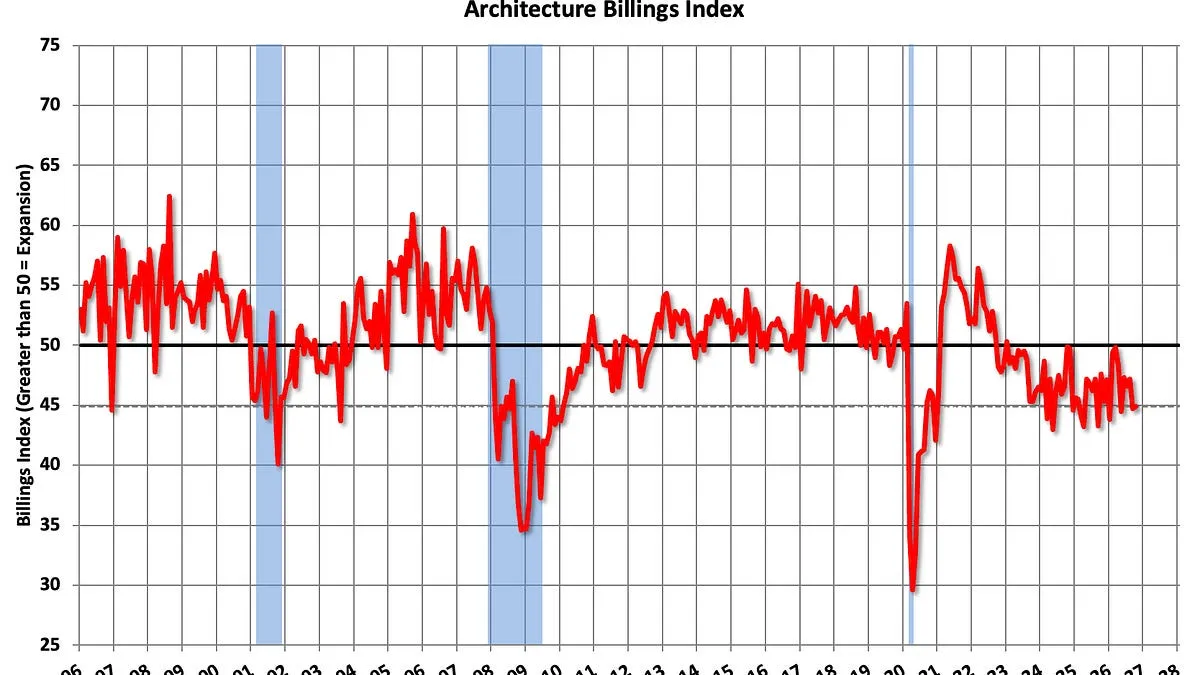
October's index of 44.9 means more architecture firms reported falling billings than rising ones, little changed from September's 44.7. Project inquiries stayed in growth at 51.0, down from 53.2, but newly signed design contracts fell further to 42.9. Clients are still asking about projects, but fewer of those inquiries are becoming signed work. [2] [4] [7]
Results differed sharply by sector and region. Commercial/industrial firms scored 51.0, the only specialization above 50. Multifamily (42.7) and institutional (42.5) stayed weak. The West was close to flat at 49.8, while the Northeast was weakest at 40.1. These scores are three-month moving averages, so they cannot be compared directly with the monthly headline figure. [4] [7]
The index usually leads nonresidential construction by about 9 to 12 months. On that basis, CalculatedRisk reads the prolonged downturn as a sign of slower commercial real estate investment into 2027. It describes this slump as shallower than the housing-bust decline but longer-lasting. [1] [6]
Firm-level figures also look soft. Average 2026 revenue is down 2.9%, and average backlog fell to 6.2 months from 6.6 in Q1, with multifamily backlogs down to 4.8 months. Firms expect 2027 revenue to be roughly flat overall, while small firms expect a 9.1% decline. [5]
a diffusion survey showing more firms with falling than rising billings, plus shrinking new contracts. Implication: if the historical lead holds, nonresidential construction and commercial real estate investment could slow into 2027.
Read the full assessment
The index does not measure how large the declines are in dollars.
Executive brief
The AIA/Deltek Architecture Billings Index (ABI) stood at 44.9 in October 2026. Any score below 50 means more firms reported falling billings than rising ones, and billings have not been consistently positive for more than four years (AIA). The ABI usually leads nonresidential construction by about 9–12 months, so CalculatedRisk's Bill McBride reads it as pointing to slower commercial real estate investment into 2027 (CalculatedRisk). One sector broke the pattern: commercial/industrial firms scored 51.0, their first growth since 2022 according to AIA. Multifamily stayed at 42.7.
What changed and event timeline
Brief uptick, falling confidence
The ABI rose to 47.2 from July's 46.6. Only 25% of firm leaders expected Q4 billings to grow, down from 31% in an earlier survey ().
October ABI at 44.9
Project inquiries rose again but more slowly, and the value of newly signed design contracts kept declining ().
Commentary ties the ABI to commercial real estate
McBride wrote that this slump is shallower than the housing bust but has lasted longer, and that it points to slower CRE investment into 2027 ().
Capabilities and access
Read the full section
- What the ABI is: a monthly diffusion index from AIA and Deltek. It is published with sub-indexes for project inquiries and newly signed design contracts, plus regional and sector breakdowns (AIA ABI page).
- October sub-indexes: inquiries 51.0 and design contracts 42.9 (Archinect). In September they were 53.2 and 43.7 (AIA).
- October regions: West 49.8, South 44.3, Midwest 43.0, Northeast 40.1.
- October sectors: commercial/industrial 51.0, multifamily 42.7, institutional 42.5, mixed practice 44.3 (Archinect).
Technical analysis for researchers and developers
- Different smoothing in different series. AIA labels the regional and sector scores as three-month moving averages (AIA).
- From September to October, institutional fell from 47.6 to 42.5 and the Midwest from 50.6 to 43.0.
- Diffusion, not dollars. A reading of 44.9 says nothing about the size of the decline.
Read the full section
- Different smoothing in different series. AIA labels the regional and sector scores as three-month moving averages (AIA). That makes them slower-moving and not directly comparable with the headline monthly figure.
- Large sector and regional swings. From September to October, institutional fell from 47.6 to 42.5 and the Midwest from 50.6 to 43.0.
- Diffusion, not dollars. The index counts how many firms report rises versus falls, not how much billing value changed. A reading of 44.9 says nothing about the size of the decline.
- Lag assumption. The 9–12 month lead to construction activity is AIA's own description. The reviewed sources include no out-of-sample test of that lead.
Claims and evidence
- Billings at 44.9 and declining: from AIA's survey release (AIA).
- Commercial/industrial's first growth since 2022: this is also AIA's characterisation.
- CRE slowdown into 2027: McBride's inference, drawn from AIA's stated lead time (CalculatedRisk).
Read the full section
- Billings at 44.9 and declining: from AIA's survey release (AIA).
- Commercial/industrial's first growth since 2022: this is also AIA's characterisation. It conflicts with AIA's September report, which already described growth "for the second consecutive month" (AIA September).
- CRE slowdown into 2027: McBride's inference, drawn from AIA's stated lead time (CalculatedRisk).
- Independent corroboration: none. Archinect and USGlass largely repeat AIA's figures (USGlass).
Context and prior work
- The October release reports architectural services employment at 204,000. According to AIA, it rose by 100 jobs in September (AIA).
- Average firm backlog fell to 6.2 months from 6.6 months in Q1. Multifamily backlogs fell more sharply, from 6.2 to 4.8 months (AIA September).
- Firms expect 2027 revenue to be roughly flat, with an average decline of 0.9%. Small firms expect a 9.1% decline.
Read the full section
- The October release reports architectural services employment at 204,000. According to AIA, it rose by 100 jobs in September (AIA).
- Average firm backlog fell to 6.2 months from 6.6 months in Q1. Multifamily backlogs fell more sharply, from 6.2 to 4.8 months (AIA September).
- Firms expect 2027 revenue to be roughly flat, with an average decline of 0.9%. Small firms expect a 9.1% decline.
Limitations, safety and contested findings
- CalculatedRisk's internal inconsistencies:
- It says October's 44.9 was "down from" September's 44.7, but 44.9 is slightly higher than 44.7.
- Its contraction counts don't match between headline and body.
Read the full section
- CalculatedRisk's internal inconsistencies:
- It says October's 44.9 was "down from" September's 44.7, but 44.9 is slightly higher than 44.7.
- Its contraction counts don't match between headline and body. The headline says 49 of the last 50 months, the body says 48 of the last 49. For multifamily, the subtitle says 48 of 50 months negative, the body says 49 of 51 below 50.
- AIA's headline still describes billings as declining, which is consistent with any score below 50 (CalculatedRisk).
- Conflicting AIA timing: AIA's own reports disagree on when commercial/industrial growth began (see Claims and evidence).
- Macro figures not checked against primary data: the October release cites 165,000 payroll jobs and 4.1% unemployment. These are AIA-reported and were not checked against BLS.
Business and practitioner implications
- Pipelines: rising inquiries alongside falling contract values points to client interest that is not turning into signed work.
- Revenue mix: firms earn an average of 9.7% of billings from work other than design and construction. 83% offer planning and pre-design services.
- Suppliers and lenders: the regional and sector scores give more useful signals than the headline.
Read the full section
- Pipelines: rising inquiries alongside falling contract values points to client interest that is not turning into signed work. One Northeast multifamily firm said many projects are "not penciling out financially" (AIA).
- Revenue mix: firms earn an average of 9.7% of billings from work other than design and construction. 83% offer planning and pre-design services.
- Suppliers and lenders: the regional and sector scores give more useful signals than the headline. The West is near flat (49.8), the Northeast is weakest (40.1), and commercial/industrial is the only specialization above 50.