
BusinessMarkets, money & strategy
Nadella says Microsoft's 60,000-employee buyout offer is about reorganizing for AI, not replacing staff with it
Microsoft has offered voluntary exits to about 60,000 employees, roughly a quarter of its staff. Satya Nadella frames the move as giving workers a choice during an AI-driven reorganization, citing small agent-heavy teams where verifying code, not writing it, is the constraint.
From the TechCrunch AI article of November 19, 2026 and cited sources: On October 26, Microsoft offered voluntary exits to staff at level 70 and below in the US, UK, Canada and India. [3] [5] [6]
SOURCES[3] CNBC: Microsoft offers voluntary buyouts to 60,000 employees cnbc.com[5] Fortune: Microsoft's 60,000-person buyout offer fortune.com[6] KUOW: Microsoft offers voluntary buyouts to a quarter of… kuow.org
 AT Pulse research deskPublished · Updated · 5 min read · AI-assisted analysis
AI-assisted, not human-edited. Methodology Corrections Who owns this site
- What happened
- On October 26, Microsoft offered voluntary exits to staff at level 70 and below in the US, UK, Canada and India. [3] [5] [6]
- Original source
- TechCrunch AI article, independent perspective
- Brief by
- AT Pulse research desk AI-assisted; publisher and contact on the desk page
- When
- November 19, 2026 article published
- Covered
- Nov 19 edition
- Evidence
- 7 sources across 7 sites
- 1TechCrunch: Nadella explains why he asked 60K employees to…techcrunch.com
- 2Linked video: Microsoft CEO Satya Nadella explains why he…youtube.com
- 3CNBC: Microsoft offers voluntary buyouts to 60,000 employeescnbc.com
- 4remio: Copilot Cowork development — nine engineers, 1,211…remio.ai
- 5Fortune: Microsoft's 60,000-person buyout offerfortune.com
- 6KUOW: Microsoft offers voluntary buyouts to a quarter of…kuow.org
RisingHow it’s measured
YouTube video · 212.2K views · 1.7K likes
Reach blends public engagement (views, likes, comments, shares, stars) from the platforms where the story or its original source lives: YouTube, Hacker News, GitHub, Substack and similar. A video and the article written from its transcript share one score, taken from the video. Platforms with no data are left out rather than counted as zero, and the age of a story never lowers its score.
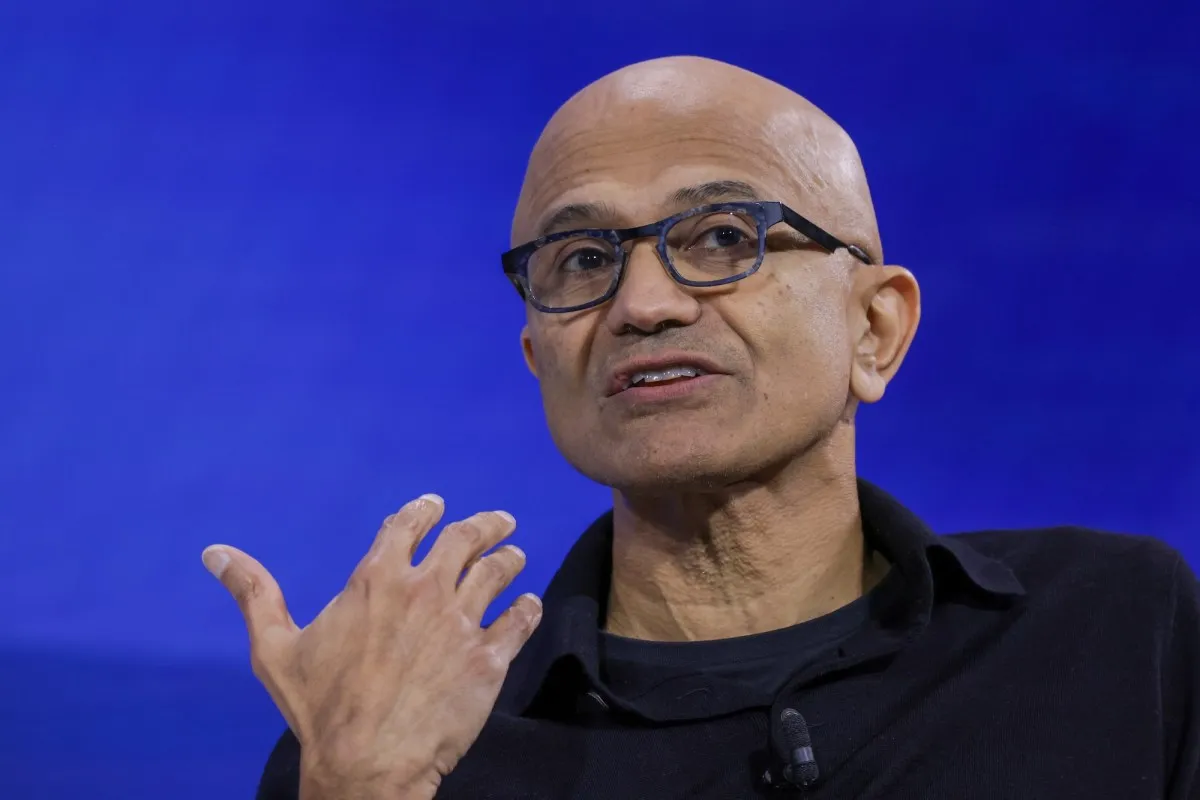
On October 26, Microsoft offered voluntary exits to staff at level 70 and below in the US, UK, Canada and India. Decisions are due in early December and departures on December 31. Organization heads chose which teams took part, and sales, security and parts of marketing were left out. The company expects fewer than 5% to accept. Earlier this year Microsoft made a retirement offer, which more than 30% of eligible staff accepted, and cut about 4,800 jobs in July. [3] [5] [6]
Accounts of the motive differ. Nadella says the offer gives employees agency at a time of upheaval, and KUOW reports the company said AI is not driving the program. CNBC links the offer to an AI-driven efficiency push. Fortune puts it alongside record capital spending and a broader shift in tech from labor toward capital. [1] [6] [3] [5]
Nadella's main example is the Copilot Cowork team. In Microsoft's own account, nine engineers merged 1,211 pull requests while agents wrote most of the code. This is a production case study, not a controlled experiment. Human reviewers caught four blocking issues the agents missed, and no cost analysis was published. Nadella's own count of the team varied between appearances. [4] [1] [2]
Nadella's engineering lessons focus on verification. He says each failure should become a test case, a model from a different family should critique the work, and production traces should confirm that fixes hold. He also advises keeping the harness, context and models separate, so that any model can be swapped out and still improve on a company's own private evaluation. [2]
a large voluntary exit offer and a single internal case study of an agent-heavy team.
Read the full assessment
Implication, not yet demonstrated: teams may shrink while review, testing and build infrastructure become the limiting work, though uptake and outcomes remain unknown.
Executive brief
Microsoft offered voluntary exit packages to about 60,000 employees, roughly a quarter of its workforce, on October 26, 2026 (CNBC). Satya Nadella says the reason is a reorganization around AI, not replacing people with it. His example is the Copilot Cowork team, which he describes as a small group of engineers who "build a software factory that builds the product" (TechCrunch). Microsoft's own engineering account points to a different constraint: when agents write most of the code, the hard part becomes checking it (remio summary).
What changed and event timeline
Spring 2026: Retirement offer
About 8,700 long-tenured US employees were offered voluntary retirement (). More than 30% of them took it ().
Cowork case study
Microsoft engineers described nine engineers merging 1,211 pull requests, with agents writing most of the code ().
- Mid Nov 2026
Podcast interview
On The Pragmatic Engineer, Nadella said the industry's talk about AI had "created enormous anxiety" among workers ().
DealBook Summit
Nadella told Andrew Ross Sorkin the offer was meant to give employees "agency" ().
Capabilities and access
- Copilot Cowork is the agent inside Microsoft 365. Microsoft's blog says it plans and carries out multi-step tasks.
- Models: Microsoft lists models from OpenAI (GPT-6 Astra, GPT-5.6, GPT-5.5 Thinking) and Anthropic (Claude Fable 5.1, Claude Opus 4.8 and 4.7), plus a cheaper fine-tuned in-house model called "Cowork 1".
- Exit package terms: comparable to standard severance, covering base pay scaled by tenure, stock, healthcare and career services (KUOW).
Read the full section
- Copilot Cowork is the agent inside Microsoft 365. Microsoft's blog says it plans and carries out multi-step tasks. By default it drafts work for a person to approve, and it is billed by usage (Microsoft Tech Community).
- Models: Microsoft lists models from OpenAI (GPT-6 Astra, GPT-5.6, GPT-5.5 Thinking) and Anthropic (Claude Fable 5.1, Claude Opus 4.8 and 4.7), plus a cheaper fine-tuned in-house model called "Cowork 1". The system picks a model automatically by task (same).
- Exit package terms: comparable to standard severance, covering base pay scaled by tenure, stock, healthcare and career services (KUOW).
Technical analysis for researchers and developers
- Verification is the bottleneck. Nadella says that with code now cheap to generate, verification is the hard part.
- Use a different model to review.
- Production traces feed back to confirm that a fix works (video).
Read the full section
- Verification is the bottleneck. Nadella says that with code now cheap to generate, verification is the hard part. Each failure should become a test case (video).
- Use a different model to review. He favors a critic from a separate model family so that one model family's weaknesses don't pass straight into the product (video).
- Production feedback loop. Production traces feed back to confirm that a fix works (video).
- Older codebases are harder. In established projects like Windows, builds and CI/CD are the hardest part. GitHub's Git protocol and storage are being reworked because coding agents have sharply raised load (video).
- Architecture advice. Keep the harness, context and models separate. The test: you should be able to swap any model and still improve on your own private evaluation (video).
Claims and evidence
- "Not replacing employees with AI." This is Nadella's framing (TechCrunch). KUOW reports the company said AI is not driving the program (KUOW).
- Nadella said 11 developers at DealBook, and "nine or 12" on the podcast (video). Microsoft's engineering account says nine.
- Expected uptake: below 5% (Fortune).
Read the full section
- "Not replacing employees with AI." This is Nadella's framing (TechCrunch). KUOW reports the company said AI is not driving the program (KUOW). CNBC instead ties the offer to an AI-driven efficiency push (CNBC).
- Cowork team size. Nadella said 11 developers at DealBook, and "nine or 12" on the podcast (video). Microsoft's engineering account says nine. The productivity figures come from Microsoft as a production case study, not a controlled experiment (remio).
- Expected uptake: below 5% (Fortune).
Context and prior work
Read the full section
- Headcount: about 144,000 in 2019, 228,000 in 2024, and roughly 220,000–223,000 now (Fortune).
- Earlier cuts: 18,000 in 2014, 10,000 in 2023 and 15,000 in 2025 (Fortune).
- Capital spending reached $115.9B in the last fiscal year, and $45.2B in Q1 of FY2027 alone. Boston University's Jay Zagorsky says tech is shifting toward capital and away from labor (Fortune).
- Competition: Nadella concedes Anthropic's model made the command line the main form factor for agentic coding, and Microsoft did not have an immediate response (video).
Limitations, safety and contested findings
- Merged pull requests measure activity, not customer value. Agents and automated reviewers may share the same blind spots. No cost analysis was published (remio).
- Nadella says a Rust migration had to be reverted (video).
- Who was offered exits. Org heads chose which teams took part. Sales, security and parts of marketing were excluded (Fortune).
Read the full section
- Limits of the Cowork numbers. Merged pull requests measure activity, not customer value. Agents and automated reviewers may share the same blind spots. Human reviewers caught four blocking issues that agents missed. No cost analysis was published (remio).
- A failed migration. Nadella says a Rust migration had to be reverted (video).
- Who was offered exits. Org heads chose which teams took part. Sales, security and parts of marketing were excluded (Fortune). That makes it harder to read the offer as company-wide AI policy.
Business and practitioner implications
- Nadella says changing how an established company works will "take a bit more time than anyone expects" (TechCrunch).
- He calls forward-deployed engineer one of Microsoft's fastest-growing jobs (video).
- He advises enterprises to own their context, private evaluations and learning loop rather than depend on a single model vendor (video).
Read the full section
- Expect a slow transition. Nadella says changing how an established company works will "take a bit more time than anyone expects" (TechCrunch).
- Shifting roles. He calls forward-deployed engineer one of Microsoft's fastest-growing jobs (video). He describes the slowdown in junior hiring as a pause while teams reconfigure, and says it is too early to call it a long-term trend (video).
- Avoid lock-in. He advises enterprises to own their context, private evaluations and learning loop rather than depend on a single model vendor (video).
The source trail.
Sources (7)
TechCrunch: Nadella explains why he asked 60K employees to quit
techcrunch.comLinked video: Microsoft CEO Satya Nadella explains why he asked 60K employees to quit
linked video auto captions
www.youtube.com