
BusinessMarkets, money & strategy
Google brings the full Gemini app to 2GB Android Go phones
Google has rebuilt its Gemini app to run on Android (Go edition) phones with 2GB of RAM. It brings Gemini Live voice chat, camera translation and Nano Banana image creation to entry-level devices, but drops the "Hey Google" wake phrase and on-screen context.
From the Google AI article of November 18, 2026 and cited sources: On 18 November 2026, Google announced a re-architected Gemini app for eligible Android (Go edition) devices. [1] [8] [2]
SOURCES[1] Google blog: The Gemini app is now available on… blog.google[8] Gemini Help: lower-memory Android devices support.google.com[2] Thurrott thurrott.com
 AT Pulse research deskPublished · Updated · 4 min read · AI-assisted analysis
AI-assisted, not human-edited. Methodology Corrections Who owns this site
- What happened
- On 18 November 2026, Google announced a re-architected Gemini app for eligible Android (Go edition) devices. [1] [8] [2]
- Original source
- Google AI article, company source
- Brief by
- AT Pulse research desk AI-assisted; publisher and contact on the desk page
- When
- November 18, 2026 article published
- Covered
- Nov 19 edition
- Evidence
- 9 sources across 9 sites
Reach: not measured yet
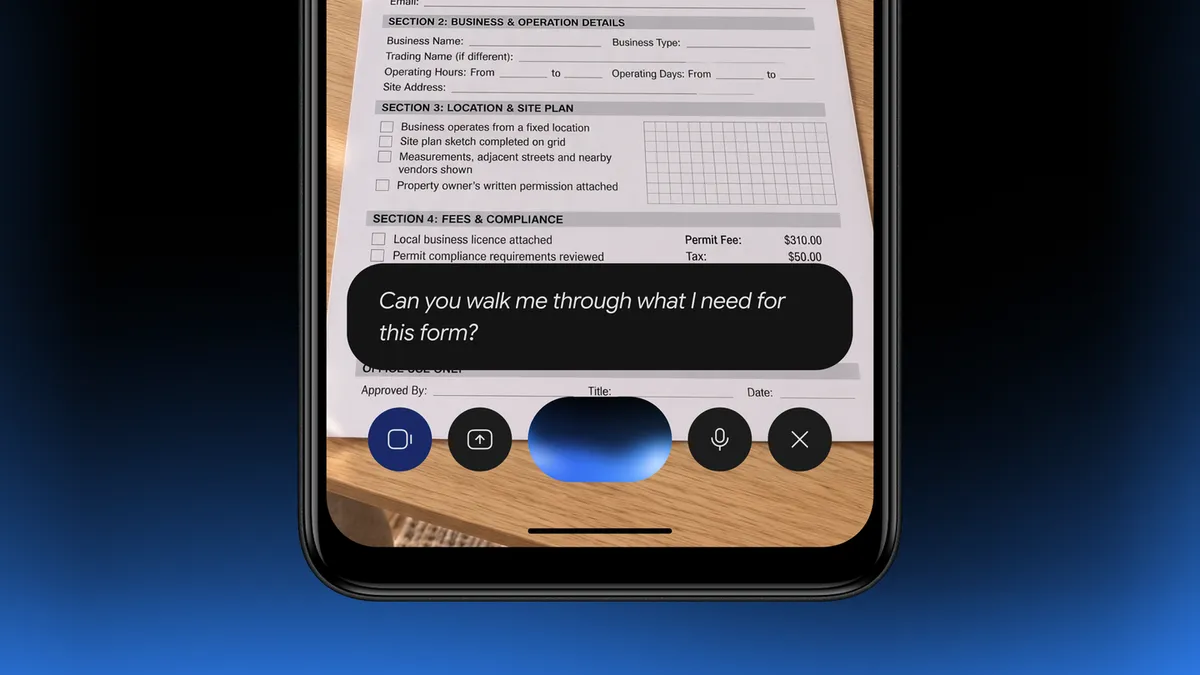
On 18 November 2026, Google announced a re-architected Gemini app for eligible Android (Go edition) devices. Google estimates these phones are the main way online for hundreds of millions of people. The app includes Gemini Live in more than 45 languages, camera-based translation and Nano Banana image generation. Users need 2GB or more of RAM and a Google Account with Gemini Apps access. [1] [8] [2]
The Go version leaves out some features. The "Hey Google" wake phrase and "Ask about this screen" are not supported. Earlier reporting on Gemini Go described it as cloud-dependent with no offline mode, which suggests the work went into slimming the app rather than running a model on the phone. Google has not confirmed this. [8] [7] [4]
Google's documentation shows that a large tier of budget phones can now run its main assistant app, and Transsion will preinstall it.
Read the full assessment
The likely result is wider default reach for Gemini, but developers should plan for cloud-dependent requests and fewer features.
Sources are verified; writing the dossier now.
Executive brief
Google says hundreds of millions of people use lower-memory Android phones as their main way online. On 18 November 2026 it announced that the Gemini app now runs on eligible Android (Go edition) devices. Google says it rebuilt the app so the core experience runs on phones with less memory, including Gemini Live voice chat and image generation with Nano Banana (Google blog). Reports put the minimum at 2GB of RAM (Thurrott). The launch builds on "Gemini Go", a lighter version that replaced Assistant Go in June (9to5Google). Google has released no performance data.
What changed and event timeline
Android Go launches
Google released a lightweight Android edition for entry-level phones. This is the hardware tier now getting Gemini ().
Assistant wind-down framing
Commentators called Gemini Go "one more nail in the coffin" of Google Assistant, part of Google's wider move from Assistant to Gemini ().
Gemini Go replaces Assistant Go
A streamlined Gemini began a gradual rollout inside the Google Search app on Go devices with 2GB+ RAM. It covers calls, texts, calendar, file uploads and music ().
Full Gemini app reaches Go devices
Google announced a re-architected app with Gemini Live in 45+ languages, camera-based translation and Nano Banana. Transsion phones will come with it preinstalled (;).
18–19 November 2026: Requirements reported
Coverage cited a 2GB RAM minimum. It also said the "Hey Google" wake phrase and "Ask about this screen" are not available on Go devices (;).
Capabilities and access
- Model versions: not disclosed. Google names features (Gemini Live, Nano Banana), not model versions (Google blog).
- Requirements: Android (Go edition), 2GB+ RAM, and a Google Account with Gemini Apps access (Gemini Help).
- Supported: calls and texts, image help (translation, step-by-step help, image creation), Gemini Live, local search, calendar and alarms, file uploads, music.
Read the full section
- Model versions: not disclosed. Google names features (Gemini Live, Nano Banana), not model versions (Google blog).
- Requirements: Android (Go edition), 2GB+ RAM, and a Google Account with Gemini Apps access (Gemini Help).
- Supported: calls and texts, image help (translation, step-by-step help, image creation), Gemini Live, local search, calendar and alarms, file uploads, music.
- Not supported: the "Hey Google" wake phrase and "Ask about this screen" (Gemini Help).
- How to get it: download from Google Play, press and hold the power button, or use a phone with it preinstalled.
Technical analysis for researchers and developers
- Architecture: Google says only that it "re-architected" the app. It has published no memory footprint, latency, battery or crash-rate figures (Google blog).
- Where the AI runs: June reporting described Gemini Go as cloud-dependent with no offline mode (Xataka Móvil).
- Missing features: dropping the wake phrase and on-screen context fits with saving memory and background processing on the phone. Google gives no reason.
Read the full section
- Architecture: Google says only that it "re-architected" the app. It has published no memory footprint, latency, battery or crash-rate figures (Google blog).
- Where the AI runs: June reporting described Gemini Go as cloud-dependent with no offline mode (Xataka Móvil). That points to optimisation of the app on the phone, not an on-device model. This is an inference; Google has not confirmed it.
- Missing features: dropping the wake phrase and on-screen context fits with saving memory and background processing on the phone. Google gives no reason.
- Evaluation: no benchmarks or independent tests are available, so the claim that it runs "smoothly" can't be reproduced.
Claims and evidence
- Reach: "Hundreds of millions more people" is Google's own estimate. No device-count method is given (Google blog).
- 2GB minimum: stated in Google's help documentation and repeated in press coverage (Gemini Help; Cryptopolitan).
- Runs smoothly: Google's claim only. No independent testing was found.
Read the full section
- Reach: "Hundreds of millions more people" is Google's own estimate. No device-count method is given (Google blog).
- 2GB minimum: stated in Google's help documentation and repeated in press coverage (Gemini Help; Cryptopolitan).
- Runs smoothly: Google's claim only. No independent testing was found.
- Independent reporting: the news coverage restates the announcement. It confirms what was announced, not how well the app performs.
Context and prior work
- Assistant Go served Android Go phones until Gemini Go replaced it in June 2026 (9to5Google).
- 2GB of RAM has been the baseline since Android 13 (Go edition), so many existing budget phones already qualify (Gizchina).
- Analysts link a revival of low-memory phones to rising DRAM prices, as chipmakers prioritise data-centre supply (Xataka Móvil).
Limitations, safety and contested findings
- Conflicting distribution details: Google's help page says Gemini on Go devices comes "as part of the Google Search app" (Gemini Help).
- Conflicting feature details: June reporting said Gemini Go dropped media generation (Xataka Móvil). The November release includes Nano Banana image creation.
- Connectivity: it reportedly needs an internet connection, which limits use where data is scarce or expensive.
Read the full section
- Conflicting distribution details: Google's help page says Gemini on Go devices comes "as part of the Google Search app" (Gemini Help). The November post tells users to download the Gemini app from Google Play (Google blog).
- Conflicting feature details: June reporting said Gemini Go dropped media generation (Xataka Móvil). The November release includes Nano Banana image creation.
- Connectivity: it reportedly needs an internet connection, which limits use where data is scarce or expensive.
- Children: users under 13 need parental controls through Family Link (Cryptopolitan).
Business and practitioner implications
- Phone makers: Transsion (itel, Tecno, Infinix) will preinstall Gemini, which strengthens Google's default-assistant position in emerging markets (Cryptopolitan).
- Developers: assume 2GB devices, no wake phrase, no screen-context features, and that every request goes to the cloud.
- Businesses targeting emerging markets: voice in 45+ languages and camera translation lower the literacy and typing barriers to using AI.
Read the full section
- Phone makers: Transsion (itel, Tecno, Infinix) will preinstall Gemini, which strengthens Google's default-assistant position in emerging markets (Cryptopolitan).
- Developers: assume 2GB devices, no wake phrase, no screen-context features, and that every request goes to the cloud.
- Businesses targeting emerging markets: voice in 45+ languages and camera translation lower the literacy and typing barriers to using AI.
- Planning: don't plan around performance until independent tests on real Go devices are published.