
FundingRounds, leads & terms
LanceDB raises $57.5M Series B co-led by Bessemer and Innovation Endeavors
LanceDB, maker of the open-source Lance data format used in AI training pipelines, raised a $57.5M Series B co-led by Bessemer Venture Partners and Innovation Endeavors, lifting total funding to $98.5M; no valuation was disclosed.
From the Tomasz Tunguz article of November 17, 2026 and cited sources: The Series B, announced November 17, 2026, drew participation from Theory Ventures, Dimension, Swift Ventures, CRV and Y Combinator. [2] [7] [8] [4]
SOURCES[2] LanceDB Series B announcement lancedb.com[7] Data Phoenix: LanceDB raises $57.5M dataphoenix.info[8] MLQ: LanceDB raises nearly $58M mlq.ai
 AT Pulse research deskPublished · Updated · 4 min read · AI-assisted analysis
AI-assisted, not human-edited. Methodology Corrections Who owns this site
- What happened
- The Series B, announced November 17, 2026, drew participation from Theory Ventures, Dimension, Swift Ventures, CRV and Y Combinator. [2] [7] [8] [4] [10]
- Original source
- Tomasz Tunguz article, independent perspective
- Brief by
- AT Pulse research desk AI-assisted; publisher and contact on the desk page
- Studies
- arXiv 2504.15247 (Apr 2025) [3] date from arXiv ID
- When
- November 17, 2026 article published
- Covered
- Nov 18 edition
- Evidence
- 10 sources across 9 sites
Reach: not measured yet
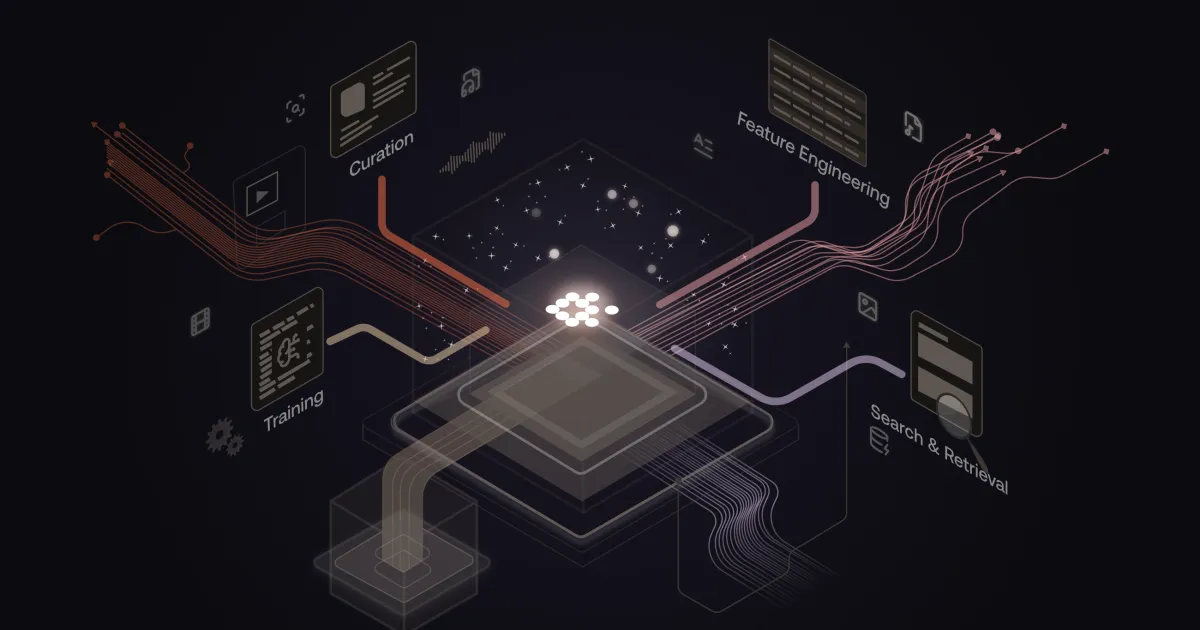
The Series B, announced November 17, 2026, drew participation from Theory Ventures, Dimension, Swift Ventures, CRV and Y Combinator. It follows a $30M Series A led by Theory in June 2025 and an $8M round in 2024. [2] [7] [8] [4] [10]
LanceDB reports that revenue grew more than 10x year over year and that open-source downloads passed 120M, up from about 20M at the Series A. These are company-reported figures without absolute revenue disclosed. Microsoft AI, NVIDIA Cosmos, Runway, Adobe and Exa are named as production users. [2] [4] [1] [8]
The company has moved from selling an open-source vector database to positioning itself as a multimodal lakehouse. Its Apache-2.0 Lance format targets random access, column backfills and vector-heavy workloads where Parquet, Iceberg and Delta are weak. Its own research paper shows that tuned Parquet performs far better than default Parquet, so comparisons need a tuned baseline. [10] [9] [3] [6] [1]
Named production users such as Microsoft AI, NVIDIA and Adobe say more about demand than the round size does. AI teams could consolidate blobs, tables and vector indexes into one open format, but they should benchmark against tuned Parquet first.
Sources are verified; writing the dossier now.
Executive brief
LanceDB says its open-source Lance format now sits under training pipelines at Microsoft AI, NVIDIA Cosmos and Runway. On November 17, 2026 it raised a $57.5M Series B, bringing total funding to $98.5M. Bessemer Venture Partners and Innovation Endeavors co-led the round. The company says revenue grew more than 10x year over year and that open-source downloads passed 120M. Both figures are self-reported. No valuation was disclosed. The headline source is a post by Tomasz Tunguz of Theory Ventures. Theory led LanceDB's Series A and also invested in this round, so the post is an investor writing about its own portfolio company.
What changed and event timeline
Lance format paper
LanceDB engineers, including co-founders Chang She and Lei Xu, published on arXiv a paper on an adaptive structural encoding for fast random access in columnar files ().
$30M Series A
Theory Ventures led the round, with CRV, Y Combinator, Databricks Ventures and RunwayML participating. LanceDB reported about 20M open-source downloads at the time (;).
Analyst framing
Ben Lorica of Gradient Flow argued that formats built for batch analytics fit AI workloads poorly. He presented Lance alongside alternatives such as Deep Lake, Pixeltable and Daft ().
Customer talks
According to Tunguz's footnotes, Exa, Runway, Microsoft AI, Adobe, NVIDIA and Luma AI presented their Lance deployments at LanceDB's Reverie Summit ().
$57.5M Series B
Theory, Dimension, Swift Ventures, CRV and YC participated, and total funding reached $98.5M (;).
Capabilities and access
- Lance is a single open spec covering the file format, the table format and the catalog.
- LanceDB Enterprise adds search, exploratory data analysis, feature engineering and training workloads (LanceDB newsletter).
- LanceDB's stated scale figures: more than 40B vectors in one table, hundreds of petabytes, 8,000 GPUs training in parallel, and over 130,000 requests per second at p95 latency under 210 ms (Data Phoenix).
Read the full section
- Lance is a single open spec covering the file format, the table format and the catalog. It runs on object storage, is licensed Apache-2.0, and integrates with Arrow, Spark, Ray, DuckDB, Trino and Unity Catalog (GitHub).
- LanceDB Enterprise adds search, exploratory data analysis, feature engineering and training workloads (LanceDB newsletter).
- LanceDB's stated scale figures: more than 40B vectors in one table, hundreds of petabytes, 8,000 GPUs training in parallel, and over 130,000 requests per second at p95 latency under 210 ms (Data Phoenix).
- Microsoft AI runs LanceDB inside its own tenant (Tunguz).
Technical analysis for researchers and developers
- Each column's structure (repetition and validity data) is encoded in one of two ways depending on the data's width.
- The same paper found that a well-tuned Parquet gets more than 60x better random access than Parquet on default settings.
- The paper evaluated format version 2.1, which was still experimental at the time.
Read the full section
- Core idea. Each column's structure (repetition and validity data) is encoded in one of two ways depending on the data's width. The goal is fast random reads on NVMe drives without slowing full scans or using more RAM (arXiv).
- Baseline worth checking. The same paper found that a well-tuned Parquet gets more than 60x better random access than Parquet on default settings. Comparisons against untuned Parquet therefore overstate Lance's advantage.
- Version caveat. The paper evaluated format version 2.1, which was still experimental at the time.
- Workflow implication. Column backfills let teams add new embeddings or labels without rewriting existing data. Exa describes this as its main use (Tunguz).
Claims and evidence
- Round size, leads and total funding. No filing confirms them, and no valuation was reported.
- 10x revenue growth and 120M downloads. Self-reported and unaudited. The download count is consistent with the roughly 20M reported in 2025 (AOL).
- Exa's 35 PB and Adobe's 40–50 PB are customer statements that reached readers through the investor's post (Tunguz).
Read the full section
- Round size, leads and total funding. These come from the company. Two outside outlets repeat the same figures, citing LanceDB's announcement (Data Phoenix; MLQ). No filing confirms them, and no valuation was reported.
- 10x revenue growth and 120M downloads. Self-reported and unaudited. The download count is consistent with the roughly 20M reported in 2025 (AOL).
- Customer scale figures. Exa's 35 PB and Adobe's 40–50 PB are customer statements that reached readers through the investor's post (Tunguz).
- NVIDIA Cosmos 3. The claim that about a million hours of video were curated with Lance is attributed to Max Li of NVIDIA (MLQ).
- Independent benchmarks. None was found to corroborate the throughput or GPU-scale figures.
Context and prior work
- Lance targets workloads where Parquet, Iceberg and Delta are weak: random access, mutable data and vector-heavy queries (Gradient Flow).
- Competing approaches include Deep Lake 4.0, Pixeltable, Daft and Magnus (Gradient Flow).
- LanceDB raised an $8M round in 2024 when it was positioned as an open-source vector database (SiliconANGLE).
Read the full section
- Lance targets workloads where Parquet, Iceberg and Delta are weak: random access, mutable data and vector-heavy queries (Gradient Flow).
- Competing approaches include Deep Lake 4.0, Pixeltable, Daft and Magnus (Gradient Flow).
- LanceDB raised an $8M round in 2024 when it was positioned as an open-source vector database (SiliconANGLE). It now positions itself as a "multimodal lakehouse."
Limitations, safety and contested findings
- Tunguz's firm, Theory Ventures, holds equity in LanceDB.
- The arXiv paper is a preprint written by LanceDB staff, and it tested an experimental format version.
- Much of the customer evidence comes from talks at the vendor's own conference.
Read the full section
- Conflicts of interest. Tunguz's firm, Theory Ventures, holds equity in LanceDB. The Gradient Flow analysis links heavily to LanceDB materials, contains no criticism, and includes no disclosure statement.
- Peer review. The arXiv paper is a preprint written by LanceDB staff, and it tested an experimental format version.
- Customer quotes. Much of the customer evidence comes from talks at the vendor's own conference.
- Undisclosed figures. LanceDB has not disclosed absolute revenue or its valuation.
Business and practitioner implications
- Teams that store blobs, Parquet files and vector indexes as separate copies could consolidate them.
- The Apache-2.0 license and catalog integrations limit lock-in at the format layer. The enterprise features are proprietary.
- For buyers, named production users (Microsoft AI, NVIDIA, Netflix, Adobe) count for more than the funding round.
Read the full section
- Teams that store blobs, Parquet files and vector indexes as separate copies could consolidate them. Evaluate Lance against a tuned Parquet baseline on your own access patterns before committing.
- The Apache-2.0 license and catalog integrations limit lock-in at the format layer. The enterprise features are proprietary.
- For buyers, named production users (Microsoft AI, NVIDIA, Netflix, Adobe) count for more than the funding round. Investors should still discount growth figures until LanceDB discloses absolute numbers.