
FundingRounds, leads & terms
SaaStr's Jason Lemkin Sets the Venture Bar at $1M to $100M ARR in Five Years, Citing Lower Software Multiples
SaaStr Fund's Jason Lemkin argues that venture-backable software startups now need to grow from $1M to $100M ARR within five years, about 151% compounded annual growth. He says investors would prefer two to three years because lower public multiples require more revenue at exit.
From the SaaStr article of November 17, 2026 and cited sources: Lemkin's new cutoff is 100x ARR growth in five years or less. [1]
SOURCES[1] How Fast Do You Really Have to Be Growing to Raise Venture… saastr.com
 AT Pulse research deskPublished · Updated · 5 min read · AI-assisted analysis
AI-assisted, not human-edited. Methodology Corrections Who owns this site
- What happened
- Lemkin's new cutoff is 100x ARR growth in five years or less. [1]
- Original source
- SaaStr article, independent perspective
- Brief by
- AT Pulse research desk AI-assisted; publisher and contact on the desk page
- When
- November 17, 2026 article published
- Covered
- Nov 18 edition
- Evidence
- 12 sources across 9 sites
- 1How Fast Do You Really Have to Be Growing to Raise Venture…saastr.com
- 2Linked video: How Fast Do You Really Have to Be Growing to…youtube.com
- 3SiliconANGLE: Figma IPO at $33siliconangle.com
- 4SiliconANGLE: Figma shares slide after first resultssiliconangle.com
- 5Trending Topics: Cursor breaks $2Btrendingtopics.eu
- 6Entrata Form S-1 (SEC)sec.gov
RisingHow it’s measured
YouTube video · 28.6K views · 43 likes
Reach blends public engagement (views, likes, comments, shares, stars) from the platforms where the story or its original source lives: YouTube, Hacker News, GitHub, Substack and similar. A video and the article written from its transcript share one score, taken from the video. Platforms with no data are left out rather than counted as zero, and the age of a story never lowers its score.
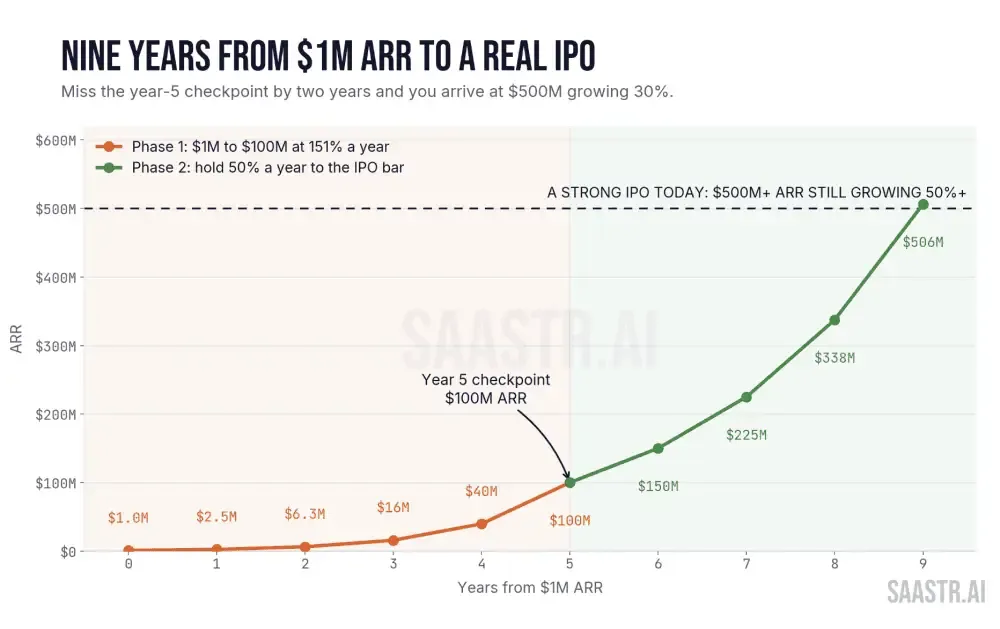
Lemkin's new cutoff is 100x ARR growth in five years or less. That makes Battery's 'triple, triple, double, double, double' (T2D3) path, which ends near $72M, too slow. He adds that VCs are really hoping to see the climb done in two to three years. [1]
He argues that public markets set the bar, not VCs. Sapphire data put fast-growing software at 8.3x next-12-month revenue, compared with a 10.8x ten-year average. At that multiple, matching a $4.3B exit takes about $520M of revenue instead of $400M. Figma's shares fell after its first post-IPO quarter showed growth slowing. [1] [11] [3] [4]
His lead example is Owner, a restaurant-software company that rebuilt itself around AI. Investors had called the pivot CEO thrash. Owner says it has passed $100M ARR and raised a $240M Series D at a $2.3B valuation. Its CEO says more than 83% of new customers start with its AI products. These figures are company-reported. [8] [9] [2] [10]
fast-growing software trades at 8.3x forward revenue versus a 10.8x decade average, and AI firms drew over 60% of Q1 2026 venture dollars on Carta. Implication: companies growing 40–60% may need non-venture capital paths.
Executive brief
Jason Lemkin, a SaaStr Fund investor, argues that a startup now needs to grow from $1M to $100M ARR in five years or less to raise venture capital. That is about 151% annual growth, compounded for five years. Under this rule, Battery's T2D3 path ("triple, triple, double, double, double"), once the aspirational target, ends at $72M and falls short. SaaStr His main example is Owner, a restaurant-software company where he is an early investor and board member, as the company's CEO notes in the video (03:39). He argues that lower public-market multiples, not the VCs themselves, set the bar.
What changed and event timeline
Figma prices its IPO at $33
The IPO valued Figma at about $19B. The company's 2024 revenue was $749M, up 48%, and it reported Q1 2025 net income of $44.9M.
Figma slows and its shares fall
First public quarter showed 41% growth. Guidance implied about 33% growth, and shares fell more than 13% after hours. Lemkin puts the next-day decline at about 20%.
Cursor reaches a $2B annualized run rate
Bloomberg reported this three months after Cursor passed $1B, and it has become the new benchmark for fast growth.
Entrata files its S-1
The private-equity-owned company reported 2025 revenue of $509.3M, up 24%, and net income of $50.7M.
More detail
Owner raises a $240M Series D at $2.3B
Growth Equity at Goldman Sachs Alternatives led the round, and the company says ARR has passed $100M.
More detail
Lemkin publishes the five-year rule
He sets the cutoff at $1M to $100M ARR in five years or less, says VCs hope to see it done in two to three, and uses Owner as his example.
Capabilities and access
This is a funding argument, not a product launch. The AI product cited is Owner's tool that rebuilds a restaurant's website. An owner types in the restaurant's name, and the AI crawls reviews and listings, checks about 90 SEO and conversion factors, upgrades photos and adds video made with Veo 3.
Read the full section
This is a funding argument, not a product launch. The AI product cited is Owner's tool that rebuilds a restaurant's website. An owner types in the restaurant's name, and the AI crawls reviews and listings, checks about 90 SEO and conversion factors, upgrades photos and adds video made with Veo 3. Owner says this takes less than five minutes and is free (09:42, 11:17). The core paid product is a flat $499-per-month subscription. Sacra
Technical analysis for researchers and developers
Owner's CEO, Adam Guild, describes several internal systems in the video. The automatic captions may contain errors. None of these systems has been evaluated publicly.
Read the full section
Owner's CEO, Adam Guild, describes several internal systems in the video. The automatic captions may contain errors.
- "Owen": an internal agent that monitors GitHub, Slack, Notion, Linear and meeting transcripts. The company says it handles about 90% of the coordination work among builders (17:30).
- First-draft fixes: Owen calls Claude Code to write a first-draft pull request for front-end bugs reported in Slack (18:45).
- Photo tool: one model writes a detailed description of each photo, then Nano Banana regenerates it using "anti-prompts" so the food doesn't look fake (28:49).
- Moat argument: Guild says forcing every customer onto the same opinionated setup gives Owner outcome data that general models like Claude or ChatGPT don't have (13:59).
None of these systems has been evaluated publicly.
Claims and evidence
- 100x in five years is about 151% a year, and T2D3 ends at $72M.
- Market multiple: Sapphire Ventures reports that fast-growing software companies trade at 8.3x next-12-month revenue, against a 10-year average of 10.8x.
- AI share of funding: Carta reports that more than 60 cents of every venture dollar on its platform in Q1 2026 went to AI companies. Carta
Read the full section
- The arithmetic holds. 100x in five years is about 151% a year, and T2D3 ends at $72M. Lemkin's multiple math also checks out: at 8.3x revenue instead of 10.8x, matching a $4.3B exit takes about $520M of revenue instead of $400M.
- Market multiple: Sapphire Ventures reports that fast-growing software companies trade at 8.3x next-12-month revenue, against a 10-year average of 10.8x. Its Broad Software Index is down 29% from peak. SaaStr on Sapphire
- AI share of funding: Carta reports that more than 60 cents of every venture dollar on its platform in Q1 2026 went to AI companies. Carta
- Unconfirmed Carta figure: Lemkin's "$3.5M ARR AI Series A bar" is not confirmed in the reviewed Carta material, which points to a median closer to $3M.
- Owner's figures are self-reported or third-party estimates:
- Owner announced the $100M+ ARR alongside its round.
- Sacra's estimates are $34M at end-2024, $81M at end-2025 and $100M in July 2026. Sacra
- Guild says more than 83% of new customers start with the AI products (12:24).
- No source establishes when Owner reached $1M ARR, so the "five years" in Lemkin's Owner example cannot be checked.
Context and prior work
T2D3 came from Neeraj Agrawal at Battery Ventures. Owner itself was beating that pace before it pivoted (00:53). Sapphire counts more than 80 AI-native companies above $100M ARR, growing 200–400% a year, compared with 60–120% for classic B2B. SaaStr on Sapphire Lemkin also cites ICONIQ: top-quartile companies under $50M ARR grew 111% in H2 2025, while the median private B2B company grew 22%.
Limitations, safety and contested findings
- The rule is one investor's heuristic, tested against his own funds' portfolios. Its main example is a company on whose board he sits.
- Lemkin's own exceptions: infrastructure and other deep-tech companies, usage-based revenue, and strong net revenue retention (e.g., 135%) can loosen the bar.
- His own earlier message: on Sept 30, 2026, he posted that gross margins and recurrence "don't matter."
Read the full section
- The rule is one investor's heuristic, tested against his own funds' portfolios. Its main example is a company on whose board he sits.
- Lemkin's own exceptions: infrastructure and other deep-tech companies, usage-based revenue, and strong net revenue retention (e.g., 135%) can loosen the bar. He also concedes that the 2021 vintage, which was priced on similar curves, led to large markdowns.
- His own earlier message: on Sept 30, 2026, he posted that gross margins and recurrence "don't matter." The article now says they are still diligenced, but only after growth clears the bar.
- Contested data: the size of Figma's post-earnings drop differs by source (more than 13% after hours vs. Lemkin's about 20% the next day).
Business and practitioner implications
- Find out early which curve you're on. A company at $10–30M ARR growing 40–60% is above the median but below the venture bar.
- AI-heavy companies should raise more. Capital is concentrating in AI.
- Not every good company fits venture. Entrata shows that a profitable company growing about 24% can still go public, but through a private-equity sponsor.
Read the full section
- Find out early which curve you're on. A company at $10–30M ARR growing 40–60% is above the median but below the venture bar. Lemkin suggests growth equity, a strategic minority round or staying default-alive as the realistic options.
- AI-heavy companies should raise more. Capital is concentrating in AI.
- Not every good company fits venture. Entrata shows that a profitable company growing about 24% can still go public, but through a private-equity sponsor.
- AI can be a pivot, not a cut. Owner's pivot went ahead over investor objections that it was "CEO thrash" (02:36). Guild argues for using AI to build more rather than to shrink headcount (30:16).
The source trail.
Sources (12)
How Fast Do You Really Have to Be Growing to Raise Venture Capital Today? $1M to $100M ARR in 5 Years, Max. But VCs Are Hoping for 2-3 Years
Article text retrieved; extracted text may omit tables or interactive elements. A transcript of the video linked from this page is supplied (linked video auto captions; https://www.youtube.com/watch?v=sJM9BrgpxwI); automatic text may contain errors.
saastr.comLinked video: How Fast Do You Really Have to Be Growing to Raise Venture Capital Today? $1M to $100M ARR in 5 Years, Max. But VCs Are Hoping for 2-3 Years
linked video auto captions
www.youtube.com