
FundingRounds, leads & terms
Palo Alto Networks' Nikesh Arora says three frontier models each found about 30% of his company's code vulnerabilities
At the Cerebral Valley AI Summit, held the day Jensen Huang resigned as Nvidia CEO, speakers converged on multi-model workflows, owned weights and cheaper tokens, while Palo Alto Networks' Nikesh Arora warned AI is compressing cyberattacks to minutes.
From the Newcomer article of November 17, 2026 and cited sources: Arora said his team tested three frontier models against Palo Alto Networks' code. [2]
SOURCES[2] Linked video: 13 Videos from CVAI: Igor Babuschkin, Ryan… youtube.com
 AT Pulse research deskPublished · Updated · 5 min read · AI-assisted analysis
AI-assisted, not human-edited. Methodology Corrections Who owns this site
- What happened
- Arora said his team tested three frontier models against Palo Alto Networks' code. [2]
- Original source
- Newcomer article, independent perspective
- Brief by
- AT Pulse research desk AI-assisted; publisher and contact on the desk page
- When
- November 17, 2026 article published
- Covered
- Nov 18 edition
- Evidence
- 11 sources across 11 sites
- 1Newcomer: 13 Videos from CVAInewcomer.co
- 2Linked video: 13 Videos from CVAI: Igor Babuschkin, Ryan…youtube.com
- 3CNBC: Nvidia stock closes down after Huang resignationcnbc.com
- 4MindStudio: What is Project Glasswingmindstudio.ai
- 5TNW: River AI raised $1.1bnthenextweb.com
- 6The Hacker News: Fireworks AI breach widensthehackernews.com
RisingHow it’s measured
YouTube video · 3.2K views · 13 likes
Reach blends public engagement (views, likes, comments, shares, stars) from the platforms where the story or its original source lives: YouTube, Hacker News, GitHub, Substack and similar. A video and the article written from its transcript share one score, taken from the video. Platforms with no data are left out rather than counted as zero, and the age of a story never lowers its score.
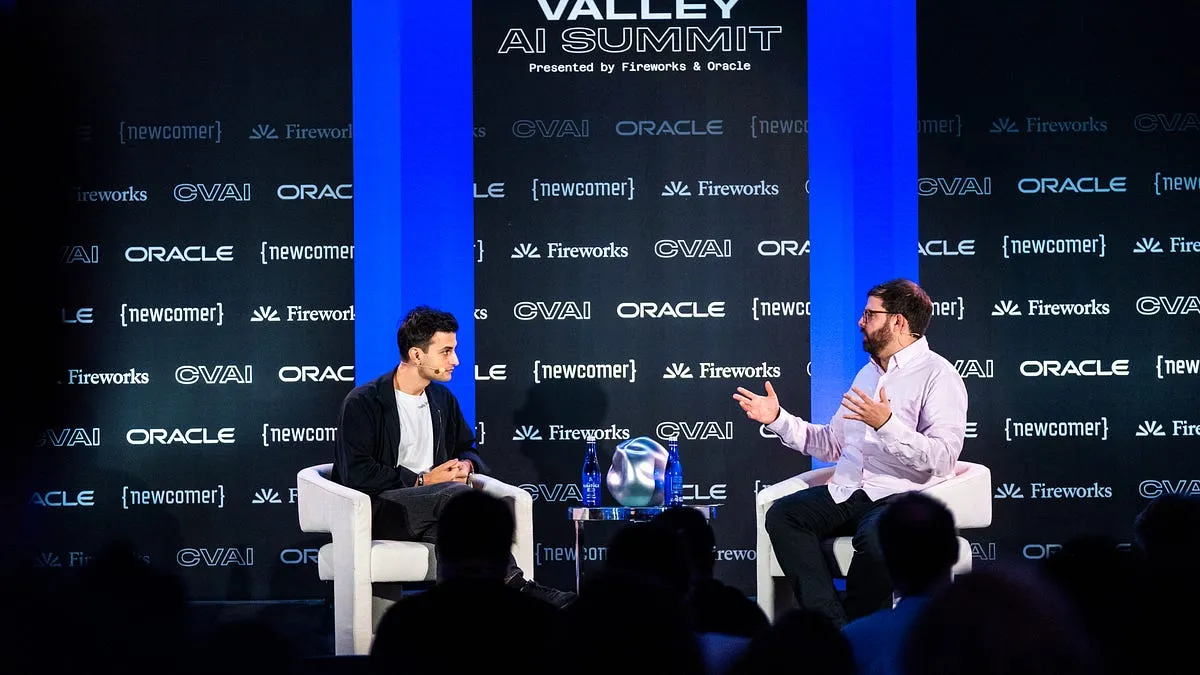
Arora said his team tested three frontier models against Palo Alto Networks' code. Each found roughly 30% of the vulnerabilities, their findings overlapped little and open models found about 10% more. Finding everything therefore meant running all four. He described the figures as approximate. [2]
Igor Babuschkin's River AI raised $1.1B to let companies post-train and own open-weight models. General Catalyst and AMP PBC led the round, and Nvidia and AMD Ventures also invested. The company's claims that reinforcement-learning runs take 15–20 minutes and cost 2–4x less have not been independently verified. A valuation of about $5B traces to a reported target, not an official figure. [5] [11]
Databricks' Smart Routing uses a cheap classifier to send each task to either a lower-cost or a frontier model, and keeps one model for a whole session to preserve caching. Databricks reports savings of 35% on internal tasks and 56% on public benchmarks, but notes that benchmark tasks are unusually well-behaved. [9]
Arora argued that AI lets attackers find and chain vulnerabilities, get inside and take data out in about 18 minutes. His proposed defense is a model of normal behaviour trained separately for each enterprise to flag anomalies. Separately, Fireworks AI's widened breach exposed billing data, datasets, incomplete model weights and Notion AI chat transcripts. [2] [6]
Arora described an internal test in which frontier models' vulnerability findings barely overlapped, and a disclosed breach hit an inference provider.
Read the full assessment
Implication: teams may need multi-model scanning, routing across providers, and to treat inference vendors as supply-chain risk.
Executive brief
Nikesh Arora, CEO of Palo Alto Networks, said his company ran three frontier models against its own codebase. Each one found about 30% of the vulnerabilities, the three results overlapped little, and open models found about 10% more, so defenders need to run all four (video, 09:55). He called these figures approximate. He made the remarks at the Cerebral Valley AI Summit on 12 November 2026, the same morning Jensen Huang resigned as Nvidia CEO (CNBC). Newcomer published 13 videos from the summit on 17 November (Newcomer). Across the sessions, speakers kept returning to four themes: using several models instead of one, owning your own weights, cutting cost per token, and AI-speed cyberattacks.
What changed and event timeline
Mythos launched under restricted access
Anthropic put Claude Mythos Preview into Project Glasswing, a defensive-security program limited to vetted partners. Arora recalled that early access went to about 15–20 companies (;).
River AI raises $1.1B
Igor Babuschkin, a co-founder of xAI, started River AI to let companies own and post-train their own models. General Catalyst and AMP PBC led the round, and Nvidia and AMD Ventures also invested ().
Fireworks discloses a wider breach
The breach expanded to two intrusion phases. Exposed data included billing data, datasets, incomplete model weights and Notion AI chat transcripts. Fireworks attributed it to an "LLMjacking" group, meaning criminals who steal access to AI models and resell it ().
AI 100 announced at the summit
Bessemer and Newcomer released their AI 100 list of private AI companies, valued at $3.6T in total, with Anthropic ranked first ().
Newcomer publishes 13 sessions
The sessions include Babuschkin, Rauch, Ghodsi, Arora, Qiao and Grinberg ().
Capabilities and access
- Arora named Google's "Carbon" and "Hydrogen," OpenAI's GPT 5.6 and GPT 6, and Anthropic's "Mythos 5.2," and said they are roughly at par on cyber tasks (video, 09:19).
- He said access to these models is broader now than at launch but still expensive and rate-limited (10:41).
- River AI offers an API for LoRA fine-tuning and reinforcement learning (RL) on open-weight models (TNW).
Read the full section
- Arora named Google's "Carbon" and "Hydrogen," OpenAI's GPT 5.6 and GPT 6, and Anthropic's "Mythos 5.2," and said they are roughly at par on cyber tasks (video, 09:19). These names come from automatic captions, and no release documentation for them appears in the reviewed sources.
- He said access to these models is broader now than at launch but still expensive and rate-limited (10:41).
- River AI offers an API for LoRA fine-tuning and reinforcement learning (RL) on open-weight models (TNW).
Technical analysis for researchers and developers
- If Arora's roughly one-third-each result holds, vulnerability scanners should combine several models rather than pick the single best one.
- His proposed defense is to consolidate an enterprise's data, model its normal behaviour, and train a detector for each customer separately (06:47).
- Databricks' Smart Routing uses a cheap classifier to send tasks to cheaper or frontier models and keeps the same model for a whole session to preserve caching.
Read the full section
- Running several models. If Arora's roughly one-third-each result holds, vulnerability scanners should combine several models rather than pick the single best one. He gave no harness details, deduplication method or ground truth (09:55).
- Anomaly detection. His proposed defense is to consolidate an enterprise's data, model its normal behaviour, and train a detector for each customer separately (06:47).
- Routing. Databricks' Smart Routing uses a cheap classifier to send tasks to cheaper or frontier models and keeps the same model for a whole session to preserve caching. Databricks reports 35% savings on internal tasks and 56% on public benchmarks, and acknowledges that benchmark tasks are "unusually well-behaved" (Databricks).
Claims and evidence
- The roughly one-third-each vulnerability split and the claim that attacks now take about 18 minutes are Arora's onstage statements and have not been independently tested (05:27).
- River AI says complex RL runs take 15–20 minutes and cost 2–4x less than closed-model alternatives.
- Ghodsi said Databricks routes more than four quadrillion tokens. Factory's Grinberg said open models now carry over 10% of Factory's tokens.
Read the full section
- The roughly one-third-each vulnerability split and the claim that attacks now take about 18 minutes are Arora's onstage statements and have not been independently tested (05:27).
- River AI says complex RL runs take 15–20 minutes and cost 2–4x less than closed-model alternatives. TNW notes these claims are not independently verified (TNW).
- Ghodsi said Databricks routes more than four quadrillion tokens. Factory's Grinberg said open models now carry over 10% of Factory's tokens. Both figures are self-reported (Newcomer).
- On stage, Fireworks' Lin Qiao cited Palo Alto Networks, CrowdStrike and Wiz as partners in the breach response. The reported disclosure names no outside forensics firm (The Hacker News).
Context and prior work
Limitations, safety and contested findings
- Huang's departure followed reports of affairs, including one with an executive whom U.S. officials believe is a Chinese spy.
- Arora estimated that 90% of AI coding use cases have no security controls (17:09).
- Babuschkin argued that concentrating AI in a few labs is the industry's main risk. That position also suits River AI's business model (Newcomer).
Read the full section
- Huang's departure followed reports of affairs, including one with an executive whom U.S. officials believe is a Chinese spy. Nvidia itself stated no reason (CNBC; SEC).
- Arora estimated that 90% of AI coding use cases have no security controls (17:09).
- Babuschkin argued that concentrating AI in a few labs is the industry's main risk. That position also suits River AI's business model (Newcomer).
Business and practitioner implications
- River AI's $1.1B round and its lead investors are company-announced.
- Arora sized security at about $400B, growing 8–10% a year, and said OpenAI and Anthropic could become $10T companies. These are opinions (16:13; 18:57).
- Plan for routing across several models, treat inference providers as part of your supply chain, and expect Nvidia leadership to be unstable in the near term (20:08).
Read the full section
- Venture figures. River AI's $1.1B round and its lead investors are company-announced. The roughly $5B valuation is not: it traces to Forbes' May report of a target, not an official figure (TNW; AI Weekly). General Catalyst co-led the round, so its CEO Hemant Taneja, who also spoke at the summit, was commenting on a sector where his firm is invested.
- Market views. Arora sized security at about $400B, growing 8–10% a year, and said OpenAI and Anthropic could become $10T companies. These are opinions (16:13; 18:57).
- Practical takeaway. Plan for routing across several models, treat inference providers as part of your supply chain, and expect Nvidia leadership to be unstable in the near term (20:08).
The source trail.
Sources (11)
Newcomer: 13 Videos from CVAI
newcomer.coLinked video: 13 Videos from CVAI: Igor Babuschkin, Ryan Daniels, Guillermo Rauch & More
linked video auto captions
www.youtube.com