
PolicyLaw, regulation & governance
U.S. requires licenses for data centers worldwide that rent advanced-chip compute to China-headquartered firms, exposing Southeast Asia's buildout
A new U.S. interim rule requires licenses for data centers worldwide that rent large amounts of advanced-chip compute to China-headquartered firms. It exposes Southeast Asian neoclouds that served Alibaba, ByteDance and others, while exempting U.S. cloud providers that file reports.
From the CNBC · Technology article of November 18, 2026 and cited sources: The Commerce Department's remote-access rule applies to any facility that provides more than 12 million TPP of compute to companies headquartered in Country Group D:5 countries or Macau. [6] [12] [2]
SOURCES[6] Pillsbury: Commerce Issues Interim Final Rule Restricting… pillsburylaw.com[12] Nixon Peabody: BIS targets remote access to advanced chips… nixonpeabody.com[2] TNW: US remote-access AI chip rule requires licenses for… thenextweb.com
 AT Pulse research deskPublished · Updated · 5 min read · AI-assisted analysis
AI-assisted, not human-edited. Methodology Corrections Who owns this site
- What happened
- The Commerce Department's remote-access rule applies to any facility that provides more than 12 million TPP of compute to companies headquartered in Country Group D:5 countries or Macau. [6] [12] [2]
- Original source
- CNBC · Technology article, independent perspective
- Brief by
- AT Pulse research desk AI-assisted; publisher and contact on the desk page
- When
- November 18, 2026 article published
- Covered
- Nov 18 edition
- Evidence
- 15 sources across 13 sites
- 1Southeast Asia’s data center boom leaned on Chinese…cnbc.com
- 2TNW: US remote-access AI chip rule requires licenses for…thenextweb.com
- 3US tightens AI chip export curbs to close China's overseas…scmp.com
- 4US remote-access chip rule formally rescinds Biden-era AI…cryptobriefing.com
- 5US tightens controls on remote access to AI technology…wunc.org
- 6Pillsbury: Commerce Issues Interim Final Rule Restricting…pillsburylaw.com
Reach: not measured yet
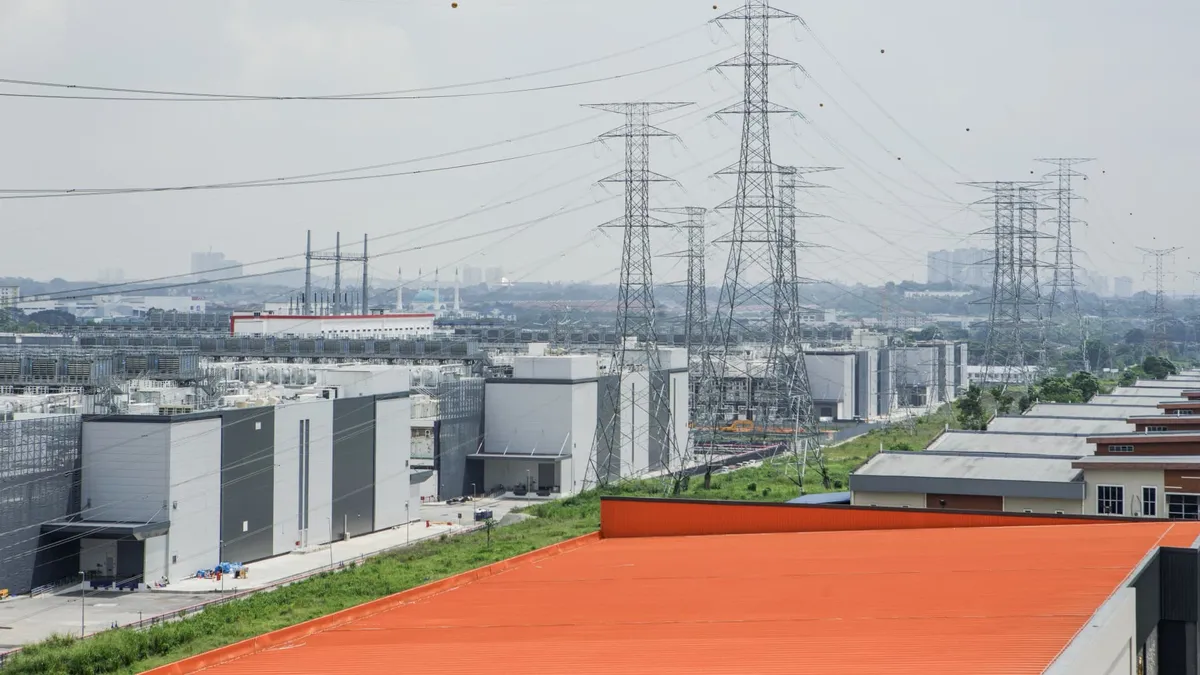
The Commerce Department's remote-access rule applies to any facility that provides more than 12 million TPP of compute to companies headquartered in Country Group D:5 countries or Macau. That total counts all linked sites, so splitting workloads across facilities does not avoid the threshold. Existing providers get 90 days to obtain licenses. The rule also adds licensing for chip exports to Singapore, Malaysia, Thailand, Indonesia and Brazil, and formally rescinds the Biden-era AI Diffusion Rule. [6] [12] [2]
Southeast Asia is the most exposed region. Estimates attributed to the Institute for Progress put roughly three-quarters of China's offshore compute there: about 75% by end-2026 in one account and about 72% of projected 2027 access in another. Both figures are modeled, not counted from verified inventories. Malaysia, Thailand and Singapore have each signaled they will comply. Analysts expect the regional buildout to slow and cost more rather than stop. [1] [7]
Demand may move rather than disappear. U.S.-headquartered clouds are exempt if they file monthly reports, which leaves open the possibility that Chinese firms rent capacity in the U.S. instead. Chinese firms are also testing other locations: Moonshot AI reportedly sought capacity in Europe, and analysts expect some high-end capacity to move to Japan, Korea and Taiwan, limited by power and land. [1] [2]
Law-firm analyses document the rule's terms; its regional impact is still a forecast.
Read the full assessment
Leaders should expect slower, costlier Southeast Asian capacity, stricter checks on who owns customers, and possible shifts of Chinese demand toward U.S. clouds or other Asian markets.
Executive brief
A U.S. rule now reaches any data center in the world that rents more than 12 million TPP of advanced-chip compute to companies headquartered in China, Macau or other Country Group D:5 countries. Those facilities need a license, and the ones already doing it have 90 days to get one (Pillsbury). The rule also adds license requirements for chip exports to Singapore, Malaysia, Thailand, Indonesia and Brazil. Southeast Asia's neocloud model, which depended partly on renting compute to Alibaba, ByteDance and other Chinese firms, is directly exposed. U.S.-headquartered cloud providers are exempt if they file reports. Analysts expect the regional buildout to become slower and more expensive rather than stop (CNBC).
What changed and event timeline
Think tank sizes China's offshore compute
The Institute for Progress projected about 2.83 million H100-equivalents of overseas access for Chinese firms in 2027, with roughly 72% of it in Southeast Asia ().
Oracle drops Tencent lease
The FT reported that Oracle cancelled a roughly $7B, five-year deal that would have given Tencent access to about 100,000 Nvidia chips in Southeast Asian data centers. U.S. officials had pressed Oracle on the deal (;).
Nvidia CEO resigns
Nvidia's board accepted Jensen Huang's resignation, effective immediately, and named CFO Colette Kress interim CEO (). Reports connected his exit to an alleged affair with a suspected Chinese spy ().
BIS issues remote-access rule
The interim final rule "Addressing Remote Access to Advanced Semiconductors" adds license requirements for five countries and formally rescinds the Biden-era AI Diffusion Rule (;).
Region signals compliance
Malaysia's trade minister said operators must follow U.S. rules "if you want to be in the game." Thailand promised to crack down on chip re-exports, and Singapore said it will seek "trusted access" ().
Federal Register publication
The rule is scheduled to be published on this date, which opens a 60-day public comment period ().
Capabilities and access
This is an export-control action. No AI model or product is involved.
Read the full section
This is an export-control action. No AI model or product is involved.
- Covered items: ECCNs 3A090 (excluding 3A090.c), 4A090 and the matching .z items, plus related software and technology (Pillsbury).
- Remote-access trigger: more than 12,000,000 aggregate TPP provided to D:5- or Macau-headquartered companies, counted across "linked" data centers.
- Exempt: U.S.-headquartered recipients, which must file monthly reports under EAR §743.10. Also exempt is compute used only for commercial recommender systems; content generation does not qualify (TNW).
Technical analysis for researchers and developers
- Aggregate metric: The threshold is measured in total TPP across physically or digitally linked sites.
- End-user test: A customer counts if it buys compute or is the exclusive or primary remote user, meaning more than 50% of a facility's compute.
- Know-your-customer duties: Exporters must verify who owns their customers.
Read the full section
- Aggregate metric: The threshold is measured in total TPP across physically or digitally linked sites. Splitting workloads across facilities therefore does not get a provider under it (Pillsbury).
- End-user test: A customer counts if it buys compute or is the exclusive or primary remote user, meaning more than 50% of a facility's compute.
- Know-your-customer duties: Exporters must verify who owns their customers. If a customer refuses to share that information, the exporter is presumed to know about a prohibited use.
- Foundry and packaging changes: Chip designers from D:1, D:4 and D:5 countries, or from the five newly listed countries, lose the transistor-count attestation route for rebutting the 3A090.a presumption.
- What the rescission removes: model-weight controls (4E091), the country tiers and the Data Center VEU. The advanced-computing foreign direct product rule stays in place.
Claims and evidence
- Southeast Asia's share of China's offshore compute: CNBC cites an IFP estimate of about 75% by end-2026.
- Malaysia's exposure: More than half of its capacity is colocation with a "sizeable" Chinese share of workloads.
- The Huang–spy link is an allegation in media reports. The 8-K does not mention it (SEC).
Read the full section
- Southeast Asia's share of China's offshore compute: CNBC cites an IFP estimate of about 75% by end-2026. A summary of the IFP report gives about 72% of projected 2027 overseas access (Magica). The two figures conflict. IFP's own range for 2027 overseas access runs from 1.97M to 3.91M H100-equivalents, built from leasing data, identified clusters and customs anomalies rather than verified inventories.
- Malaysia's exposure: More than half of its capacity is colocation with a "sizeable" Chinese share of workloads. Capital Economics estimates a hit of up to 0.2 percentage points to GDP growth through 2028. This is a forecast, not measured data (CNBC).
- The Huang–spy link is an allegation in media reports. The 8-K does not mention it (SEC).
Context and prior work
Earlier U.S. controls limited physical chip shipments. That pushed Chinese firms to rent offshore capacity instead (TechSpot). The AI Diffusion Rule was the earlier attempt to govern this through country tiers, and it was never enforced before this rule rescinded it (TNW). Researchers had already mapped the shift of China's compute overseas, with Southeast Asia at the center (Jamestown).
Limitations, safety and contested findings
- The U.S.-cloud loophole: CFR's Chris McGuire calls the rule a "major step forward" but warns that Chinese firms could move from renting in Southeast Asia to renting in Virginia (CNBC; TNW).
- Displacement to other countries: Chinese firms are already testing other locations. Moonshot AI reportedly sought Nvidia capacity in Europe.
- Rule may change: It is an interim rule open to comment, so the final terms could differ.
Read the full section
- The U.S.-cloud loophole: CFR's Chris McGuire calls the rule a "major step forward" but warns that Chinese firms could move from renting in Southeast Asia to renting in Virginia (CNBC; TNW).
- Displacement to other countries: Chinese firms are already testing other locations. Moonshot AI reportedly sought Nvidia capacity in Europe. Verisk Maplecroft expects some high-end capacity to move to Japan, Korea and Taiwan, limited by power and land.
- Rule may change: It is an interim rule open to comment, so the final terms could differ.
Business and practitioner implications
- Neoclouds in Johor, Bangkok and Batam: expect licensing delays and higher compliance costs.
- U.S. hyperscalers: they gain a relative advantage but face political scrutiny, as the Oracle–Tencent cancellation shows (Network World).
- Buyers of compute: expect stricter know-your-customer checks, ownership disclosure, and possible capacity cuts at Southeast Asian providers with large Chinese tenants.
Read the full section
- Neoclouds in Johor, Bangkok and Batam: expect licensing delays and higher compliance costs. Thailand says new projects without U.S. approval may "not be able to complete construction" (CNBC).
- U.S. hyperscalers: they gain a relative advantage but face political scrutiny, as the Oracle–Tencent cancellation shows (Network World).
- Buyers of compute: expect stricter know-your-customer checks, ownership disclosure, and possible capacity cuts at Southeast Asian providers with large Chinese tenants.
The source trail.
Sources (15)
Southeast Asia’s data center boom leaned on Chinese demand. New U.S. rules put that pipeline at risk
Article text retrieved; extracted text may omit tables or interactive elements.
cnbc.comTNW: US remote-access AI chip rule requires licenses for data centers serving China-headquartered firms
thenextweb.comUS tightens AI chip export curbs to close China's overseas data-centre loophole
Related coverage; assess separately
scmp.comUS remote-access chip rule formally rescinds Biden-era AI Diffusion Rule
Related coverage; assess separately
cryptobriefing.comUS tightens controls on remote access to AI technology amid Nvidia fallout
Related coverage; assess separately
wunc.org