
AgentsAutonomy & tool use
Microsoft Research podcast pairs Science-published diagnostic agent results with a warning that slow adoption and scarce patient data, not accuracy, now hold back medical AI
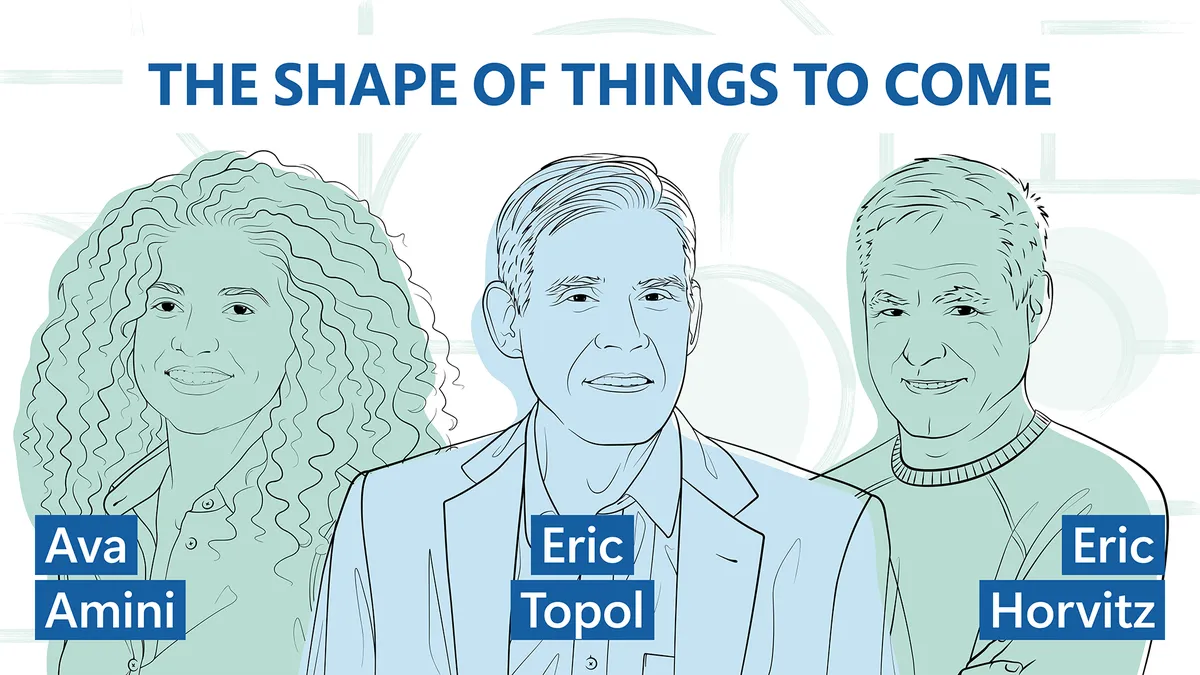
In a Microsoft Research podcast, Eric Horvitz, Eric Topol and Ava Amini discuss Microsoft's Science-published sequential-diagnosis agent. The panel argues that slow clinical uptake of trial-backed imaging AI and scarce longitudinal, functional biological data now limit medical AI.
From the Microsoft Research article of November 17, 2026 and cited sources: MAI Diagnostic Orchestrator (MAI-DxO) has a single language model play a five-persona clinical panel. [3] [5] [7] [10]
SOURCES[3] Unite.AI on Science study unite.ai[5] arXiv 2506.22405 arxiv.org[7] Microsoft Research publication page microsoft.com
 AT Pulse research deskPublished · Updated · 5 min read · AI-assisted analysis
AI-assisted, not human-edited. Methodology Corrections Who owns this site
- What happened
- MAI Diagnostic Orchestrator (MAI-DxO) has a single language model play a five-persona clinical panel. [3] [5] [7] [10]
- Original source
- Microsoft Research article, company source
- Brief by
- AT Pulse research desk AI-assisted; publisher and contact on the desk page
- Studies
- arXiv 2506.22405 (Jun 2025) [5] date from arXiv ID
- When
- November 17, 2026 article published
- Covered
- Nov 19 edition
- Evidence
- 13 sources across 11 sites
- 1Can AI help build a healthier future?microsoft.com
- 2Linked video: Can AI help build a healthier future?youtube.com
- 3Unite.AI on Science studyunite.ai
- 4ACP Gastroenterology: CADe meta-analysisgastroenterology.acponline.org
- 5arXiv 2506.22405arxiv.org
- 6Science Media Centre Spain: MASAIsciencemediacentre.es
QuietHow it’s measured
YouTube video · 742 views · 9 likes
Reach blends public engagement (views, likes, comments, shares, stars) from the platforms where the story or its original source lives: YouTube, Hacker News, GitHub, Substack and similar. A video and the article written from its transcript share one score, taken from the video. Platforms with no data are left out rather than counted as zero, and the age of a story never lowers its score.
MAI Diagnostic Orchestrator (MAI-DxO) has a single language model play a five-persona clinical panel. The panel asks questions, orders tests that each carry a cost, and decides when to commit to a diagnosis. In the Science paper, it scored 83.2% on hard NEJM cases. Generalist physicians with reference resources scored 36.1%. On MIMIC-IV emergency-department cases, the scores were 80.3% and 46.8%. It cost less than physicians only in its cost-constrained setting: $2,241 per case, against $3,049–4,725 for physicians. Unrestricted, it averaged $5,431. [3] [5] [7] [10]
Topol argues that image AI already backed by randomized trials rarely reaches patients. One example is a Swedish mammography trial of more than 100,000 women that found 12% fewer interval cancers. Another is a 44-trial colonoscopy meta-analysis showing higher adenoma detection, though detection of advanced neoplasia did not improve. He blames thin health-system margins, a slow-moving profession, little demand from doctors or patients, and one-year US insurance coverage that gives insurers little reason to fund prevention. [1] [2] [4] [6]
Data, not compute, is described as the binding constraint. Burger expects token costs to keep falling 4–10× a year. Topol counters that medicine has nothing like the Protein Data Bank behind AlphaFold, and that deep, long-term patient data barely exists. Amini says the missing pieces are activity-first datasets that link biological state to function, and that real-world experiments will always be the bottleneck. [1] [2]
The peer-reviewed results show that a diagnostic agent can outscore generalists on curated cases, but it has not been tested in clinical practice.
Read the full assessment
The trial-backed imaging examples suggest that workflow, payment and data gaps, not accuracy alone, will decide whether medical AI delivers value.
Executive brief
Microsoft's sequential-diagnosis system was published in Science in October 2026. In the paper, the system reached 83.2% accuracy on hard NEJM cases, while generalist physicians who could use reference resources reached 36.1% (Unite.AI). In the November 17 Microsoft Research podcast, Scripps' Eric Topol argues that the bigger problem is adoption: image AI already backed by randomized trials still rarely reaches patients (09:41). Ava Amini adds that real-world experiments will always be the bottleneck (33:53). No independent replication of the Science diagnostic results has been published.
What changed and event timeline
Colonoscopy AI meta-analysis
A meta-analysis of 44 randomized trials found that computer-aided detection raised adenoma detection. Detection of advanced neoplasia per colonoscopy did not improve. This is the evidence Topol cites.
SDBench preprint
Microsoft released a preprint introducing SDBench and MAI-DxO. Paired with o3, the system scored 80% against 20% for physicians, and costs fell 20% relative to physicians.
MASAI interval-cancer results
A Swedish randomized trial of more than 100,000 women reported 12% fewer interval cancers with AI-supported screening than with double reading by two radiologists.
Science publication
The peer-reviewed version appeared in Science 394(6822). All 15 authors are Microsoft employees.
More detail
Podcast airs
Doug Burger hosts Horvitz, Topol and Amini on the future of AI in medicine, covering diagnosis, whole-patient models and data bottlenecks.
Capabilities and access
- It works with any underlying model. The headline Science result pairs it with GPT-5; the paper also tested GPT-4.1, o3 and GPT-5.5 (Unite.AI).
- Benchmark: SDBench, available from Microsoft's SDBench page (microsoft.github.io/sdbench).
- Clinical status: Microsoft calls MAI-DxO a research demonstration.
Read the full section
- System: MAI Diagnostic Orchestrator (MAI-DxO). It works with any underlying model. The headline Science result pairs it with GPT-5; the paper also tested GPT-4.1, o3 and GPT-5.5 (Unite.AI).
- Benchmark: SDBench, available from Microsoft's SDBench page (microsoft.github.io/sdbench).
- Clinical status: Microsoft calls MAI-DxO a research demonstration. It has not been validated as a medical device and is not available for clinical use (critique summary).
Technical analysis for researchers and developers
- Task design: SDBench turns 304 NEJM clinicopathological cases into step-by-step encounters. Horvitz describes this as moving from scoring whole cases to "medical cognition" (06:11).
- Architecture: A single language model is prompted to act as five clinical personas, a simulated panel that debates the next step (arXiv HTML).
- Generalization: In the preprint, the gains held across the OpenAI, Gemini, Claude, Grok, DeepSeek and Llama families (arXiv).
Read the full section
- Task design: SDBench turns 304 NEJM clinicopathological cases into step-by-step encounters. The agent starts with a short case summary, asks questions or orders tests, each with a cost, and decides when to commit to a diagnosis (arXiv). Horvitz describes this as moving from scoring whole cases to "medical cognition" (06:11).
- Architecture: A single language model is prompted to act as five clinical personas, a simulated panel that debates the next step (arXiv HTML).
- Generalization: In the preprint, the gains held across the OpenAI, Gemini, Claude, Grok, DeepSeek and Llama families (arXiv).
- Second dataset: The Science version adds MIMIC-IV emergency-department cases, where the system scored 80.3% and physicians 46.8% (Microsoft Research).
Claims and evidence
- "Almost doubling" physician accuracy at lower cost (Topol, 08:25). Accuracy more than doubled (83.2% vs 36.1%). The cost-constrained configuration averaged $2,241 (Unite.AI).
- About 800,000 Americans harmed by diagnostic error each year (Topol, 28:20).
- Image AI is proven in trials: supported by the MASAI trial and the 44-trial colonoscopy meta-analysis cited in the timeline above.
Read the full section
- "Almost doubling" physician accuracy at lower cost (Topol, 08:25). This needs qualifying. Accuracy more than doubled (83.2% vs 36.1%). On cost, the unrestricted configuration averaged $5,431 per case, above physicians' $3,049–4,725. The cost-constrained configuration averaged $2,241 (Unite.AI). The diagnostic results are vendor-reported and not independently replicated.
- About 800,000 Americans harmed by diagnostic error each year (Topol, 28:20). A Johns Hopkins analysis estimates about 795,000 deaths and permanent disabilities per year (CLP Magazine).
- Image AI is proven in trials: supported by the MASAI trial and the 44-trial colonoscopy meta-analysis cited in the timeline above.
Context and prior work
- AlphaFold and data: Topol says AlphaFold succeeded because the Protein Data Bank already existed, and medicine has nothing comparable (35:31).
- Project Ex Vivo: Microsoft and the Broad Institute are building "state-to-function maps" that link cancer-cell states to outcomes such as therapy resistance (41:02).
- Virtual cells: Amini calls virtual cells "perhaps overhype[d]" compared with system-level readouts such as the immune system and aging (47:52).
Read the full section
- AlphaFold and data: Topol says AlphaFold succeeded because the Protein Data Bank already existed, and medicine has nothing comparable (35:31). Amini adds that the PDB holds static structures; what is missing are "activity-first" datasets that map sequence or cell state to function (39:03).
- Project Ex Vivo: Microsoft and the Broad Institute are building "state-to-function maps" that link cancer-cell states to outcomes such as therapy resistance (41:02).
- Virtual cells: Amini calls virtual cells "perhaps overhype[d]" compared with system-level readouts such as the immune system and aging (47:52).
Limitations, safety and contested findings
- Physician comparison: Critics of the preprint noted that physicians were barred from references and colleagues, only 21 took part, and NEJM cases are deliberately unusual (BMJ Leader blog; Techy Surgeon).
- Colonoscopy AI: The colonoscopy AI also led to more removal of non-neoplastic polyps and longer withdrawal times (HealthDay).
- Venue mismatch: Microsoft's publication page lists the venue as Nature, but the DOI is a Science DOI (Microsoft Research).
Read the full section
- Physician comparison: Critics of the preprint noted that physicians were barred from references and colleagues, only 21 took part, and NEJM cases are deliberately unusual (BMJ Leader blog; Techy Surgeon). The Science version reportedly allowed reference resources. The authors say the results do not show superiority over specialists, multidisciplinary teams or real-world practice (Unite.AI). Horvitz himself says the comparisons have limitations (07:28).
- Colonoscopy AI: The colonoscopy AI also led to more removal of non-neoplastic polyps and longer withdrawal times (HealthDay).
- Venue mismatch: Microsoft's publication page lists the venue as Nature, but the DOI is a Science DOI (Microsoft Research).
Business and practitioner implications
- Adoption, not accuracy, is the main barrier. He also says one-year US insurance coverage gives insurers little reason to fund prevention (22:40).
- Ambient scribes are spreading fast and now trigger downstream orders and prior authorizations (27:04).
- Cost assumptions: Burger estimates token costs falling 4–10× a year (30:37).
Read the full section
- Adoption, not accuracy, is the main barrier. Topol blames thin health-system margins, slow change in the profession and little demand from physicians or patients (11:30). He also says one-year US insurance coverage gives insurers little reason to fund prevention (22:40).
- Ambient scribes are spreading fast and now trigger downstream orders and prior authorizations (27:04).
- Cost assumptions: Burger estimates token costs falling 4–10× a year (30:37). Topol counters that long-term, multi-layer patient data, not compute, is the binding cost (35:31).
- Diagnostic agents: Anyone deploying one should check results at their chosen cost setting, against specialists and on their own case mix.
The source trail.
Sources (13)
Can AI help build a healthier future?
Article text retrieved; extracted text may omit tables or interactive elements. A transcript of the video linked from this page is supplied (linked video manual captions; https://www.youtube.com/watch?v=K1iNbVIFcJE); automatic text may contain errors.
microsoft.comLinked video: Can AI help build a healthier future?
linked video manual captions
www.youtube.com