
Funds & ETFsFlows, fees & vehicles
Paul Enright of Jain Global discusses pod shops, single-manager hedge funds and AI on Capital Allocators EP.527
Paul Enright, who chairs fundamental equities at Jain Global, discusses single-manager hedge funds, multi-manager pod shops and AI-era equity research. His firm has moved its flagship fund to Millennium-only capital after about $1.8bn in gross profit left investors 8.4% net.
From the Capital Allocators podcast episode of November 16, 2026 and cited sources: Enright spent more than a decade at Viking Global before joining Jain Global as Chairman of Fundamental Equities in 2023. [1] [3]
SOURCES[1] Capital Allocators EP.527 – Paul Enright tedseides.libsyn.com[3] Hedgeweek – Jain continues recruitment drive (Sep 2023) hedgeweek.com
 AT Pulse research deskPublished · Updated · 4 min read · AI-assisted analysis
AI-assisted, not human-edited. Methodology Corrections Who owns this site
- What happened
- Enright spent more than a decade at Viking Global before joining Jain Global as Chairman of Fundamental Equities in 2023. [1] [3]
- Original source
- Capital Allocators podcast episode, independent perspective
- Brief by
- AT Pulse research desk AI-assisted; publisher and contact on the desk page
- When
- November 16, 2026 podcast episode published
- Covered
- Nov 16 edition
- Evidence
- 7 sources across 5 sites; no transcript
- 1Capital Allocators EP.527 – Paul Enrighttedseides.libsyn.com
- 2Hedgeweek – Jain Global made $1.8bn before switching to…hedgeweek.com
- 3Hedgeweek – Jain continues recruitment drive (Sep 2023)hedgeweek.com
- 4AIMA – Front-office Gen AI adoption press releaseaima.org
- 5Hedgeweek – Jain Global equities unit faces uncertaintyhedgeweek.com
- 6Bloomberg – Jain's hedge fund made $1.8 billion as…bloomberg.com
Reach: not measured yet
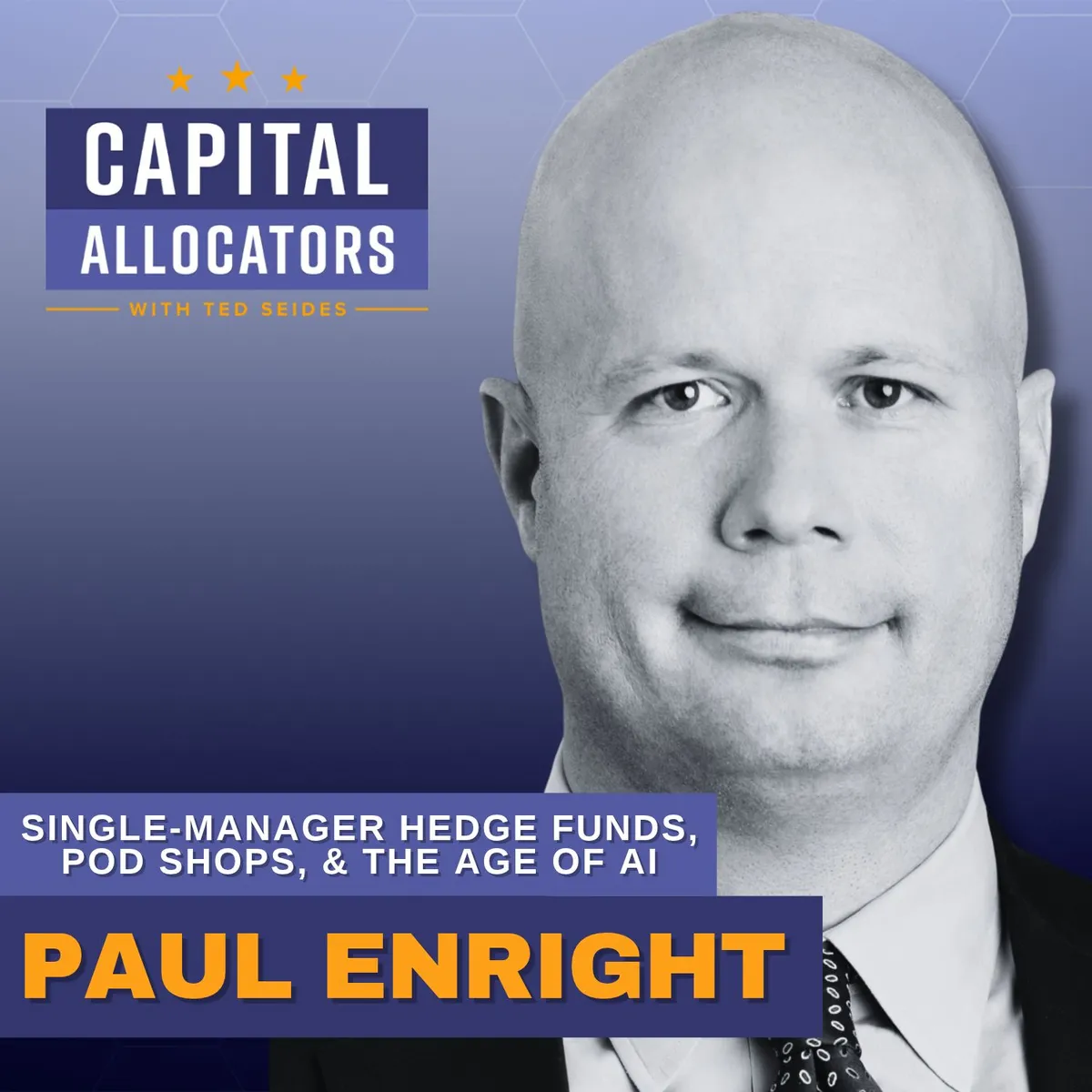
Enright spent more than a decade at Viking Global before joining Jain Global as Chairman of Fundamental Equities in 2023. On EP.527 he compares single-manager funds with multi-manager platforms and discusses how AI affects equity research. [1] [3]
Jain Global launched in July 2024 with $5.3bn, below its roughly $10bn target. It made about $1.8bn in gross trading profit, roughly 34% gross on capital raised, but investors kept about 8.4% net. These are firm figures reported by the press, not audited filings. Its flagship fund now runs only Millennium capital and has returned outside money. [2] [6]
Generative AI is now standard at funds. In AIMA's survey of 150 managers, 95% said they use it, up from 86% in 2023. Many allocators favor managers that invest in it, yet half of respondents at smaller firms reported no restrictions on its use. [4]
The documented evidence covers Jain's gap between gross and net returns and AIMA's adoption data. The implication is that allocators now weigh both AI spending and platform costs. No reviewed source links AI use to better returns at any named fund.
Sources are verified and the dossier is drafted below.
Executive brief
Paul Enright chairs fundamental equities at Jain Global, and that firm no longer manages outside money. Jain Global launched in 2024 as one of the largest hedge fund debuts of its era. It made about $1.8bn in gross trading profit, but investors kept only about 8.4% net. It then returned outside capital to run money only for Millennium (Hedgeweek). On Capital Allocators EP.527, Enright, who spent more than ten years at Viking Global, discusses single-manager funds, multi-manager "pod shops" and equity research in the age of AI (episode page). The reviewed sources include only the episode's published description, so his specific arguments can't be checked here.
What changed and event timeline
Enright joins Jain Global
Hedgeweek reported that Enright, after more than a decade at Viking, was named Chairman of Fundamental Equities. Townie Wells was named CIO for Americas equities. The firm expected to launch with about $10bn ().
Launch with $5.3bn
Jain Global started trading with $5.3bn, below the earlier target. It took about 20 months to deploy that capital fully ().
Gen AI becomes standard at funds
In AIMA's survey of 150 managers, 95% said they use generative AI, up from 86% in 2023 ().
Equities unit in doubt
After the April deal with Millennium, Hedgeweek reported four portfolio-manager departures in 2026 and said Wells's future was under review ().
The Millennium switch closes
Jain Global reported about $1.8bn in gross profit, roughly 34% gross on capital raised against 8.4% net to investors. External capital was to be returned by the end of September ().
EP.527 published
The episode covers single-manager and multi-manager structures and equity research in the age of AI ().
Capabilities and access
- No AI model, vendor version or internal tool is named in the episode description (episode page).
- The full transcript is behind a Capital Allocators premium membership.
- Jain Global's flagship fund now runs only Millennium capital and cannot raise outside money. Its separate Strategic Transactions Fund still accepts external investors (Hedgeweek).
Read the full section
- No AI model, vendor version or internal tool is named in the episode description (episode page).
- The full transcript is behind a Capital Allocators premium membership. AlphaSense, a research-platform vendor, sponsors the episode, so AI-research tooling is commercially close to the topic.
- Jain Global's flagship fund now runs only Millennium capital and cannot raise outside money. Its separate Strategic Transactions Fund still accepts external investors (Hedgeweek).
Technical analysis for researchers and developers
- Survey method: AIMA's numbers are self-reported. There are no controls and no data on how AI use relates to returns (AIMA).
- Gross vs. net returns: Jain Global's numbers show how much of a pod shop's gross profit goes to setup costs, pass-through expenses and talent pay.
- What this means for tools: No reviewed source documents how AI changed analyst productivity or returns at any named fund.
Read the full section
- Survey method: AIMA's numbers are self-reported. They come from 150 managers with about $788bn in assets plus 18 institutional allocators, split roughly by thirds across the UK, US and Asia-Pacific. There are no controls and no data on how AI use relates to returns (AIMA).
- Gross vs. net returns: Jain Global's numbers show how much of a pod shop's gross profit goes to setup costs, pass-through expenses and talent pay. Hedgeweek reports about 41% gross on deployed capital against 8.4% net (Hedgeweek).
- What this means for tools: No reviewed source documents how AI changed analyst productivity or returns at any named fund.
Claims and evidence
- The $1.8bn profit and the 34% gross / 8.4% net split come from Hedgeweek, which follows Bloomberg's reporting (Hedgeweek; Bloomberg).
- The 95% Gen AI adoption figure is from a survey by AIMA, an industry trade body (AIMA).
- Calling Enright a "guru" is the podcast's own framing. No independent source corroborates his views from the episode.
Read the full section
- The $1.8bn profit and the 34% gross / 8.4% net split come from Hedgeweek, which follows Bloomberg's reporting (Hedgeweek; Bloomberg). These are firm figures relayed by the press, not audited filings.
- The 95% Gen AI adoption figure is from a survey by AIMA, an industry trade body (AIMA).
- Calling Enright a "guru" is the podcast's own framing. No independent source corroborates his views from the episode.
Context and prior work
- Bobby Jain founded the firm after seven years at Millennium. Millennium manages about $92bn (Hedgeweek).
- Rupak Ghose asks whether this is "peak pod shop." He notes flat 2026 results at Balyasny and Walleye, and Verition up 3.5%, and argues high costs are wiping out the premium over cash for many platforms (Rupak Ghose).
Read the full section
- Bobby Jain founded the firm after seven years at Millennium. Millennium manages about $92bn (Hedgeweek).
- Rupak Ghose asks whether this is "peak pod shop." He notes flat 2026 results at Balyasny and Walleye, and Verition up 3.5%, and argues high costs are wiping out the premium over cash for many platforms (Rupak Ghose).
Limitations, safety and contested findings
- AIMA found a governance gap.
- Jain Global's performance can be read two ways. Gross returns look strong, but net returns to investors were modest.
- The 2026 staff departures in Jain's equities unit cloud any reading of how that unit performed (Hedgeweek).
Read the full section
- AIMA found a governance gap. Half of respondents at smaller managers reported no restrictions on Gen AI use, and data governance and model reliability topped the list of concerns (AIMA).
- Jain Global's performance can be read two ways. Gross returns look strong, but net returns to investors were modest. Ghose treats that gap as a warning sign for the whole pod model (Rupak Ghose).
- The 2026 staff departures in Jain's equities unit cloud any reading of how that unit performed (Hedgeweek).
Business and practitioner implications
- Allocators: In AIMA's survey, 60% of allocators said they lean toward managers that spend meaningfully on Gen AI.
- Builders of research tools: Buyers will expect governance features such as permissions, audit trails and controls on data use, not just analysis.
- Platform economics: The Jain–Millennium deal shows a large platform taking over a newer one's capital base.
Read the full section
- Allocators: In AIMA's survey, 60% of allocators said they lean toward managers that spend meaningfully on Gen AI. Fifty-eight percent of investors ask, or plan to ask, about AI in due diligence (AIMA).
- Builders of research tools: Buyers will expect governance features such as permissions, audit trails and controls on data use, not just analysis.
- Platform economics: The Jain–Millennium deal shows a large platform taking over a newer one's capital base. It also shows how costs at newer platforms limit what investors keep.
- None of this is investment advice.