
StocksEquities, earnings & valuations
Jensen Huang resigns as Nvidia CEO; CFO Colette Kress named interim chief
Jensen Huang quit as Nvidia CEO on Nov. 12 with no reason given in the company's filing, and CFO Colette Kress became interim chief. The same week, CoreWeave's debt sold off, the Fed tied data-center building to inflation, and Anthropic launched its IPO.
From the The Transcript article of November 16, 2026 and cited sources: Huang left immediately after 33 years running Nvidia. [2] [3] [9]
SOURCES[2] Nvidia Form 8-K (SEC) sec.gov[3] CNBC: Nvidia CEO Jensen Huang resigns, live updates cnbc.com[9] NBC News: Huang resigns nbcnews.com
 AT Pulse research deskPublished · Updated · 5 min read · AI-assisted analysis
AI-assisted, not human-edited. Methodology Corrections Who owns this site
- Original source
- The Transcript article, independent perspective
- Brief by
- AT Pulse research desk AI-assisted; publisher and contact on the desk page
- When
- November 16, 2026 article published
- Covered
- Nov 16 edition
- Evidence
- 12 sources across 8 sites
- 1The Transcript: International Intriguethetranscript.substack.com
- 2Nvidia Form 8-K (SEC)sec.gov
- 3CNBC: Nvidia CEO Jensen Huang resigns, live updatescnbc.com
- 4CNBC: CoreWeave bond yield tops 16%cnbc.com
- 524/7 Wall St.: CoreWeave's bonds yield more than 16%247wallst.com
- 6The Decoder: Anthropic kicks off IPO roadshowthe-decoder.com
RisingHow it’s measured
Substack · 5 likes · 1 share
Reach blends public engagement (views, likes, comments, shares, stars) from the platforms where the story or its original source lives: YouTube, Hacker News, GitHub, Substack and similar. A video and the article written from its transcript share one score, taken from the video. Platforms with no data are left out rather than counted as zero, and the age of a story never lowers its score.
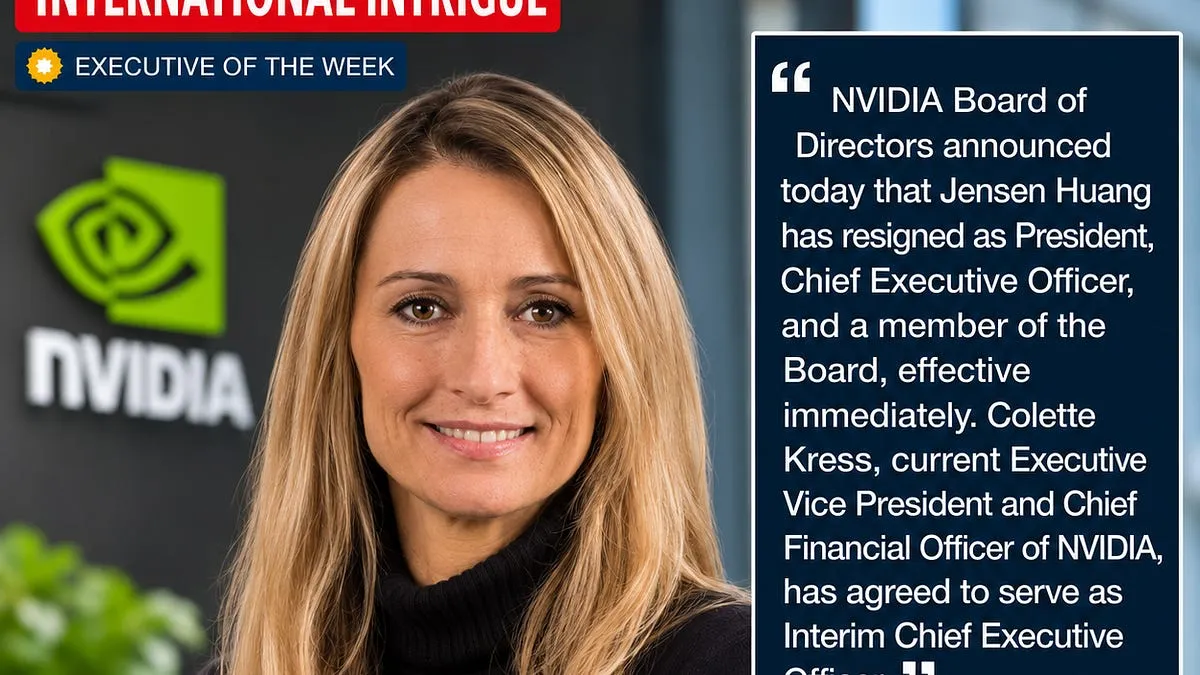
Huang left immediately after 33 years running Nvidia. Kress is interim CEO and stays on as CFO, Harvey C. Jones becomes the company's first board chair, and the board is looking inside and outside the company for a permanent CEO. The filing gives no reason for the exit, but press reports tie it to alleged affairs. The stock opened down 13% and closed down 4.3%, near $160. [2] [3] [9]
Credit for GPU cloud providers tightened. On Nov. 6, CoreWeave's 2032 bond, which has a 9.625% coupon, yielded more than 16%, and its five-year default swaps cost more than 1,200 basis points. The company still expects $35–39 billion in 2026 capital spending. Part of the stress is blamed on state-level politics around data-center permits. [4] [5] [12]
Fed Vice Chair Philip Jefferson said large-scale data-center construction is pushing up prices, especially for memory and logic chips. He cited September PCE inflation of 3.6% and said planned DRAM capacity should ease prices in the coming years. [7]
Anthropic is offering 825 million shares at $70–$78 each to list on Nasdaq as "ANT". Pricing is expected on Nov. 18. Reported compute purchase commitments are about $895 billion. Outlets differ on the implied valuation: about $1.02 trillion in one report and about $1.405 trillion in another. [6] [8]
Documented facts: a leadership gap at Nvidia, distressed-level yields on a major GPU cloud provider's bonds, and a Fed official citing chip-price inflation.
Read the full assessment
The implication, not yet shown, is higher costs and counterparty risk for anyone buying AI compute.
Executive brief
Nvidia co-founder Jensen Huang resigned as CEO, effective immediately, on November 12, 2026. He had run the company for 33 years. Nvidia's Form 8-K gives no reason. Press reports link the exit to alleged affairs, one of them with a woman U.S. intelligence reportedly believes is a Chinese spy (CNBC). Three other pressures hit AI infrastructure in the same week. Credit costs for AI cloud providers rose, the Fed said data-center spending is adding to inflation, and Anthropic opened what would be a record IPO. The Transcript's commentary asks whether roughly $1 trillion in infrastructure spending can absorb these shocks.
What changed and event timeline
CoreWeave debt reprices
CoreWeave's 2032 bond, which pays a 9.625% coupon, traded at a yield above 16%. Its five-year credit default swaps (insurance against default) cost more than 1,200 basis points, above the October high (;).
Anthropic launches its IPO roadshow
It offers 825 million Class A shares at $70–$78 each and plans to list on Nasdaq as "ANT" ().
Huang resigns
CFO Colette Kress becomes interim CEO while keeping the CFO role. Harvey C. Jones becomes Nvidia's first board chair. The board is searching internally and externally for a permanent CEO ().
Fed Vice Chair links data centers to inflation
Philip Jefferson said large-scale data-center construction is pushing up resource use and prices, especially for memory and logic chips. He put September PCE inflation at 3.6% ().
Capabilities and access
Read the full section
- Nvidia leadership: Kress now holds both the interim CEO and CFO roles. No permanent successor has been named (8-K). Huang is expected to testify before Congress and has hired the law firm Paul Weiss (CNBC).
- Anthropic offering: Up to 20% of the shares are aimed at retail investors (CNBC). Anthropic is selling 801,351,354 of the shares and existing shareholders are selling 23,648,646 (The Decoder).
- No new model or product release is part of this story.
Technical analysis for researchers and developers
The reviewed sources document no architecture or benchmark changes.
Read the full section
The reviewed sources document no architecture or benchmark changes. The technical points are about supply and compute:
- Compute obligations: Anthropic's prospectus reportedly lists nearly $900 billion in committed compute capacity with Amazon and Google. CNBC cites $895.4 billion in purchase commitments (The Decoder; CNBC). Commitments that large tie a frontier lab's training and inference plans to its cloud partners for years.
- Hardware supply: Jefferson named memory and logic chips as constrained goods with steep price rises. He also said announced DRAM capacity expansions should ease prices in coming years (Fed).
- Cost of capital: CoreWeave guided 2026 capital spending to $35–39 billion while its debt traded at distressed-level yields (24/7 Wall St.). That could make GPU cloud capacity more expensive.
Claims and evidence
- Market impact: Nvidia shares opened down 13% on Nov 12 and closed down 4.3%, near $160, from $173.73 the day before.
- Reason for the exit: The affair allegations come from press reports. Nvidia's filing states no reason (NBC News; Al Jazeera).
- "Handshake" supply deals: The Transcript quotes Elon Musk saying many of Nvidia's supply deals were handshakes with Huang rather than written contracts.
Read the full section
- Market impact: Nvidia shares opened down 13% on Nov 12 and closed down 4.3%, near $160, from $173.73 the day before. That move is price action and says nothing yet about Nvidia's fundamentals (CNBC).
- Reason for the exit: The affair allegations come from press reports. Nvidia's filing states no reason (NBC News; Al Jazeera).
- "Handshake" supply deals: The Transcript quotes Elon Musk saying many of Nvidia's supply deals were handshakes with Huang rather than written contracts. No other reviewed source corroborates this.
- Anthropic's valuation conflicts across outlets: The Decoder puts it at about $1.02 trillion, based on the prospectus share count. CNBC says about $1.405 trillion (The Decoder; CNBC).
- Anthropic revenue: Q3 revenue reportedly reached $16.96 billion, up 47% from the previous quarter. Growth slowed from the prior quarter's 144% jump (The Decoder).
Context and prior work
- Nvidia's position: Huang built Nvidia into a company worth about $4 trillion that powered the AI boom (Al Jazeera).
- Neocloud debt worries: The debate over debt-funded "neocloud" GPU providers was already running before the Nvidia news (CNBC).
- IPO benchmark: Anthropic's expected institutional demand is being compared with SpaceX's $86 billion IPO in June 2026 (CNBC).
Read the full section
- Nvidia's position: Huang built Nvidia into a company worth about $4 trillion that powered the AI boom (Al Jazeera). CNBC reports the stock had already lost about $2 trillion in market value since its October peak, before the resignation (CNBC).
- Neocloud debt worries: The debate over debt-funded "neocloud" GPU providers was already running before the Nvidia news (CNBC).
- IPO benchmark: Anthropic's expected institutional demand is being compared with SpaceX's $86 billion IPO in June 2026 (CNBC).
Limitations, safety and contested findings
- Espionage claims: The spy allegations come from reports citing U.S. intelligence.
- Credit stress drivers: Reporting attributes part of the widening to state-level political changes affecting data-center permitting (24/7 Wall St.).
- Jefferson voted to hold rates at the last meeting and says inflation data will decide policy (Fed).
Read the full section
- Espionage claims: The spy allegations come from reports citing U.S. intelligence. The reviewed sources contain no official findings, and Nvidia's filing does not mention them.
- Credit stress drivers: Reporting attributes part of the widening to state-level political changes affecting data-center permitting (24/7 Wall St.). It is not attributed only to AI demand.
- Rate outlook: Fed officials disagree. Jefferson voted to hold rates at the last meeting and says inflation data will decide policy (Fed). Other officials quoted in The Transcript lean toward further tightening.
Business and practitioner implications
- Nvidia buyers: Leadership is in transition, so watch the Nov 17 earnings call for any change to supply allocation or partner terms.
- Anyone renting GPU capacity: If credit stays this tight, neocloud contract terms and capacity timelines become a counterparty risk.
- Budgets: Memory and chip inflation, plus possible rate rises, can raise the cost of AI infrastructure projects.
Read the full section
- Nvidia buyers: Leadership is in transition, so watch the Nov 17 earnings call for any change to supply allocation or partner terms.
- Anyone renting GPU capacity: If credit stays this tight, neocloud contract terms and capacity timelines become a counterparty risk. That applies to both developers and enterprises.
- Budgets: Memory and chip inflation, plus possible rate rises, can raise the cost of AI infrastructure projects.
- Anthropic IPO: The final pricing on Nov 18 will be an observable public-market read on what a frontier AI lab is worth. Disclosures will rise once the company is listed.