
FundingRounds, leads & terms
TypeSafe AI, maker of the Jev decision model, raises at a $7.5B valuation in an Andreessen Horowitz-led round
TypeSafe AI makes Jev, a model that returns typed decisions with confidence scores instead of text. Weeks after launch, it raised at a $7.5B valuation in a round led by Andreessen Horowitz. Benchmarks show very low cost but accuracy that varies by task.
From the 20VC podcast episode of November 16, 2026 and cited sources: TypeSafe left stealth in September 2026 with a $40M seed round led by DCVC, at a reported post-money valuation of about $200M. [4] [2] [3] [12]
SOURCES[4] Dealroom: TypeSafe exits stealth dealroom.co[2] Sacra: TypeSafe AI sacra.com[3] Investing.com (Bloomberg): TypeSafe raises $870M ca.investing.com
 AT Pulse research deskPublished · Updated · 5 min read · AI-assisted analysis
AI-assisted, not human-edited. Methodology Corrections Who owns this site
- What happened
- TypeSafe left stealth in September 2026 with a $40M seed round led by DCVC, at a reported post-money valuation of about $200M. [4] [2] [3] [12]
- Original source
- 20VC podcast episode, independent perspective
- Brief by
- AT Pulse research desk AI-assisted; publisher and contact on the desk page
- Studies
- arXiv 2609.29769 (Sep 2026) [13] date from arXiv ID
- When
- November 16, 2026 podcast episode published
- Covered
- Nov 16 edition
- Evidence
- 13 sources across 13 sites; no transcript
- 120VC: Jev Creator on Why Data Is More Important Than…thetwentyminutevc.libsyn.com
- 2Sacra: TypeSafe AIsacra.com
- 3Investing.com (Bloomberg): TypeSafe raises $870Mca.investing.com
- 4Dealroom: TypeSafe exits stealthdealroom.co
- 5Runtimewire: $40M seedruntimewire.com
- 6PriorBench Jev evaluation (GitHub)github.com
Reach: not measured yet
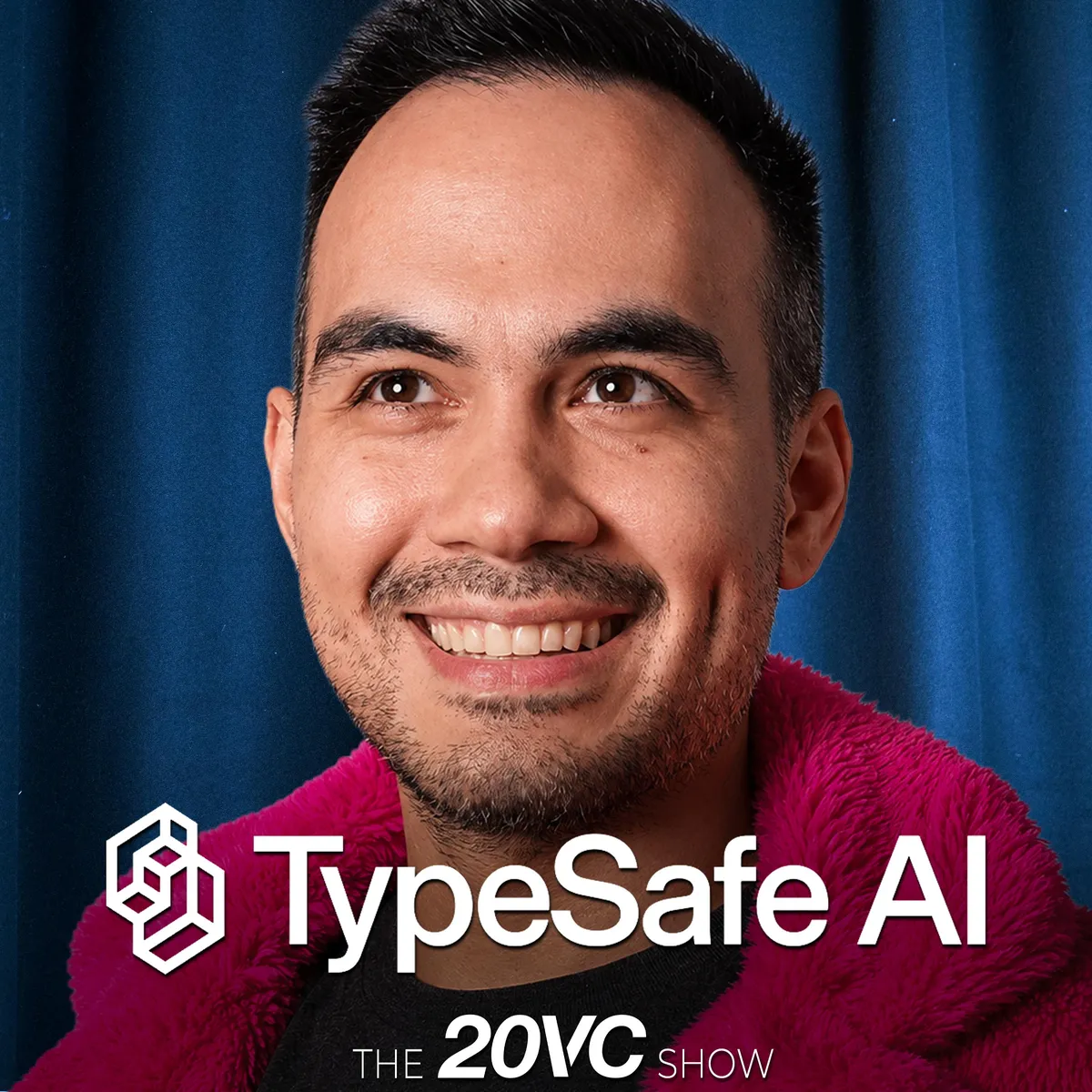
TypeSafe left stealth in September 2026 with a $40M seed round led by DCVC, at a reported post-money valuation of about $200M. About three weeks after Jev launched, it raised again at a $7.5B valuation in a round led by Andreessen Horowitz. Bloomberg reported that round at $870M. [4] [2] [3] [12]
Pat Grady of Sequoia says Jev reached a $100M annualized revenue run rate within seven days of its September 15 launch. Sequoia is an investor in TypeSafe, and this figure is the main evidence for the company's rapid growth. [2]
Jev returns yes/no, choice or score decisions with a confidence value and charges $42 per billion input tokens. In Vals AI's comparison of 12 systems, Jev cost about 1/498th as much as GPT-6 Astra. It tied the leaders on claim verification (0.975) but ranked last on LegalBench (0.730). Its calibration error also rose from 0.011 to 0.108 between those two tasks. [8] [9] [7]
Jev's lead looks narrow and needs tuning to use well. TypeSafe has not disclosed its training method, base model or model size. An untuned Gemma 4 26B scored only 2.1 points behind Jev. Jev gave 0.97 confidence on random letters, so teams need confidence thresholds set per task, or recalibration with 50–300 labeled examples. [10] [6] [7]
a participating investor confirmed the valuation, and benchmarks show large cost savings on bounded tasks.
Read the full assessment
Implication: cheap typed decisions could replace prompted LLMs for classification and routing, but uneven calibration and close open-model rivals may limit pricing power.
The sources are gathered and checked against each other; the dossier follows.
Executive brief
TypeSafe AI is the startup behind Jev, a model that returns typed decisions with a confidence score instead of generating text. Sequoia's Pat Grady says Jev hit a $100M annualized revenue run rate within seven days of its September 2026 launch (Sacra). That figure is self-reported, and Sequoia is an investor. About three weeks later, Bloomberg reported an $870M round at a $7.5B valuation led by Andreessen Horowitz (Investing.com/Bloomberg). The 20VC episode's agenda lists "$750M in a week" instead. Independent tests find Jev is very cheap and fast. Its accuracy and calibration vary a lot from task to task.
What changed and event timeline
TypeSafe leaves stealth
TypeSafe announced a $40M seed round led by DCVC, at a reported post-money valuation of about $200M (;).
Jev launches
Jev was presented as a "System One" decision model. A launch video was reported to reach about 40M views in under a week (;).
First pre-registered audit
PriorBench tested
jev-1.13-20260917over 5,721 API calls and registered 50 predictions before collecting data ().Vals AI runs a 12-system comparison
Jev tied the leading frontier models on claim verification and ranked last on LegalBench ().
$870M at $7.5B
Bloomberg reported a round led by a16z, with Sequoia and angel investors also participating ().
CEO goes on 20VC
Diogo Almeida discussed reliability, why data matters more than compute, US vs. Chinese open models, and the speed of the raise ().
Capabilities and access
- Versions: the independent tests used Jev 1.13 (
typesafe/jev-1.13-20260917) (PriorBench). TypeSafe's site lists "Version 0.01" with early access through an API console (TypeSafe). - What it returns: three decision types with probabilities and confidence: yes/no ("Noul"), Choice among defined options, and Score on a scale (Firecrawl).
- Price: $42 per billion input tokens, with no charge for output (TypeSafe).
Read the full section
- Versions: the independent tests used Jev 1.13 (
typesafe/jev-1.13-20260917) (PriorBench). TypeSafe's site lists "Version 0.01" with early access through an API console (TypeSafe). - What it returns: three decision types with probabilities and confidence: yes/no ("Noul"), Choice among defined options, and Score on a scale (Firecrawl).
- Price: $42 per billion input tokens, with no charge for output (TypeSafe).
- Access: also available through OpenRouter (PriorBench).
Technical analysis for researchers and developers
- Training is undisclosed beyond a name. TypeSafe names its training method "Reinforcement Learning for Calibrated Decisions" (RLCD) (TypeSafe).
- Confidence is a black box. TypeSafe publishes no reliability curves and no calibration error, Brier score or log loss (BERI).
- The confidence score can mislead. Jev reported 0.97 confidence on random letters (PriorBench).
Read the full section
- Training is undisclosed beyond a name. TypeSafe names its training method "Reinforcement Learning for Calibrated Decisions" (RLCD) (TypeSafe). The method, model size and base model are not published (DEV Community).
- Confidence is a black box. TypeSafe publishes no reliability curves and no calibration error, Brier score or log loss (BERI).
- The confidence score can mislead. Jev reported 0.97 confidence on random letters (PriorBench). In another review, rewording the answer options changed 32.5% of answers (DEV).
- Implementation: Vals AI's 95% coverage at 1.6% error comes from confidence gating, which only works with per-task thresholds (Vals AI). With 50–300 labels, recalibration closes most of the gap (DEV).
Claims and evidence
- "193.6x faster, 444.6x cheaper" than LLMs: this comes from TypeSafe's own benchmark (TypeSafe). It does not name the comparison models.
- Cost: Vals AI found Jev costs about 1/498th of GPT-6 Astra (Vals AI).
- Accuracy: 0.975 on claim verification, which tied the leaders. Last place at 0.730 on LegalBench (Vals AI).
Read the full section
- "193.6x faster, 444.6x cheaper" than LLMs: this comes from TypeSafe's own benchmark (TypeSafe). It does not name the comparison models. Independent speedups ranged from 0.5x to 12.1x (DEV).
- Cost: Vals AI found Jev costs about 1/498th of GPT-6 Astra (Vals AI).
- Accuracy: 0.975 on claim verification, which tied the leaders. Last place at 0.730 on LegalBench (Vals AI).
- $100M run rate in seven days: self-reported, and it comes from Pat Grady of Sequoia, an investor (Sacra).
- Used by about a third of the Fortune 500: this is the company's claim and no names are given (Investing.com).
- $7.5B valuation with a16z leading: confirmed by participating investor Flat Capital (TradingView). The $870M round size is reported by Bloomberg. No filing confirmation appears in the reviewed sources.
Context and prior work
Almeida is a former OpenAI researcher credited with contributing to the technology behind ChatGPT (TradingView). Jev is aimed at classification, routing and LLM-as-judge work, where it competes with prompted LLMs. University of Pennsylvania researchers found Jev and LLMs, used as rubric judges, "wrong in the same places" (arXiv).
Read the full section
Almeida is a former OpenAI researcher credited with contributing to the technology behind ChatGPT (TradingView). Jev is aimed at classification, routing and LLM-as-judge work, where it competes with prompted LLMs. It also competes with small open models: plain Gemma 4 26B trailed Jev by only 2.1 points (DEV). University of Pennsylvania researchers found Jev and LLMs, used as rubric judges, "wrong in the same places" (arXiv).
Limitations, safety and contested findings
- Expected calibration error was 0.011 on claim verification and 0.108 on LegalBench (Vals AI).
- Weak where outside knowledge is needed.
- TypeSafe's own documentation says number comparison and date ordering are unreliable. PriorBench measured 99.6% accuracy on them (PriorBench).
Read the full section
- Calibration doesn't transfer between tasks. Expected calibration error was 0.011 on claim verification and 0.108 on LegalBench (Vals AI).
- Weak where outside knowledge is needed. Jev fails when the answer requires knowledge not in the input, and trails the frontier by 11.6 F1 points in the largest pre-registered study (DEV).
- Vendor docs undersell some skills. TypeSafe's own documentation says number comparison and date ordering are unreliable. PriorBench measured 99.6% accuracy on them (PriorBench).
- Round size conflicts. Bloomberg reported $870M. The 20VC agenda cites $750M.
Business and practitioner implications
- Fit: high-volume, bounded decisions in English, such as spam filtering, triage and claim checks. Expect large cost savings there (Vals AI).
- Before deploying: recalibrate on your own labeled data and set confidence thresholds per task. Don't rely on the default confidence score.
- Watch for lock-in: the training method is opaque and cheap open models are close behind (DEV).
Read the full section
- Fit: high-volume, bounded decisions in English, such as spam filtering, triage and claim checks. Expect large cost savings there (Vals AI).
- Before deploying: recalibrate on your own labeled data and set confidence thresholds per task. Don't rely on the default confidence score.
- Watch for lock-in: the training method is opaque and cheap open models are close behind (DEV).
- Investors: the revenue and adoption figures that support the valuation are self-reported or come from investors.
The source trail.
Sources (13)
20VC: Jev Creator on Why Data Is More Important Than Compute | Will US Open-Source Models Catch Chinese | The Cost of Intelligence and Tokens: What No One Sees But Needs to Know with Diogo Almeida
Metadata only. Transcript unavailable: Audio transcription returned HTTP 429.
thetwentyminutevc.libsyn.com