
ResearchPapers, evidence & method
Apple launches a study of up to 200,000 people on how consumers use OpenEvidence's AI health answers
Apple is recruiting up to 200,000 US adults to ask health questions in a dedicated iPhone app and rate answers from OpenEvidence, a clinician-focused AI whose accuracy against general-purpose models is disputed. The study examines use and comprehension, not clinical accuracy.
From the The Verge · AI article of November 16, 2026 and cited sources: Apple announced its Health AI Usage Study at the HLTH conference in Las Vegas. [1] [6] [7] [8]
SOURCES[1] Apple’s new study looks to improve the effectiveness of AI… theverge.com[6] Chief Healthcare Executive chiefhealthcareexecutive.com[7] Engadget engadget.com
 AT Pulse research deskPublished · Updated · 4 min read · AI-assisted analysis
AI-assisted, not human-edited. Methodology Corrections Who owns this site
- What happened
- Apple announced its Health AI Usage Study at the HLTH conference in Las Vegas. [1] [6] [7] [8]
- Original source
- The Verge · AI article, independent perspective
- Brief by
- AT Pulse research desk AI-assisted; publisher and contact on the desk page
- When
- November 16, 2026 article published
- Covered
- Nov 16 edition
- Evidence
- 12 sources across 10 sites
Reach: not measured yet
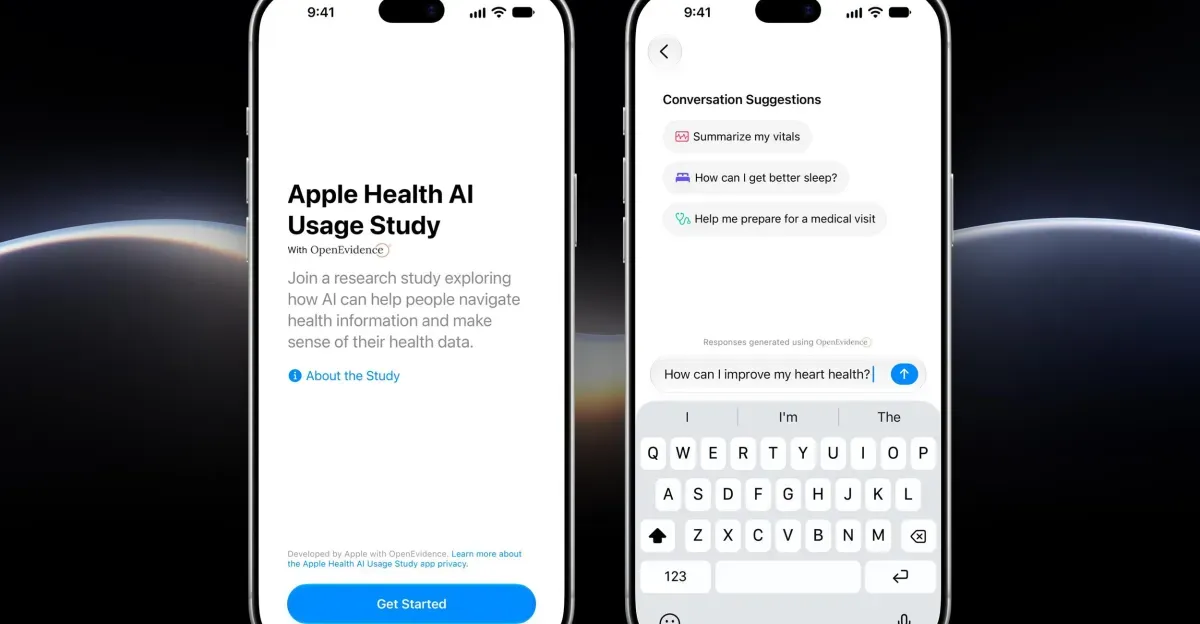
Apple announced its Health AI Usage Study at the HLTH conference in Las Vegas. It is open to US adults aged 21 or older with an iPhone 15 Pro or later running iOS 26. Participants type or dictate questions and can choose to share HealthKit data so that answers are more personal. They rate each answer for accuracy, detail and relevance. Most outlets say the app is separate from Siri and Apple Intelligence, but one report says Apple Intelligence must be turned on. [1] [6] [7] [8]
Researchers disagree about how accurate OpenEvidence is. A June 2026 Nature Medicine study tested it on 100 real physician questions. It scored 62.6 out of 100, against 88.0 for GPT-5.2, and OpenEvidence asked the journal to retract the study. A later preprint used 620 queries and 149 physician graders and ranked OpenEvidence first. The two studies drew questions from different users, matched graders differently and tested different model versions. [2] [4]
Basic details of the study have not been published. There is no public protocol, ethics-board information or publication timeline. Only one outlet reports a study length of more than 12 months and the deletion of de-identified questions within 24 hours. Apple says participant data will not be used to train AI models, but no one outside the companies has audited that claim. [6] [7] [8]
participants give lay ratings, and most reports place the app outside Siri and Apple Intelligence. Implication: Apple can collect consumer health-AI usage data at scale with limited direct exposure.
Read the full assessment
Real-world comprehension may matter as much as benchmark scores.
Executive brief
Apple is recruiting up to 200,000 US adults for a consumer study of health chatbot answers. The answers come from OpenEvidence, whose tools were built for clinicians. In June 2026, a Nature Medicine study found OpenEvidence behind general-purpose models from OpenAI, Google and Anthropic, and the company asked the journal to retract it (TechTarget). People will ask health questions in a dedicated iPhone app and rate the answers (The Verge). The study looks at how people use and understand the answers, not whether they are clinically accurate.
What changed and event timeline
OpenEvidence hits $12B valuation
OpenEvidence raised $250M in a Series D at a $12B valuation, as more doctors adopted it. This made it one of the best-funded clinical AI companies ().
Nature Medicine study favors general-purpose models
NYU Langone and UT Austin researchers found GPT-5.2, Gemini 3.1 Pro and Claude Opus 4.6 ahead of OpenEvidence and UpToDate Expert AI. OpenEvidence sent a retraction request on June 15 ().
Critique and reply published
A formal critique of the study appeared in Nature, together with a reply from the original authors ().
Apple expands its Health app
Apple's redesigned Health app, built around Apple Intelligence, gained support for more languages ().
Study launches at HLTH
Apple announced the Health AI Usage Study at the HLTH conference in Las Vegas, and enrollment opened the same day (;). AI Weekly gives Nov 15, likely the US date.
Capabilities and access
- Who can join: US adults aged 21 or older, using an iPhone 15 Pro or later on iOS 26 or later (Engadget).
- How it works: questions are typed, and iOS dictation works. The app is not connected to Siri or Apple Intelligence (The Verge).
- Conflicting report: AI Weekly says Apple Intelligence must be turned on.
Read the full section
- Who can join: US adults aged 21 or older, using an iPhone 15 Pro or later on iOS 26 or later (Engadget).
- How it works: questions are typed, and iOS dictation works. The app is not connected to Siri or Apple Intelligence (The Verge).
- Conflicting report: AI Weekly says Apple Intelligence must be turned on.
- Health data: sharing HealthKit data (activity, sleep, lab results) is optional and makes answers more personal.
- Model: the version of the model behind OpenEvidence has not been disclosed.
Technical analysis for researchers and developers
- Design: Answers are grounded in the reviewed sources and link to peer-reviewed literature. Named sources are NEJM, JAMA and Nature (AI Weekly).
- What participants measure: they rate answers for accuracy, detail and relevance, and AI Weekly adds monthly surveys. These are lay ratings, not clinician grading.
- Privacy pipeline: AI Weekly reports that identifying details are removed before questions reach OpenEvidence, which deletes questions and answers within 24 hours.
Read the full section
- Design: Answers are grounded in the reviewed sources and link to peer-reviewed literature. Named sources are NEJM, JAMA and Nature (AI Weekly).
- What participants measure: they rate answers for accuracy, detail and relevance, and AI Weekly adds monthly surveys. These are lay ratings, not clinician grading.
- Privacy pipeline: AI Weekly reports that identifying details are removed before questions reach OpenEvidence, which deletes questions and answers within 24 hours.
- Missing details: there is no public protocol, ethics board (IRB) information or publication timeline (Chief Healthcare Executive). The results cannot yet be checked or reproduced.
Claims and evidence
- "Data won't train AI models": this is Apple's statement (Engadget). Nobody outside the companies has audited it.
- Study length of 12+ months and 24-hour deletion: only AI Weekly reports these. Other reviewed outlets say the duration was not disclosed.
- OpenEvidence accuracy: in Nature Medicine, it scored 89.6% on MedQA against 97.4% for Gemini.
Read the full section
- "Data won't train AI models": this is Apple's statement (Engadget). Nobody outside the companies has audited it.
- Study length of 12+ months and 24-hour deletion: only AI Weekly reports these. Other reviewed outlets say the duration was not disclosed.
- OpenEvidence accuracy: in Nature Medicine, it scored 89.6% on MedQA against 97.4% for Gemini. On 100 real physician queries it scored 62.6 out of 100, against 88.0 for GPT-5.2 (TechTarget).
- Conflicting result: a later preprint, Real-POCQi, used 620 real queries and 149 physician graders and ranked OpenEvidence first (Iatrox).
Context and prior work
- Apple's earlier health AI: an Apple-supported foundation model trained on wearable behavior data flagged health conditions with up to 92% accuracy (9to5Mac).
- Apple's Health app: the app's redesign already relies on Apple Intelligence (Apple Newsroom).
- Earlier OpenEvidence research: studies have reported mixed results for OpenEvidence in medical education (PMC).
Read the full section
- Apple's earlier health AI: an Apple-supported foundation model trained on wearable behavior data flagged health conditions with up to 92% accuracy (9to5Mac).
- Apple's Health app: the app's redesign already relies on Apple Intelligence (Apple Newsroom).
- Earlier OpenEvidence research: studies have reported mixed results for OpenEvidence in medical education (PMC).
Limitations, safety and contested findings
- Who can join: requiring an iPhone 15 Pro or later may skew who takes part (Chief Healthcare Executive).
- Disputed benchmarks: OpenEvidence argues the MedQA and HealthBench results may be inflated because frontier models could have seen those benchmarks in training (TechTarget).
- Why the two studies disagree: they drew questions from different user bases, matched graders differently and tested different model versions.
Read the full section
- Who can join: requiring an iPhone 15 Pro or later may skew who takes part (Chief Healthcare Executive).
- Disputed benchmarks: OpenEvidence argues the MedQA and HealthBench results may be inflated because frontier models could have seen those benchmarks in training (TechTarget).
- Why the two studies disagree: they drew questions from different user bases, matched graders differently and tested different model versions. Both sides have competing interests (Iatrox).
- No outside commentary yet: none of the reviewed sources quote independent experts on the Apple study itself.
Business and practitioner implications
- Apple's approach: Apple is testing consumer health AI in a separate research app with a third-party model, keeping it apart from Apple Intelligence.
- What it means for OpenEvidence: the study is a route into consumer health.
- For builders: benchmark leadership is contested, and evidence on real-world comprehension may matter as much as exam scores.
Read the full section
- Apple's approach: Apple is testing consumer health AI in a separate research app with a third-party model, keeping it apart from Apple Intelligence. That limits Apple's direct exposure while it gathers usage data at scale.
- What it means for OpenEvidence: the study is a route into consumer health. Separately, AI Weekly reports a September 2026 raise at $15B, which is not confirmed by primary sources (AI Weekly).
- For builders: benchmark leadership is contested, and evidence on real-world comprehension may matter as much as exam scores.
The source trail.
Sources (12)
Apple’s new study looks to improve the effectiveness of AI health tools
Article text retrieved; extracted text may omit tables or interactive elements.
theverge.com