
AgentsAutonomy & tool use
SAP and Infosys pitch governed data layer for enterprise AI agents, citing 86-to-6-hour cut in SAP specification work
In a sponsored MIT Technology Review podcast, SAP and Infosys executives argue that enterprise agents need a governed semantic data layer. They point to SAP's newly available Business AI Platform and an Infosys system that cut SAP specification writing from 86 hours to 6.
From the MIT Technology Review · AI article of November 16, 2026 and cited sources: SAP's Business AI Platform became generally available in early November. [1] [6] [7] [8]
SOURCES[1] Building AI that can work across the enterprise technologyreview.com[6] SiliconANGLE: SAP expands Joule into an agentic work layer siliconangle.com[7] SAP Africa News: SAP beefs up Business AI Platform and Joule news.sap.com
 AT Pulse research deskPublished · Updated · 5 min read · AI-assisted analysis
AI-assisted, not human-edited. Methodology Corrections Who owns this site
- What happened
- SAP's Business AI Platform became generally available in early November. [1] [6] [7] [8]
- Original source
- MIT Technology Review · AI article, independent perspective
- Brief by
- AT Pulse research desk AI-assisted; publisher and contact on the desk page
- When
- November 16, 2026 article published
- Covered
- Nov 16 edition
- Evidence
- 10 sources across 9 sites
- 1Building AI that can work across the enterprisetechnologyreview.com
- 2BCG: AI Adoption in 2024: 74% of Companies Strugglebcg.com
- 3HFS Research: Stop scaling agentic AI on operating models…hfsresearch.com
- 4SAP News: New Joule Studionews.sap.com
- 5Constellation Research: SAP Sapphire 2026constellationr.com
- 6SiliconANGLE: SAP expands Joule into an agentic work layersiliconangle.com
Reach: not measured yet
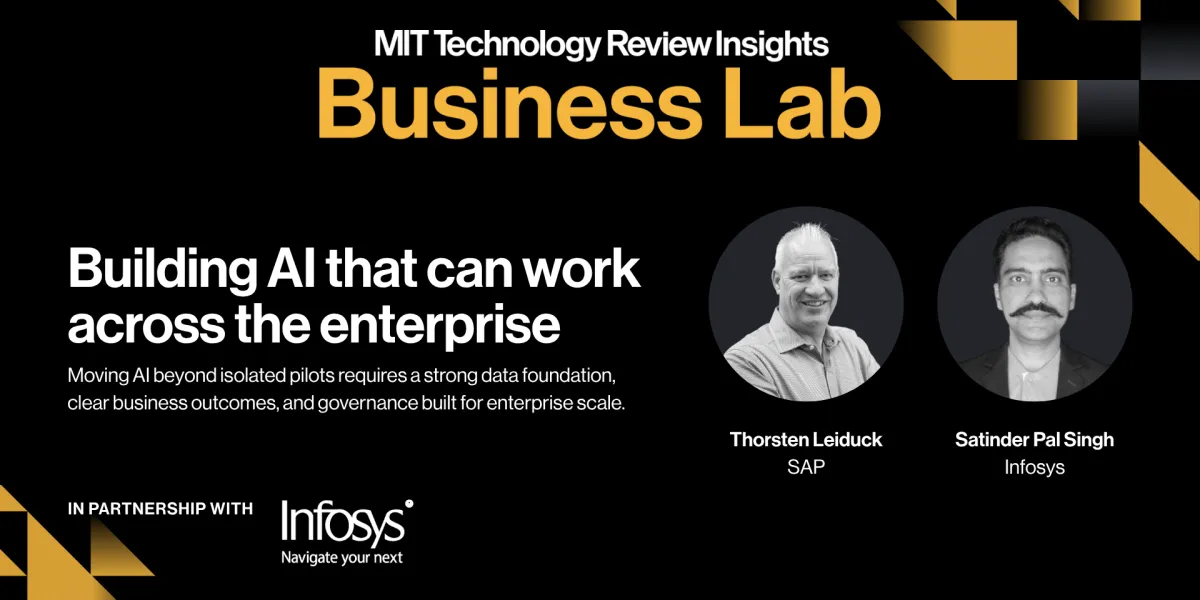
SAP's Business AI Platform became generally available in early November. It runs agents as a layer alongside SAP and non-SAP applications rather than inside them. The agents are grounded in a knowledge graph of ERP business semantics and draw on Business Data Cloud, which gives zero-copy access to Databricks and Snowflake. They are governed through AI Agent Hub, which also covers non-SAP agents that connect through the A2A protocol. [1] [6] [7] [8]
Infosys reports that a Claude-powered retrieval system cut the time to write a complex SAP specification from 86 hours to 6, with 95% accuracy across 51 task types. These are Infosys's own figures. For month-end close, Infosys describes a master agent that coordinates five specialist agents, with exceptions routed to humans. [1]
SAP's platform is generally available, and surveys show most firms have not scaled agents.
Read the full assessment
Implication: in finance and supply chains, where the executives call 80% accuracy unacceptable, buyers should ask for baselines and test sets before trusting percentage gains.
Executive brief
The headline case study in this MIT Technology Review piece comes from Infosys, which sponsored it. Infosys says a Claude-powered retrieval system running on SAP's Business AI Platform cut the time to write a complex SAP specification document from 86 hours to 6, with 95% accuracy across 51 task types (MIT Technology Review). The episode is a Business Lab podcast in which SAP and Infosys executives argue that enterprise agents need a governed semantic data layer.
Read the full section
The headline case study in this MIT Technology Review piece comes from Infosys, which sponsored it. Infosys says a Claude-powered retrieval system running on SAP's Business AI Platform cut the time to write a complex SAP specification document from 86 hours to 6, with 95% accuracy across 51 task types (MIT Technology Review). No independent party has checked that number. The episode is a Business Lab podcast in which SAP and Infosys executives argue that enterprise agents need a governed semantic data layer. Their point on accuracy: 80% may be fine for drafting emails but is "terrible" for supply chains or closing the books. It came out two weeks after SAP made its Business AI Platform generally available.
What changed and event timeline
BCG puts a number on the AI value gap
A survey of 1,000 executives found that 74% of companies had yet to show tangible value from AI. In the podcast, SAP restates this as 74% "stuck in pilot mode with no plan to scale," which is not quite what BCG reported ().
Infosys and HFS report on agentic maturity
Of 505 Global 2000 enterprises, 14% were at the "Scaling" stage, 6% were "Pioneers" and 80% were still exploring or emerging ().
SAP Sapphire launches the Autonomous Enterprise
SAP announced the Business AI Platform, more than 50 Joule assistants, Joule Studio and AI Agent Hub. Anthropic's Claude was named Joule's primary reasoning model (;).
Joule Work and Joule Desktop become generally available
These are agent layers that run alongside both SAP and non-SAP apps, billed in consumption-based "AI units" ().
Business AI Platform becomes generally available at TechEd
The GA release bundles Joule Studio, Joule Work, SAP Knowledge Graph and Business Data Cloud, along with the SAP-RPT-2.0 tabular model ().
The sponsored podcast airs
SAP's Thorsten Leiduck and Infosys's Satinder Pal Singh present the platform and the Infosys Topaz case studies ().
Capabilities and access
- Build: Joule Studio supports pro-code work with LangChain, Pydantic AI and LlamaIndex.
- Contextualize: Business Data Cloud gives zero-copy access to Databricks and Snowflake. A knowledge graph holds business semantics (MIT TR).
- Govern: AI Agent Hub sits in LeanIX. It governs SAP agents and any non-SAP agents that connect through the A2A protocol (SAP Insider).
Read the full section
- Build: Joule Studio supports pro-code work with LangChain, Pydantic AI and LlamaIndex. It also embeds n8n for visual multi-agent orchestration and uses NVIDIA OpenShell sandboxes. Design-time access is free under fair-use limits through the end of 2026 (SAP News).
- Contextualize: Business Data Cloud gives zero-copy access to Databricks and Snowflake. The generative AI hub offers "more than 50" models. A knowledge graph holds business semantics (MIT TR).
- Govern: AI Agent Hub sits in LeanIX. It governs SAP agents and any non-SAP agents that connect through the A2A protocol (SAP Insider).
Technical analysis for researchers and developers
- Architecture: SAP calls this "AI on apps": agents run as a layer outside the applications, not inside them.
- Infosys's month-end-close design: a master agent coordinates five specialist agents covering WBS accruals, revenue recognition, intercompany settlement, master-data reconciliation and SOX audit trails.
- Reproducibility: the reviewed sources give no evaluation protocol, baseline definition, error analysis or task taxonomy for the "95% across 51 task types" figure.
Read the full section
- Architecture: SAP calls this "AI on apps": agents run as a layer outside the applications, not inside them. They are grounded in a knowledge graph of ERP semantics, which general-purpose models lack (SiliconANGLE).
- Infosys's month-end-close design: a master agent coordinates five specialist agents covering WBS accruals, revenue recognition, intercompany settlement, master-data reconciliation and SOX audit trails. Exceptions go to humans (MIT TR).
- Reproducibility: the reviewed sources give no evaluation protocol, baseline definition, error analysis or task taxonomy for the "95% across 51 task types" figure.
Claims and evidence
- 86→6 hours (92%), 95% accuracy, 51 task types: comes only from Infosys, in a podcast Infosys sponsored (MIT TR).
- Close automation: Infosys says it removed an L1.5 support tier, handles 300+ incidents a month with no human touch, and has a savings pipeline above $1M.
- "86% not scaled": HFS reports 14% Scaling plus 6% Pioneers, so the "not scaled" share could be read as 80% rather than 86% (HFS).
Read the full section
- 86→6 hours (92%), 95% accuracy, 51 task types: comes only from Infosys, in a podcast Infosys sponsored (MIT TR).
- Close automation: Infosys says it removed an L1.5 support tier, handles 300+ incidents a month with no human touch, and has a savings pipeline above $1M. Infosys also cites 480 RICEF objects in five months and time to value cut from 12–18 months to 4–6. None of these is independently confirmed (same source).
- "86% not scaled": HFS reports 14% Scaling plus 6% Pioneers, so the "not scaled" share could be read as 80% rather than 86% (HFS).
- "8% AI-native earn 4× AI revenue": Infosys's own maturity research shows 8% "visionaries" and a 3.5× growth-rate gap. The 4× figure does not appear in the reviewed sources (Infosys IKI).
- 42% struggle with data access/quality: this matches Anthropic's survey of 500+ US technical leaders (Anthropic report coverage).
Context and prior work
BCG found that about 70% of AI challenges come from people and process, not algorithms (BCG). HFS likewise found that workflow redesign (35%) and orchestration roles (30%) speed up adoption more than adding agents does (HFS). Salesforce, ServiceNow, Microsoft and Workday are all chasing similar agent control layers (Constellation).
Limitations, safety and contested findings
- Both speakers are commercial partners, and the episode is sponsored content.
- HFS found that roughly 60% of deployments are simple, rules-based tasks.
- Constellation's Holger Mueller says it is still unclear whether the autonomous-enterprise value proposition is strong enough.
Read the full section
- Both speakers are commercial partners, and the episode is sponsored content.
- HFS found that roughly 60% of deployments are simple, rules-based tasks. Only 16% of organisations have security frameworks ready for agent-specific threats, and 52% report workforce resistance (HFS).
- Constellation's Holger Mueller says it is still unclear whether the autonomous-enterprise value proposition is strong enough. He sees finance as the test case, and notes that SAP's clean-core and cloud requirements may limit existing customers (Constellation).
Business and practitioner implications
- Sequencing: set success metrics (cycle time, cost per transaction, accuracy) before building. Treat data unification as the step that unblocks everything else.
- Lock-in: governance through Agent Hub depends on A2A integration with SAP, so non-SAP agent stacks should support A2A.
- Cost: AI-unit consumption pricing makes token economics a line item that has to be managed (SiliconANGLE).
Read the full section
- Sequencing: set success metrics (cycle time, cost per transaction, accuracy) before building. Treat data unification as the step that unblocks everything else.
- Lock-in: governance through Agent Hub depends on A2A integration with SAP, so non-SAP agent stacks should support A2A.
- Cost: AI-unit consumption pricing makes token economics a line item that has to be managed (SiliconANGLE).
- Diligence: before buying, ask vendors for the baselines and test sets behind their percentage gains.
The source trail.
Sources (10)
Building AI that can work across the enterprise
Article text retrieved; extracted text may omit tables or interactive elements.
technologyreview.com