
Fed & ratesCentral banks & interest rates
Matthew Klein Argues 2026 Midterm Exit Polls Back Further Fed Rate Hikes
In The Overshoot, Matthew Klein compares the 2024 and 2026 exit polls. He finds similar economy-driven swings against incumbents despite what he calls strong jobs and household finances, and concludes that voters punish rising prices. He says this message favors the Fed's hawkish dissenters.
From the The Overshoot article of November 12, 2026 and cited sources: Klein breaks down the vote by voters' top issue. [1] [6] [7]
SOURCES[1] The Midterms’ Message for the Fed: Hike theovershoot.co[6] NBC News Exit Poll: midterms as rebuke of Trump nbcnews.com[7] CBS News exit polls: how Democrats won the 2026 midterms cbsnews.com
 AT Pulse research deskPublished · Updated · 5 min read · AI-assisted analysis
AI-assisted, not human-edited. Methodology Corrections Who owns this site
- Original source
- The Overshoot article, independent perspective
- Brief by
- AT Pulse research desk AI-assisted; publisher and contact on the desk page
- When
- November 12, 2026 article published
- Covered
- Nov 14 edition
- Evidence
- 9 sources across 8 sites
- 1The Midterms’ Message for the Fed: Hiketheovershoot.co
- 2FOMC statement, October 28, 2026 — what changed (fomcdiff)fomcdiff.com
- 3What to know about the Fed's first rate hike in 3 years —…aljazeera.com
- 4Consumer Price Index News Release, September 2026 — BLSbls.gov
- 5Live Fed Statement Breakdown: October 2026 — Raisinraisin.com
- 6NBC News Exit Poll: midterms as rebuke of Trumpnbcnews.com
RisingHow it’s measured
Substack · 12 likes · 1 comment
Reach blends public engagement (views, likes, comments, shares, stars) from the platforms where the story or its original source lives: YouTube, Hacker News, GitHub, Substack and similar. A video and the article written from its transcript share one score, taken from the video. Platforms with no data are left out rather than counted as zero, and the age of a story never lowers its score.
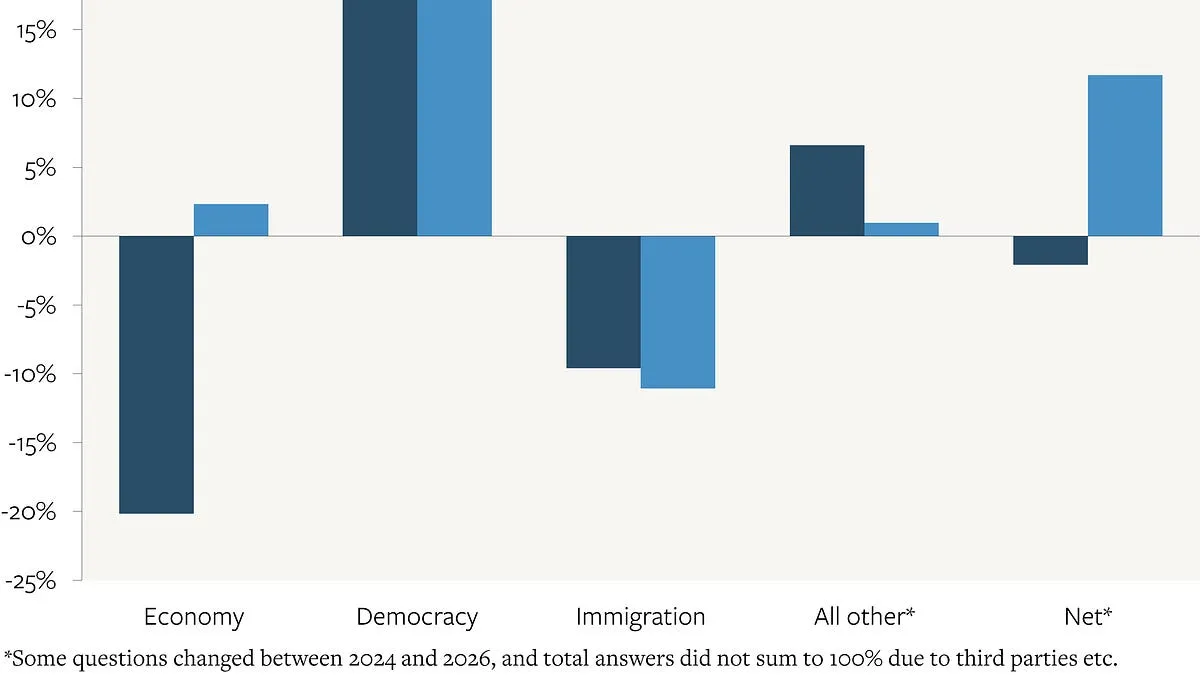
Klein breaks down the vote by voters' top issue. In 2024, Republicans won about 81% of economy-first voters, roughly a quarter of respondents, which was worth about 20 points of margin. In 2026, Democrats won 52% of a larger economy-first group, which he says produced a 23-point improvement. In 2026, 39% named the economy as their top issue, and nearly eight in ten said inflation caused their families hardship. [1] [6] [7]
The Fed is already split toward tightening. In September it raised rates 12–0 to 3.75%–4.00%, its first hike in three years and Kevin Warsh's first rate move as chair. In October it held 10–2, with Governor Lisa Cook and Cleveland Fed President Beth Hammack dissenting in favor of another quarter-point hike. [2] [3] [5]
The case for hiking faces strong objections. September headline CPI was 3.7% against 2.6% core, and gasoline accounted for over half of the monthly increase, which points to an energy supply shock. Other exit-poll analyses stress rejection of tariffs, the Iran action and corruption rather than a general dislike of rising prices. [4] [7] [9]
rates sit at 3.75%–4.00%, a hawkish minority wants more, and voters again reported inflation hardship. Implication, which is Klein's inference: the political cost of inflation may outweigh White House pressure for cuts.
Read the full assessment
But inflation driven by energy weakens the case for tightening.
Sources are verified; writing the dossier now.
Executive brief
Two Federal Reserve policymakers have already voted to raise rates again, and Matthew Klein argues the 2026 midterms back them up. The Fed lifted its target range to 3.75%–4.00% in September. At the October meeting, Governor Lisa Cook and Cleveland Fed President Beth Hammack dissented in favor of another quarter-point hike (FOMC diff). Klein's piece is commentary, not data. He points out that the 2026 exit polls on the economy look almost identical to the 2024 ones, even though employment and household balance sheets are strong. From that he concludes that voters dislike rising prices far more than they value other economic gains (The Overshoot).
What changed and event timeline
Fed hikes for the first time in three years
The vote was 12–0 for a quarter point, to 3.75%–4.00%. It was Kevin Warsh's first rate move as chair, and officials signaled one more hike this year ().
Energy pushes CPI higher
September CPI rose 0.6% on the month and 3.7% on the year. Core CPI was up 2.6% year over year. Gasoline jumped 9.1% in the month (34.2% over the year), accounting for over half of the monthly increase ().
Fed holds, with two hawkish dissents
The vote was 10–2 to keep 3.75%–4.00%. Cook and Hammack wanted a quarter-point hike. The statement moved from describing policy action to relying on "accumulation of more information" (;).
Midterms punish incumbents
In exit polls, 39% named the economy as their top issue, and just under 8 in 10 said inflation was causing their families hardship (;).
Klein's argument
He compares the 2024 and 2026 exit polls and concludes that voters' aversion to rising prices, not weak economic fundamentals, explains back-to-back swings against incumbents. He frames this as a message for the Fed ().
Capabilities and access
There is no product or model here. The source is a paywalled Substack column, and only the free preamble is public. Its policy recommendations are behind the paywall, so the headline "Hike" is the only stated conclusion (The Overshoot). The underlying data is public: national exit polls (NBC, CBS), AP VoteCast (PBS), BLS CPI and FOMC statements.
Technical analysis for researchers and developers
- Method: Klein breaks down the 2024-to-2026 swing by voters' top-issue group.
- Caveats: Klein himself notes that some exit-poll questions changed between cycles, which rules out a clean comparison.
- Reproducibility: The arithmetic can be checked against published exit-poll crosstabs. The causal step, from survey answers to "voters hate nominal price increases," is interpretation.
Read the full section
- Method: Klein breaks down the 2024-to-2026 swing by voters' top-issue group. In 2024, Republicans won 81% of voters who put the economy first (about 26% of respondents), worth roughly 20 points of overall margin. In 2026, Democrats won 52% of a larger economy-first group, which he says accounts for a 23-point margin improvement (The Overshoot).
- Caveats: Klein himself notes that some exit-poll questions changed between cycles, which rules out a clean comparison. Exit polls are weighted survey estimates, not counts of actual votes.
- Reproducibility: The arithmetic can be checked against published exit-poll crosstabs. The causal step, from survey answers to "voters hate nominal price increases," is interpretation.
Claims and evidence
- 75% rated the economy poorly and 39% called it their top issue. Klein gives "state of democracy" as 33%, while NBC reports 32% (NBC).
- About two-thirds blamed Trump's policies. AP VoteCast found about two-thirds said Trump's policies had made the economy worse (PBS).
- Klein's claims that employment, real spending and household wealth are strong are his own characterizations. No independent check of them is cited here.
Read the full section
- 75% rated the economy poorly and 39% called it their top issue. The numbers match NBC's poll. Klein gives "state of democracy" as 33%, while NBC reports 32% (NBC).
- About two-thirds blamed Trump's policies. NBC puts the share blaming Trump for high prices at 62% and the share calling the Iran military action wrong at 63% (NBC). AP VoteCast found about two-thirds said Trump's policies had made the economy worse (PBS).
- Klein's claims that employment, real spending and household wealth are strong are his own characterizations. No independent check of them is cited here.
- The "hike" conclusion is commentary. No independent analysis of the same thesis was found in the reviewed sources.
Context and prior work
Klein's numbers show that the economy-first swing was about the same size in 2024 (against Democrats) and 2026 (against Republicans). The Fed's September hike was its first since 2023 and came under a chair Trump appointed, who then publicly demanded rates of "1%, or less" (Al Jazeera).
Read the full section
Klein's numbers show that the economy-first swing was about the same size in 2024 (against Democrats) and 2026 (against Republicans). His point is that 2024 had no tariffs or shipping disruptions, so the 2026 drivers were not unique (The Overshoot). CBS describes 2026 as the second straight election in which most voters called inflation a hardship (CBS). The Fed's September hike was its first since 2023 and came under a chair Trump appointed, who then publicly demanded rates of "1%, or less" (Al Jazeera).
Limitations, safety and contested findings
- Supply shock vs. demand: Much of the recent inflation comes from energy. That weakens the case that tighter monetary policy is the right response.
- The FOMC itself is split: Ten members preferred to hold in October (FOMC diff).
- Different reading of the vote: Other exit-poll coverage stresses specific policy rejections (tariffs, Iran, immigration enforcement) rather than a general aversion to prices (CBS).
Read the full section
- Supply shock vs. demand: Much of the recent inflation comes from energy. Core CPI is 2.6% against 3.7% headline (BLS), and coverage ties it to the Iran war and tariffs (Al Jazeera). That weakens the case that tighter monetary policy is the right response.
- The FOMC itself is split: Ten members preferred to hold in October (FOMC diff).
- Different reading of the vote: Other exit-poll coverage stresses specific policy rejections (tariffs, Iran, immigration enforcement) rather than a general aversion to prices (CBS). AP found government corruption ranked slightly above cost of living as a voting factor (PBS).
Business and practitioner implications
- Rates: The policy range is 3.75%–4.00%.
- Pricing and planning: Gasoline, groceries, utilities and healthcare top voters' cost concerns, each cited by more than 85% (NBC).
- Political pressure: Open White House opposition to rate hikes (Al Jazeera), set against an electorate punishing inflation, leaves the Fed's path uncertain.
Read the full section
- Rates: The policy range is 3.75%–4.00%. The September projections pointed to one more hike in 2026 (Al Jazeera), and two October dissents show a hawkish minority (FOMC diff).
- Pricing and planning: Gasoline, groceries, utilities and healthcare top voters' cost concerns, each cited by more than 85% (NBC). Companies passing through energy costs face consumers who are highly sensitive to prices.
- Political pressure: Open White House opposition to rate hikes (Al Jazeera), set against an electorate punishing inflation, leaves the Fed's path uncertain.
The source trail.
Sources (9)
The Midterms’ Message for the Fed: Hike
Article text retrieved; extracted text may omit tables or interactive elements.
theovershoot.co