
FundingRounds, leads & terms
SpaceX's AI segment brings in more than half of Q3 revenue as 137 Ventures' Christian Garrett pitches 'return of the conglomerate' and Onodrim raises $300M
SpaceX's AI segment, built from its merger with xAI, brought in $7.6B of $14.6B in Q3 revenue. Christian Garrett, a partner at 137 Ventures, uses that shift to argue for dual-use conglomerates. It also frames Onodrim, the European defence-supplier acquirer he co-founded, which just raised $300M.
From the Sourcery video of November 13, 2026 and cited sources: SpaceX's Q3 2026 revenue rose 161% to $14.6B, with net income of $4.4B and adjusted EBITDA of $8.8B. [2] [4] [1]
SOURCES[2] Motley Fool – SpaceX Q3 2026 call transcript fool.com[4] Backpack – SpaceX and xAI merger explained learn.backpack.exchange[1] SpaceX, Palantir, Anduril & Onodrim | The Return of… youtube.com
 AT Pulse research deskPublished · Updated · 5 min read · AI-assisted analysis
AI-assisted, not human-edited. Methodology Corrections Who owns this site
- What happened
- SpaceX's Q3 2026 revenue rose 161% to $14.6B, with net income of $4.4B and adjusted EBITDA of $8.8B. [2] [4] [1]
- Original source
- Sourcery video, independent perspective
- Brief by
- AT Pulse research desk AI-assisted; publisher and contact on the desk page
- When
- November 13, 2026 video published
- Covered
- Nov 14 edition
- Evidence
- 9 sources across 9 sites; transcript sourced
- 1SpaceX, Palantir, Anduril & Onodrim | The Return of…youtube.com
- 2Motley Fool – SpaceX Q3 2026 call transcriptfool.com
- 3TNW – Onodrim raises $300Mthenextweb.com
- 4Backpack – SpaceX and xAI merger explainedlearn.backpack.exchange
- 5KQED – SpaceX $75B IPOkqed.org
- 6FourWeekMBA – Anduril tender at ~$90Bfourweekmba.com
RisingHow it’s measured
YouTube video · 21.1K views · 209 likes
Reach blends public engagement (views, likes, comments, shares, stars) from the platforms where the story or its original source lives: YouTube, Hacker News, GitHub, Substack and similar. A video and the article written from its transcript share one score, taken from the video. Platforms with no data are left out rather than counted as zero, and the age of a story never lowers its score.
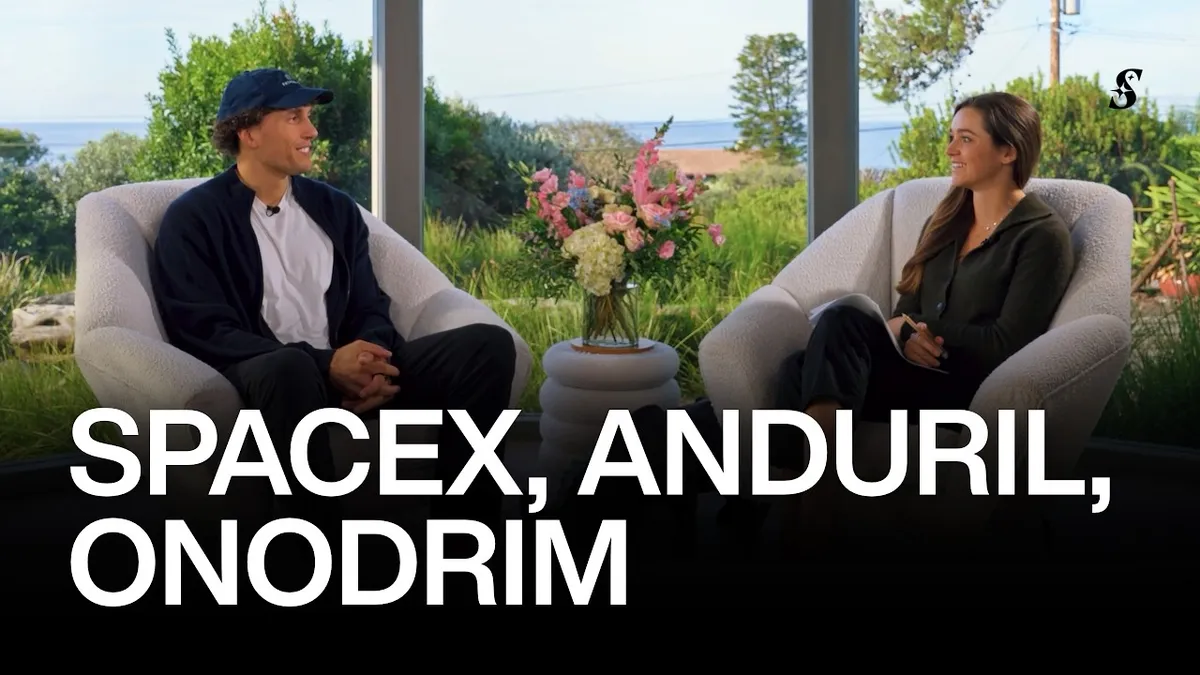
SpaceX's Q3 2026 revenue rose 161% to $14.6B, with net income of $4.4B and adjusted EBITDA of $8.8B. Its Super Intelligence segment, which grew out of the February xAI merger, now outearns launch and Starlink. Capex was $19.6B, and the company guided $35–40B for Q4. Management says compute pays back in under a year. That figure is management's own, and the company has not published a per-customer or cohort breakdown. [2] [4] [1]
Garrett argues that the companies best placed in AI earn money at the app, model and compute layers at once. More broadly, he argues for dual-use conglomerates that share one technology platform, unlike the 1980s conglomerates built from unrelated businesses. In his view, commercial scale can pay for defence capacity that industrial policy alone cannot sustain. He names Palantir and SpaceX as the only current examples. SpaceX is his firm's largest holding. [1] [3]
Onodrim, which Garrett co-founded with two former Palantir staff, raised a $300M Series A at a $1.3B valuation. Lux Capital led the round, and 137 Ventures took part. Onodrim plans to buy European aerospace, defence and industrial suppliers, a layer Garrett calls underfunded compared with Europe's roughly 4,000 drone companies. It has announced no acquisitions so far and says it is in talks with ten companies. [3] [9] [1]
Recent prices for other companies in Garrett's thesis are a mix of deal types. SpaceX's June IPO raised about $75B at roughly a $1.75T valuation. Anduril's reported valuation of about $90B comes from an employee tender of about $1.3B, a secondary sale rather than new money, up from its $61B Series H in May. [5] [6]
The SpaceX figures come from its earnings call, and the Onodrim round from its announcement and trade press. The broader implication, that commercial scale can sustain defence capacity, is Garrett's argument about companies his firm holds.
Read the full assessment
It has not been shown in practice.
Status: research is done (SpaceX's Q3 call, Onodrim's round, Anduril's tender and SpaceX's IPO). Writing the dossier now.
Executive brief
SpaceX now books more revenue from AI than from rockets or Starlink. In its Q3 2026 results, the "Super Intelligence" (SI) segment, built on the xAI merger, brought in $7.6B of $14.6B total revenue (Motley Fool transcript). Christian Garrett, a partner at 137 Ventures, says this makes SpaceX a "dual-use conglomerate." SpaceX is 137's largest holding. He uses that idea to pitch Onodrim, a European defence-supplier buyout company he co-founded. Onodrim raised a $300M Series A at a $1.3B valuation four days before the episode aired (TNW). The episode is commentary from an investor talking about his own portfolio.
What changed and event timeline
SpaceX absorbs xAI
An all-stock deal valued SpaceX at $1T and xAI at $250B, for $1.25T combined. This created the AI segment that now leads revenue ().
Record IPO
SpaceX sold 555,555,555 shares at $135 on Nasdaq (SPCX). That raised about $75B at a valuation of about $1.75T. Musk keeps more than 80% of voting control ().
Anduril tender at ~$90B
Bloomberg reported an employee share sale of about $1.3B at $94.80 per share. Its $61B Series H in May was led by Thrive and a16z. The tender is a secondary sale, not new money ().
SpaceX Q3
Revenue was $14.6B, up 161%. Net income was $4.4B and adjusted EBITDA $8.8B. Capex was $19.6B, with $35–40B guided for Q4 ().
Onodrim Series A
The company announced $300M at $1.3B, led by Lux Capital. General Catalyst, Lakestar, Altimeter and 137 Ventures also took part. It plans to buy European aerospace, defence and industrial suppliers ().
Sourcery episode
Garrett sets out his "return of the conglomerate" thesis using SpaceX, Palantir, Anduril and Onodrim (;).
Capabilities and access
- SpaceX compute (SI segment): 1.7 GW of nameplate capacity at the end of Q3, with a target of 2.5–3 GW by year-end.
- The reviewed sources name no specific model versions. The Cursor link was not confirmed in the reviewed sources.
- Starlink: 13.6M consumer subscribers. Starship Flight 14 deployed V3 satellites that management says deliver 26 Tbps (transcript).
Read the full section
- SpaceX compute (SI segment): 1.7 GW of nameplate capacity at the end of Q3, with a target of 2.5–3 GW by year-end. Management cited a deployment rate of about 20,000 GB300 units a month (transcript).
- The reviewed sources name no specific model versions. Garrett points to Grok and Cursor as products being monetized (1:45). The Cursor link was not confirmed in the reviewed sources.
- Starlink: 13.6M consumer subscribers. Starship Flight 14 deployed V3 satellites that management says deliver 26 Tbps (transcript).
Technical analysis for researchers and developers
- Vertical integration: Garrett argues the safest bet in AI is a company that earns money at the app, model and compute layers at once (2:58).
- Unit economics: management says compute capex pays back in under a year at current prices (transcript).
- Lab independence: he says app- and harness-layer companies that can switch between models (Cognition, Hex) are easier to underwrite because many customers don't want to depend on a single AI lab (16:56).
Read the full section
- Vertical integration: Garrett argues the safest bet in AI is a company that earns money at the app, model and compute layers at once (2:58). He describes SpaceX as becoming a hyperscaler, meaning it adds software and services on top of its own compute.
- Unit economics: management says compute capex pays back in under a year at current prices (transcript). Garrett reads that as a sign of strong demand (2:45). The company has not published a cohort-level or per-customer breakdown.
- Lab independence: he says app- and harness-layer companies that can switch between models (Cognition, Hex) are easier to underwrite because many customers don't want to depend on a single AI lab (16:56).
Claims and evidence
- SpaceX Q3 figures: Garrett's numbers (about 160% growth, $4.4B net income, $8.8B EBITDA) match the earnings call (transcript; Yahoo/Simply Wall St).
- "Over 50% of revenue is AI": this is the host's framing (5:13). It fits the reported segment split of $7.6B out of $14.6B.
- Onodrim's $300M at $1.3B: company-announced and repeated in trade press (TNW; Vestbee). It does not appear in any filing.
Read the full section
- SpaceX Q3 figures: Garrett's numbers (about 160% growth, $4.4B net income, $8.8B EBITDA) match the earnings call (transcript; Yahoo/Simply Wall St).
- "Over 50% of revenue is AI": this is the host's framing (5:13). It fits the reported segment split of $7.6B out of $14.6B.
- Onodrim's $300M at $1.3B: company-announced and repeated in trade press (TNW; Vestbee). It does not appear in any filing.
- Anduril at ~$90B: reported by Bloomberg as a tender price, not a priced primary round (FourWeekMBA).
- Cognition at $48B: stated by the host (23:44). No independent confirmation was found.
- Garrett's other claims: that a handful of V3 satellites added about 1% of world capacity (6:50), and that 68% of Chinese defence primes' revenue is commercial (31:24). Neither was corroborated.
- Garrett's interests: he is a partner at 137 Ventures, which holds SpaceX as its largest position and also invests in Anduril, Cognition and Onodrim. He co-founded Onodrim (TNW).
Context and prior work
Garrett sets his thesis against the 1980s conglomerate collapse. Onodrim's founders include two former Palantir staff, CEO Aistis Šimaitis and CTO Alexander Blessing. The company raised a €40M seed round in February 2026 (TNW).
Read the full section
Garrett sets his thesis against the 1980s conglomerate collapse. His argument is that old conglomerates were collections of unrelated businesses, while new ones share a single technology and operating platform (28:43). He names Palantir and SpaceX as the only current dual-use examples (31:14). Onodrim's founders include two former Palantir staff, CEO Aistis Šimaitis and CTO Alexander Blessing. The company raised a €40M seed round in February 2026 (TNW).
Limitations, safety and contested findings
- SpaceX capex: spending is very high and the company plans about $40B in new financing.
- Uncertain outlook: Garrett himself concedes that compute pricing, the open- vs closed-model mix and the cost of capital make it hard to forecast earnings even two years out (15:32).
- Onodrim: it had not announced any acquisitions as of the episode. It says it is in talks with ten companies (TNW).
Read the full section
- SpaceX capex: spending is very high and the company plans about $40B in new financing. Bearish analysts argue SpaceX is "sprinting ahead of proven demand" (Yahoo/Simply Wall St).
- Uncertain outlook: Garrett himself concedes that compute pricing, the open- vs closed-model mix and the cost of capital make it hard to forecast earnings even two years out (15:32).
- Onodrim: it had not announced any acquisitions as of the episode. It says it is in talks with ten companies (TNW).
Business and practitioner implications
- AI infrastructure buyers: SpaceX is now a GW-scale compute supplier that also owns its own models.
- Defence-tech investors: Garrett argues Europe is overcrowded with about 4,000 drone companies, while component, structures and engine suppliers are underfunded (36:52).
- Operators: the thesis rewards companies with several product lines and commercial revenue, which can carry defence capacity when government demand drops.
Read the full section
- AI infrastructure buyers: SpaceX is now a GW-scale compute supplier that also owns its own models. That adds supply, and it also adds a competitor that sits on both sides of the market.
- Defence-tech investors: Garrett argues Europe is overcrowded with about 4,000 drone companies, while component, structures and engine suppliers are underfunded (36:52).
- Operators: the thesis rewards companies with several product lines and commercial revenue, which can carry defence capacity when government demand drops. That is still an investor's claim, not a demonstrated result.
The source trail.
Sources (9)
SpaceX, Palantir, Anduril & Onodrim | The Return of Conglomerates
Transcript retrieved via youtube_auto_captions; language en. Timestamped text, not direct audiovisual review. Source: https://www.youtube.com/watch?v=4J7tjyVCrqA. Automatic captions/transcription may contain errors.
www.youtube.com