
FundingRounds, leads & terms
Mercor raises $750M Series D at a $20B valuation and pitches evals to enterprises
Mercor's $750M Series D, which includes an employee tender, values the AI training-data company at $20B. That is double the price it set in October 2025. Brendan Foody says Mercor sells reinforcement-learning environments and is now bringing evals and post-training to enterprises.
From the Sourcery video of November 10, 2026 and cited sources: Mercor announced the round on 2026-11-10: $750M at a $20B valuation. [2] [7] [3]
SOURCES[2] Mercor: Organizing human intelligence for the entire… mercor.com[7] SiliconANGLE: Mercor raises $750M at $20B valuation siliconangle.com[3] TechCrunch: Mercor quintuples valuation to $10B techcrunch.com
 AT Pulse research deskPublished · Updated · 5 min read · AI-assisted analysis
AI-assisted, not human-edited. Methodology Corrections Who owns this site
- Original source
- Sourcery video, independent perspective
- Brief by
- AT Pulse research desk AI-assisted; publisher and contact on the desk page
- When
- November 10, 2026 video published
- Covered
- Nov 12 edition
- Evidence
- 10 sources across 8 sites; transcript sourced
- 1Mercor Raises $750M at $20B Valuation | CEO Brendan Foodyyoutube.com
- 2Mercor: Organizing human intelligence for the entire…mercor.com
- 3TechCrunch: Mercor quintuples valuation to $10Btechcrunch.com
- 4TechCrunch: After data breach, Mercor is having a monthtechcrunch.com
- 5Hausfeld: Mercor Data Breachhausfeld.com
- 6Staffing Industry Analysts: Mercor to acquire Deeptunestaffingindustry.com
RisingHow it’s measured
YouTube video · 27.5K views · 115 likes
Reach blends public engagement (views, likes, comments, shares, stars) from the platforms where the story or its original source lives: YouTube, Hacker News, GitHub, Substack and similar. A video and the article written from its transcript share one score, taken from the video. Platforms with no data are left out rather than counted as zero, and the age of a story never lowers its score.
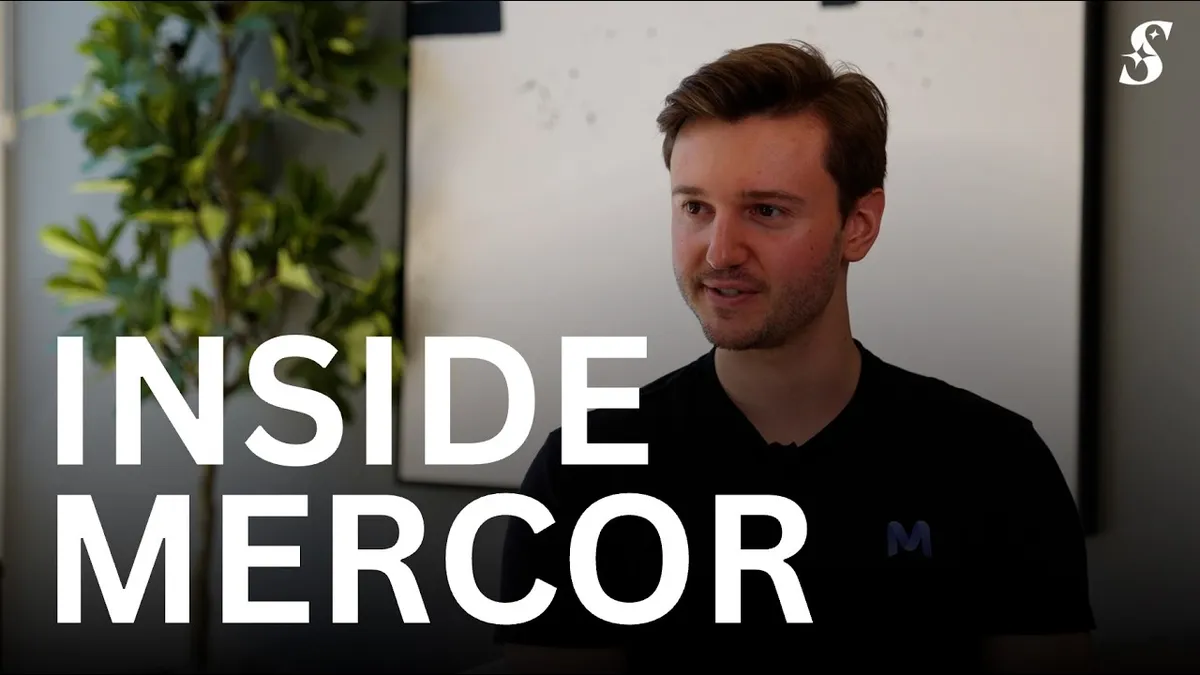
Mercor announced the round on 2026-11-10: $750M at a $20B valuation. Its $350M Series C, led by Felicis in October 2025, set a $10B valuation. Nvidia, Salesforce, Benchmark, Felicis and General Catalyst took part in the new round. No lead investor was named, and part of the round is an employee tender. [2] [7] [3]
Foody says Mercor's product is reinforcement-learning (RL) environments, not a labour marketplace. Each environment has three parts: cloned business apps, the content inside those apps, and tasks graded against rubrics written by experts. Mercor bought Deeptune in July 2026 to get app clones, which Foody calls its main bottleneck. Mercor's public APEX-Agents benchmark uses this approach on 480 tasks that span several apps. The best model scored 24.0% Pass@1. [1] [6] [8]
Foody's case for enterprise demand rests on two claims. First, most frontier training compute now goes to RL scored against rubrics. Second, firms such as Goldman Sachs will not let AI labs train on their data, so they will need their own models. He offers a rule of thumb, which is his opinion rather than measured data. Companies spending $10M–$100M a year on inference should put about 10% of it into evals. Above $100M, post-training their own models starts to pay off. [1] [2]
The round comes after a March 2026 supply-chain attack, carried out through a malicious LiteLLM update. It exposed contractors' passport scans, Social Security numbers and video interviews. Contractors filed lawsuits that are still ongoing, and Meta reportedly paused its work with Mercor. The Series D announcement does not mention the breach. [4] [5] [2]
Mercor's valuation doubled in about a year despite a breach of contractor data and pending lawsuits. Implication: if enterprises follow AI labs into RL training scored against rubrics, as Foody argues, expert-built evals become a recurring cost.
Read the full assessment
Buyers would then also need to check vendors' data security.
Mercor's Series D was announced on 2026-11-10 and the sources are checked. The dossier is below.
Executive brief
Mercor doubled its valuation to $20B in about a year, according to its Series D announcement. That came seven months after a supply-chain breach exposed contractor data and was followed by lawsuits. The $750M round includes an employee tender, and no lead investor is named. Independent outlets repeat the company's figures, but none adds a filing. On the Sourcery podcast, co-CEO Brendan Foody says Mercor's business is selling reinforcement-learning (RL) environments, not a labour marketplace. He adds that enterprises, not just frontier labs, will become the next buyers of evals and post-training.
What changed and event timeline
Series C at $10B
Mercor raised $350M led by Felicis. The company reported a $500M+ run rate and $1.5M+ in daily contractor payouts at the time ().
To 03-31: LiteLLM supply-chain breach
Attackers used a malicious LiteLLM update to reach Mercor's systems, and hackers claimed 4TB of data. Five contractor lawsuits followed, and Meta reportedly paused its work with Mercor (;).
Deeptune acquisition
Mercor bought Deeptune, a startup backed by a16z that builds simulated enterprise apps. Terms were not disclosed. Foody had been an angel investor in Deeptune's Series A ().
$750M Series D at $20B
The round includes an employee tender. Participants include Nvidia, Salesforce, Benchmark, Felicis and General Catalyst (;).
Capabilities and access
- Talent platform: more than 5M experts. Foody says 70% arrive through referrals and the company has run more than 7M AI interviews (00:02:45, 00:14:27).
- Studio: a tool where experts build environments, tasks and verifiers with help from an AI copilot and automated quality checks.
- AI project manager: agents that hire experts, set KPIs and score the quality of their data (00:03:31).
Read the full section
- Talent platform: more than 5M experts. Foody says 70% arrive through referrals and the company has run more than 7M AI interviews (00:02:45, 00:14:27).
- Studio: a tool where experts build environments, tasks and verifiers with help from an AI copilot and automated quality checks.
- AI project manager: agents that hire experts, set KPIs and score the quality of their data (00:03:31).
- Enterprise offering: custom evals covering more than 800 U.S. occupations, plus infrastructure for post-training open models (Mercor).
- No pricing or self-serve access is published.
Technical analysis for researchers and developers
- What an RL environment contains, in Foody's description (00:06:14):
- apps: clones of tools such as Google Workspace, Salesforce and Adobe
- worlds: the content inside those apps
Read the full section
- What an RL environment contains, in Foody's description (00:06:14):
- apps: clones of tools such as Google Workspace, Salesforce and Adobe
- worlds: the content inside those apps
- tasks: prompts plus grading rubrics
- Why it matters: Foody says most frontier training compute now goes to RL that is scored against rubrics written by subject-matter experts, rather than to supervised fine-tuning (SFT) (00:48:51).
- Public evidence of the method: APEX-Agents has 480 long-horizon, cross-application tasks, released with rubrics, gold outputs and the Archipelago harness. The top Pass@1 score was 24.0%, by Gemini 3 Flash.
- Earlier benchmark: APEX v1-extended open-sourced only 100 example cases and its harness, not the full test set.
Claims and evidence
- Valuation, round size and investors: these are company-announced. Outlets including SiliconANGLE repeat them, and no filing confirms them.
- Revenue: the claim of more than $2B annualized revenue by June comes from Foody's own X post (self-reported).
- Payouts (self-reported, and inconsistent within the episode):
Read the full section
- Valuation, round size and investors: these are company-announced. Outlets including SiliconANGLE repeat them, and no filing confirms them. The split between new capital and the employee tender is not disclosed.
- Revenue: the claim of more than $2B annualized revenue by June comes from Foody's own X post (self-reported).
- Payouts (self-reported, and inconsistent within the episode):
- "$4 million a day" at 00:02:55
- "call it $5 million a day" at 00:14:52
- about $1B paid out in total at 00:05:16
- Growth: Foody says revenue grew more than 5x since September 2025 (00:00:47). This is self-reported.
Context and prior work
- Valuation path: Mercor's valuation rose 5x at the Series C (TechCrunch) and doubled again at the Series D.
- Origin: Foody says the company started by selling AI interviewing to seed-stage startups, then moved to direct contracts with labs.
- Competitors: he points to Meta's deal with Scale AI as a structure Mercor would not copy (00:32:25).
Read the full section
- Valuation path: Mercor's valuation rose 5x at the Series C (TechCrunch) and doubled again at the Series D.
- Origin: Foody says the company started by selling AI interviewing to seed-stage startups, then moved to direct contracts with labs. One reason was that experts it supplied to another data vendor went unpaid (00:04:27).
- Competitors: he points to Meta's deal with Scale AI as a structure Mercor would not copy (00:32:25).
- Industry framing: Futurum presents environments as the next point of competition in AI training.
Limitations, safety and contested findings
- The breach: it exposed passport scans, Social Security numbers and video interviews of contractors, according to the Hausfeld claim summary and TechCrunch.
- What the funding coverage leaves out: the Series D announcement and SiliconANGLE do not mention the breach.
- Durability of the market: Foody accepts that demand for human data depends on how fast superintelligence arrives.
Read the full section
- The breach: it exposed passport scans, Social Security numbers and video interviews of contractors, according to the Hausfeld claim summary and TechCrunch. The litigation is ongoing.
- What the funding coverage leaves out: the Series D announcement and SiliconANGLE do not mention the breach. In the episode it comes up only briefly, as one of the setbacks Foody describes (00:21:00).
- Durability of the market: Foody accepts that demand for human data depends on how fast superintelligence arrives. He argues that Jevons paradox (cheaper expert work creating more demand) extends it (00:09:12).
Business and practitioner implications
- Spend thresholds for enterprises: Foody proposes a rough rule (00:46:35).
- below about $10M a year on inference, companies care little about evals
- between $10M and $100M, about 10% should go to evals
Read the full section
- Spend thresholds for enterprises: Foody proposes a rough rule (00:46:35). These are his opinions, not measured data:
- below about $10M a year on inference, companies care little about evals
- between $10M and $100M, about 10% should go to evals
- above $100M, post-training their own models starts to pay off
- Data sovereignty: Foody argues companies like Goldman Sachs won't let frontier labs train on their data, which pushes them toward their own models (00:45:51).
- Switching costs: he says Mercor switches model APIs daily based on its own evals (00:41:03).
- IPO: not within 12 months (00:50:07).
- For buyers: check a vendor's data security practices before handing over workflow data.
The source trail.
Sources (10)
Mercor Raises $750M at $20B Valuation | CEO Brendan Foody
Transcript retrieved via youtube_auto_captions; language en. Timestamped text, not direct audiovisual review. Source: https://www.youtube.com/watch?v=xzA6lYBzmzQ. Automatic captions/transcription may contain errors.
www.youtube.com