
RoboticsMachines in the physical world
Google DeepMind's Gemini Robotics 2.5 hits 96% parts-sorting success in Mercedes-Benz factory pilots
Google DeepMind's Gemini Robotics 2.5 is a vision-language-action model. It sorted metal parts with 96% success in Mercedes-Benz factory pilots on Apptronik's Apollo 2 humanoid. It is rolling out only to industrial partners, with dexterity gains reported across more than 200 tasks.
From the Google DeepMind article of November 9, 2026 and cited sources: In pilots at Mercedes-Benz plants in Kecskemét and Sindelfingen, the model gathered and sorted parts for assembly with 96% success. [2] [3]
SOURCES[2] The Decoder: Gemini Robotics 2.5 scores 96 percent in… the-decoder.com[3] Interesting Engineering: Gemini Robotics 2.5 factory trial interestingengineering.com
 AT Pulse research deskPublished · Updated · 5 min read · AI-assisted analysis
AI-assisted, not human-edited. Methodology Corrections Who owns this site
- What happened
- In pilots at Mercedes-Benz plants in Kecskemét and Sindelfingen, the model gathered and sorted parts for assembly with 96% success. [2] [3]
- Original source
- Google DeepMind article, company source
- Brief by
- AT Pulse research desk AI-assisted; publisher and contact on the desk page
- Studies
- arXiv 2510.03342 (Oct 2025) [5] date from arXiv ID
- When
- November 9, 2026 article published
- Covered
- Nov 12 edition
- Evidence
- 9 sources across 9 sites
- 1Gemini Robotics 2.5: Accelerating Physical Intelligence…deepmind.google
- 2The Decoder: Gemini Robotics 2.5 scores 96 percent in…the-decoder.com
- 3Interesting Engineering: Gemini Robotics 2.5 factory trialinterestingengineering.com
- 4Wikipedia: Gemini Roboticsen.wikipedia.org
- 5arXiv 2510.03342: Gemini Robotics 1.5arxiv.org
- 6Dealroom: Gemini Robotics 2 with whole-body controldealroom.co
RisingHow it’s measured
Hacker News · 7 likes · 1 comment
Reach blends public engagement (views, likes, comments, shares, stars) from the platforms where the story or its original source lives: YouTube, Hacker News, GitHub, Substack and similar. A video and the article written from its transcript share one score, taken from the video. Platforms with no data are left out rather than counted as zero, and the age of a story never lowers its score.
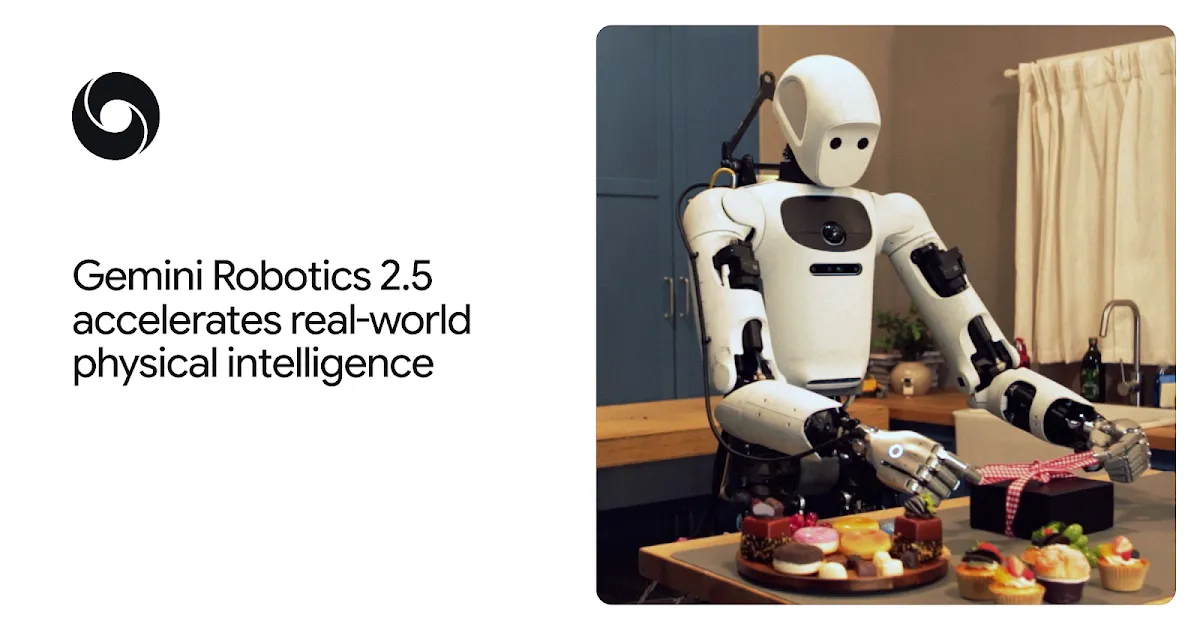
In pilots at Mercedes-Benz plants in Kecskemét and Sindelfingen, the model gathered and sorted parts for assembly with 96% success. Gemini Robotics ER oversaw the workflow while 2.5 handled motor control. Coverage treats this as a proof of concept, not a commercial rollout at scale. [2] [3]
DeepMind reports success rates 30–100% higher than Gemini Robotics 2, depending on the task, and task completion 20–30% faster. Demonstrated tasks include serving food with tongs, tying bows and pipetting. The model runs on both the Apollo 2 humanoid and Franka Duo two-finger grippers, so it does not depend on a humanoid hand. [1] [2] [7]
The evidence: a factory pilot and lab task results suggest one model can handle precise manipulation on different robot bodies.
Read the full assessment
The implication: humanoid parts kitting may become practical for manufacturers, but reliability and cost at production scale have not been shown.
Executive brief
Google DeepMind says its Gemini Robotics 2.5 model sorted metal parts at a 96% success rate in pilots on live Mercedes-Benz production lines in Hungary and Germany. The model ran on Apptronik's Apollo 2 humanoid (The Decoder). Gemini Robotics 2.5 is a vision-language-action (VLA) model: it turns camera input and instructions into robot movements. DeepMind reports gains in dexterity, reliability and safety across more than 200 tasks, and the model is going to industrial partners only (DeepMind). Independent coverage describes the factory result as a proof of concept, not evidence of commercial deployment at scale (Interesting Engineering).
What changed and event timeline
First Gemini Robotics models
DeepMind released a VLA model built on Gemini 2.0, plus an embodied-reasoning model called Gemini Robotics-ER. Access was limited to trusted testers such as Boston Dynamics, Agility Robotics and Agile Robots ().
Gemini Robotics 1.5 technical report
The arXiv paper introduced Motion Transfer, which lets one model learn from several robot types, and "embodied thinking," where the model reasons in text between actions ().
Gemini Robotics 2
A single learned policy now controlled a humanoid's whole body, from feet to fingertips. The release also included ER 2, On-Device 2 and the ASIMOV-Agentic safety benchmark (;).
- Late Sep 2026
Gemini 4 Argon
DeepMind released its frontier model Gemini 4 Argon. SiliconANGLE describes it as the foundation of Gemini Robotics 2.5 ().
Gemini Robotics 2.5 announced
The release covers more than 200 tasks, Mercedes-Benz pilots in Kecskemét and Sindelfingen, and the open-source ASIMOV-Jailbreak benchmark. The blog's feed timestamp is November 9, 19:51 UTC (;).
Capabilities and access
- Model: Gemini Robotics 2.5, a VLA model. Demonstrated tasks include serving food with tongs, tying bows and pipetting liquids (DeepMind).
- Robots: Apptronik Apollo 2, a humanoid with 22 degrees of freedom, and Franka Duo, which uses two-finger parallel grippers.
- Access: The model is rolling out through partners including Apptronik, Agile Robots and Boston Dynamics.
Read the full section
- Model: Gemini Robotics 2.5, a VLA model. Demonstrated tasks include serving food with tongs, tying bows and pipetting liquids (DeepMind).
- Robots: Apptronik Apollo 2, a humanoid with 22 degrees of freedom, and Franka Duo, which uses two-finger parallel grippers. The model does not need a humanoid hand (The Decoder; SiliconANGLE).
- Access: The model is rolling out through partners including Apptronik, Agile Robots and Boston Dynamics. None of the reviewed sources mention public API access to 2.5. By comparison, ER 2 is available through the Gemini API (SiliconANGLE; Wikipedia).
Technical analysis for researchers and developers
- Two models working together: In the factory pilot, Gemini Robotics ER monitored the workflow while 2.5 handled motor control (The Decoder).
- Training data: Gemini 4 Argon served as a simulation engine to generate training data (The Decoder). The reviewed sources do not describe the sim-to-real method.
- Safety at run time: The model uses reasoning at inference time to steer around physical hazards (Dataconomy).
Read the full section
- Two models working together: In the factory pilot, Gemini Robotics ER monitored the workflow while 2.5 handled motor control (The Decoder). This follows the planner/controller split from 1.5 (arXiv).
- Training data: Gemini 4 Argon served as a simulation engine to generate training data (The Decoder). The reviewed sources do not describe the sim-to-real method.
- Safety at run time: The model uses reasoning at inference time to steer around physical hazards (Dataconomy).
- Reproducibility: No technical report for 2.5 appears in the reviewed sources. The task suite, number of trials and baseline setups are not documented. ASIMOV-Jailbreak is the only released artifact, published on Hugging Face.
Claims and evidence
All performance figures below come from DeepMind. No independent replication exists.
Read the full section
All performance figures below come from DeepMind. No independent replication exists.
- 30–100% higher success rates than Gemini Robotics 2, depending on the task, and 20–30% faster task completion (DeepMind).
- 96% success on parts kitting (gathering and sorting parts for assembly) at Mercedes-Benz plants (The Decoder).
- 33% more tasks completed safely around obstacles and 43% more around people (Interesting Engineering).
- 99.5% jailbreak resistance. Secondary reports attribute this score to Gemini 4 Argon, against 82% for ER 2, not to the 2.5 model itself (The Decoder).
- Apptronik CEO Jeff Cardenas, a partner, said post-training brought large gains within a few weeks, with little performance drop-off on the production line (SiliconANGLE).
Context and prior work
- 1.5 introduced Motion Transfer across ALOHA, bi-arm Franka and Apollo robots, and interleaved reasoning with actions (arXiv).
- 2 extended the family to whole-body humanoid control and multi-robot collaboration (Robotics 24/7).
- 2.5 is a step up within the 2.x generation: it keeps that architecture and focuses on dexterity, reliability and moving into factory pilots.
Read the full section
- 1.5 introduced Motion Transfer across ALOHA, bi-arm Franka and Apollo robots, and interleaved reasoning with actions (arXiv).
- 2 extended the family to whole-body humanoid control and multi-robot collaboration (Robotics 24/7).
- 2.5 is a step up within the 2.x generation: it keeps that architecture and focuses on dexterity, reliability and moving into factory pilots.
Limitations, safety and contested findings
- The 96% factory figure comes from a pilot, not a commercial deployment (Interesting Engineering).
- The reported improvements cover a wide 30–100% range, and baselines differ by task.
- Sources disagree on which model the 99.5% jailbreak figure applies to: DeepMind's framing is ambiguous, while secondary outlets credit Gemini 4 Argon.
Read the full section
- The 96% factory figure comes from a pilot, not a commercial deployment (Interesting Engineering).
- The reported improvements cover a wide 30–100% range, and baselines differ by task. Without a published task breakdown, the size of the gains cannot be compared.
- Sources disagree on which model the 99.5% jailbreak figure applies to: DeepMind's framing is ambiguous, while secondary outlets credit Gemini 4 Argon.
- No independent evaluation of 2.5 was found.
Business and practitioner implications
- Manufacturers: Partner pilots in Mercedes-Benz plants suggest humanoids can do parts kitting. Reliability at production scale and a cost case are still unpublished.
- Robot makers: Support for both humanoids and gripper arms lowers the dependence on any one hardware design. Apptronik reports adaptation within weeks of post-training.
- Developers: Without partner access, ER 2 through the Gemini API and the open ASIMOV-Jailbreak benchmark are the only usable pieces.
Read the full section
- Manufacturers: Partner pilots in Mercedes-Benz plants suggest humanoids can do parts kitting. Reliability at production scale and a cost case are still unpublished.
- Robot makers: Support for both humanoids and gripper arms lowers the dependence on any one hardware design. Apptronik reports adaptation within weeks of post-training.
- Developers: Without partner access, ER 2 through the Gemini API and the open ASIMOV-Jailbreak benchmark are the only usable pieces. Treat the 2.5 numbers as vendor guidance until a technical report or third-party evaluation is published.