
ResearchPapers, evidence & method
Kapoor, Bommasani and Narayanan launch STABL, a non-profit studying AI bottlenecks and recursive self-improvement
Kapoor, Bommasani and Narayanan have launched STABL, a non-profit that studies how institutional bottlenecks shape AI's impact. A related evaluation effort, CRUX, found that frontier agents could run experiments but wrote research papers their original authors rated at rejection level.
From the AI as Normal Technology article of November 10, 2026 and cited sources: STABL (Societal Transformation and AI Bottlenecks Lab) has four workstreams and an advisory board, and it is raising money and hiring. [1] [6] [3]
SOURCES[1] The missing quadrant in responses to AI (Normal Tech) normaltech.ai[6] Arvind Narayanan on X x.com[3] AI as Normal Technology (Knight First Amendment Institute) knightcolumbia.org
 AT Pulse research deskPublished · Updated · 5 min read · AI-assisted analysis
AI-assisted, not human-edited. Methodology Corrections Who owns this site
- What happened
- STABL (Societal Transformation and AI Bottlenecks Lab) has four workstreams and an advisory board, and it is raising money and hiring. [1] [6] [3]
- Original source
- AI as Normal Technology article, independent perspective
- Brief by
- AT Pulse research desk AI-assisted; publisher and contact on the desk page
- When
- November 10, 2026 article published
- Covered
- Nov 11 edition
- Evidence
- 8 sources across 7 sites
- 1The missing quadrant in responses to AI (Normal Tech)normaltech.ai
- 2Can AI agents conduct open-ended AI research? (alphaXiv)alphaxiv.org
- 3AI as Normal Technology (Knight First Amendment Institute)knightcolumbia.org
- 4Lab vs. Life: Dissecting "AI as Normal Technology"…secondthoughts.ai
- 5Open-world evaluations for measuring frontier AI…normaltech.ai
- 6Arvind Narayanan on Xx.com
StrongHow it’s measured
Substack · 82 likes · 10 comments
Reach blends public engagement (views, likes, comments, shares, stars) from the platforms where the story or its original source lives: YouTube, Hacker News, GitHub, Substack and similar. A video and the article written from its transcript share one score, taken from the video. Platforms with no data are left out rather than counted as zero, and the age of a story never lowers its score.
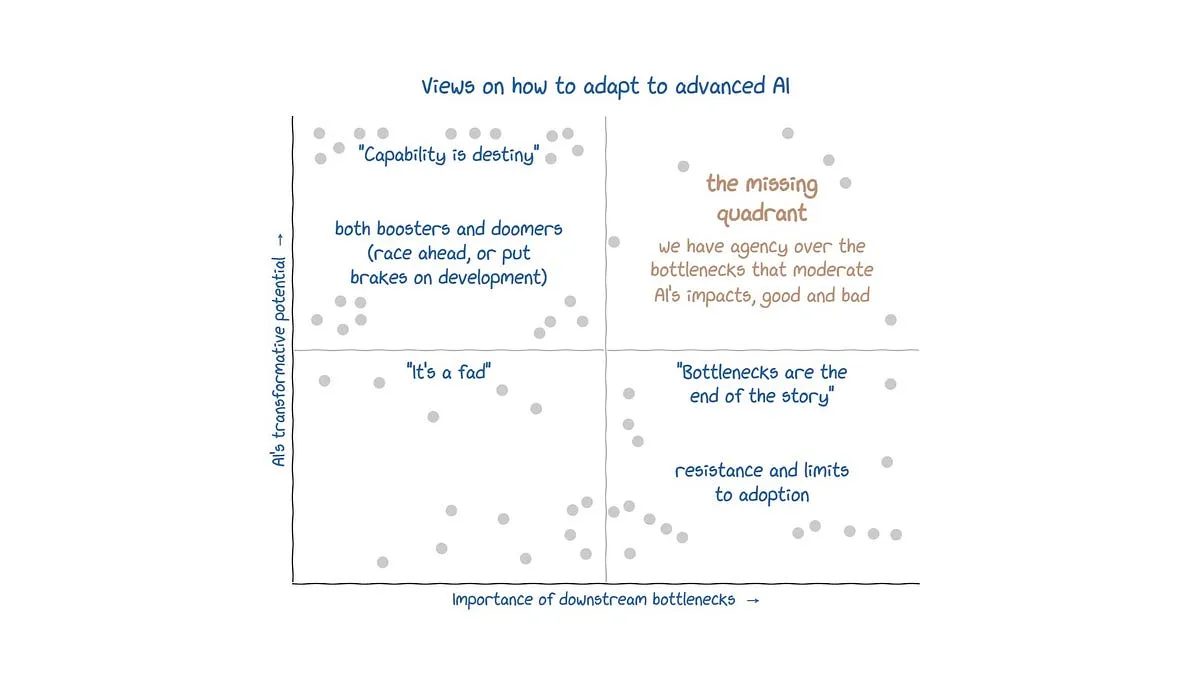
STABL (Societal Transformation and AI Bottlenecks Lab) has four workstreams and an advisory board, and it is raising money and hiring. Its stated position is a 'missing quadrant' in AI debates: it takes AI's transformative potential seriously but treats institutional bottlenecks as problems to fix, not fixed limits. One of its research areas is AI that automates AI research. [1] [6] [3]
In a CRUX study, agents built on Claude Opus 4.8 and GPT-5.6 each got six days and $3,000 in API credits to write papers on two unpublished NeurIPS 2026 submissions. They debugged environments and managed GPUs on their own, but the original authors scored the papers 2/6 and 1/6. The agents showed weak judgment about research quality, did little backtracking from dead ends, spent less than half their budget and drifted from instructions over time. [2] [5] [8]
in two research runs, agents handled engineering work but struggled with judgment, backtracking and staying on task. Implication: strong benchmark results on verifiable tasks may overstate how ready agents are for long, open-ended work.
Read the full assessment
Organizations should test agents in their own workflows and review the logs.
Executive brief
Three researchers known for arguing that AI's impact will be slow and limited by real-world bottlenecks have started a non-profit called STABL (Societal Transformation and AI Bottlenecks Lab). One of its four research areas is recursive self-improvement, meaning AI that automates AI research (launch essay). Their latest results argue it isn't here yet. In the lab's own case study, original authors scored frontier agents' research papers 2/6 and 1/6, both rejection-level (CRUX case study). STABL describes its place in AI debates as a "missing quadrant": it takes AI's transformative potential seriously while treating institutional bottlenecks as problems to fix, not as fixed limits. No independent coverage of the launch turned up.
What changed and event timeline
"AI as Normal Technology" published
Narayanan and Kapoor argued that diffusion bottlenecks would make AI's impact play out over decades, and that resilience should be preferred over non-proliferation. This is the intellectual groundwork for STABL ().
Prominent critique
Steve Newman argued that capable AI could get around deployment feedback loops and could spread faster than past technologies ().
CRUX launches
A 17-person collaboration began "open-world" evaluations. In its first experiment an agent published an iOS app to the App Store; development and submission cost about $25 ().
Agents fail at open-ended research
Expert reviewers rejected both papers produced by agents. The authors identified five recurring failure modes ().
STABL announced
Kapoor, Bommasani and Narayanan launched the lab with four workstreams and an advisory board. It is fundraising and hiring (;).
Capabilities and access
This is an organizational launch. No model was released.
Read the full section
This is an organizational launch. No model was released.
- Models tested in the CRUX research study: Claude Opus 4.8 with extra-high reasoning on the OpenClaw scaffold (primary), and GPT-5.6 Sol Ultra on Codex (robustness check) (alphaXiv).
- Model in the earlier iOS experiment: Claude Opus 4.6 on OpenClaw (Normal Tech).
- Access: STABL's outputs are public essays, a newsletter and research papers. No product or API is announced (launch essay).
Technical analysis for researchers and developers
The agents could still debug environments, run experiments and manage GPUs on their own (alphaXiv).
Read the full section
- Evaluation design: CRUX gives up benchmark-style automation in exchange for long, loosely constrained tasks. Each uses a small sample, sometimes needs human intervention, and is judged by analyzing agent logs. The team plans new experiments every 1–2 months (Normal Tech).
- Research study setup: two unpublished NeurIPS 2026 submissions, six days per run, $3,000 in API credits per agent, plus GPU budgets. The original authors scored outputs on a 1–6 scale (alphaXiv).
- Failure modes:
- poor judgment about research quality
- little creative problem-solving when experiments failed
- weak backtracking from dead ends
- spending under 50% of the budget
- drifting from instructions over time
The agents could still debug environments, run experiments and manage GPUs on their own (alphaXiv).
- Reproducibility: the authors acknowledge these evaluations are hard to standardize or compare across runs.
Claims and evidence
- "Growing chasm" between verifiable and open-ended task performance: this is a hypothesis in the launch essay (launch essay).
- US unemployment largely unchanged despite wide adoption: asserted in the essay without cited data (launch essay).
- Earlier diffusion evidence: 40% of US adults used generative AI by August 2024, but this accounted for only 0.5–3.5% of work hours (Knight Institute).
Read the full section
- "Growing chasm" between verifiable and open-ended task performance: this is a hypothesis in the launch essay (launch essay). Its main empirical support is two papers and five runs from the founders' own collaboration (alphaXiv).
- US unemployment largely unchanged despite wide adoption: asserted in the essay without cited data (launch essay).
- Earlier diffusion evidence: 40% of US adults used generative AI by August 2024, but this accounted for only 0.5–3.5% of work hours (Knight Institute).
- Influence on policy and industry (adoption of their benchmarks, effect on US and EU governance): self-reported in the launch essay.
Context and prior work
- STABL extends the "AI as Normal Technology" thesis, including its push for resilience over non-proliferation (Knight Institute).
- The founders' earlier work includes the AI Snake Oil book, the Foundation Model Transparency Index and research on open foundation models (launch essay; Semantic Scholar).
- Advisory board: Erik Brynjolfsson, Michael R. Strain, Audrey Tang, Helen Toner and Robb Willer.
Read the full section
- STABL extends the "AI as Normal Technology" thesis, including its push for resilience over non-proliferation (Knight Institute).
- The founders' earlier work includes the AI Snake Oil book, the Foundation Model Transparency Index and research on open foundation models (launch essay; Semantic Scholar).
- Advisory board: Erik Brynjolfsson, Michael R. Strain, Audrey Tang, Helen Toner and Robb Willer.
- CRUX collaborators come from academia, government (including the UK AI Security Institute) and industry (Princeton CITP news).
Limitations, safety and contested findings
- Weaknesses of the research study: a tiny sample, non-blind review by the papers' own authors, possible scaffold limits and a six-day cap.
- Errors in the iOS run: the agent misplaced credentials and invented a phone number (Normal Tech).
- Disputed premise: Newman argues the bottleneck thesis depends on there being no fast path to general AI, which he considers uncertain (Second Thoughts).
Read the full section
- Weaknesses of the research study: a tiny sample, non-blind review by the papers' own authors, possible scaffold limits and a six-day cap. The human coauthors disagreed on why the agents failed: lack of creativity, weak reasoning, or getting locked into an approach (alphaXiv).
- Errors in the iOS run: the agent misplaced credentials and invented a phone number (Normal Tech).
- Disputed premise: Newman argues the bottleneck thesis depends on there being no fast path to general AI, which he considers uncertain (Second Thoughts).
- Safety agenda: STABL proposes control, downstream defenses and resilience planned for specific domains and worst cases, alongside alignment.
Business and practitioner implications
- Evaluation practice: benchmark wins on verifiable tasks may overstate how well agents handle long, messy work.
- Agent deployment: agents can already handle substantial engineering and operations work. Judgment, backtracking and staying on task over long runs remain weak points (alphaXiv).
- Strategy: STABL pushes firms toward augmenting workers rather than straight labor substitution, and toward investing in sector-specific resilience such as hospital cybersecurity (launch essay).
Read the full section
- Evaluation practice: benchmark wins on verifiable tasks may overstate how well agents handle long, messy work. Testing in your own workflows, with log review, matters (Normal Tech).
- Agent deployment: agents can already handle substantial engineering and operations work. Judgment, backtracking and staying on task over long runs remain weak points (alphaXiv).
- Strategy: STABL pushes firms toward augmenting workers rather than straight labor substitution, and toward investing in sector-specific resilience such as hospital cybersecurity (launch essay).
- What to watch: repeat CRUX runs with stronger models will be useful early-warning signals.