
AgentsAutonomy & tool use
TechCrunch reports Superhuman is acquiring Fathom to add meeting context to its agent platform
The reported deal would bring Fathom’s AI meeting notes, transcripts, action items, search and CRM workflows into Superhuman’s broader productivity stack, underscoring a shift from standalone assistants toward agents grounded in workplace context.
 AT Pulse research deskSeptember 14, 2026 · 12 min read · AI-assisted analysis
The acquisition is reported by TechCrunch, but no official acquisition announcement, deal price, closing terms or independent corroboration were found in the reviewed sources. [1]
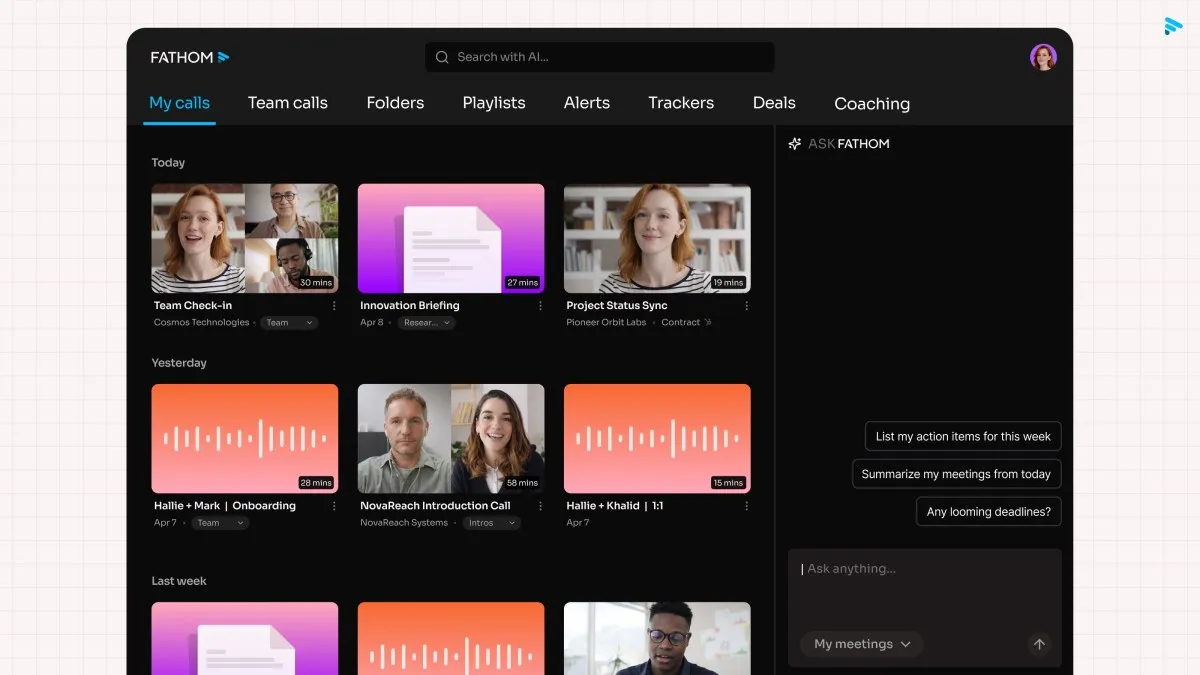
Fathom’s product footprint adds meeting recordings, transcripts, summaries, action items, follow-up drafts, Ask Fathom search and CRM sync to Superhuman’s existing agent-oriented productivity surfaces. [4] [5] [11] [12] [13]
The evidence shows a reported acquisition, documented Fathom capabilities, and Superhuman’s stated push toward proactive agents across work tools.
Read the full assessment
Separately, meeting-summarization research indicates this is a technically difficult domain involving multi-speaker dialogue, long context and evaluation challenges. The implication for practitioners is that the competitive layer is moving beyond note generation toward governed meeting memory, retrieval and action execution. For business leaders, the main value and risk both come from connecting sensitive meeting content to automated workflows.
Executive brief
On September 14, 2026, TechCrunch reported that Superhuman is acquiring Fathom, a YC-backed AI meeting-notetaker, rather than continuing to build a notetaker entirely in-house. TechCrunch reports that Fathom has 400,000+ monthly active users, that 1M+ people have recorded meetings with it, and that it had raised $30M+ and reached a $94M valuation in 2024, but those figures are either company-reported or attributed to PitchBook via TechCrunch, not independently re-audited here. Superhuman acquires YC-backed notetaker Fathom as productivity platforms push for agentic work | TechCrunch A 2024 TechCrunch article said Fathom relied on its “own models” or fine-tuned open models, but no model lineage or evaluation suite was disclosed.
Read the full section
On September 14, 2026, TechCrunch reported that Superhuman is acquiring Fathom, a YC-backed AI meeting-notetaker, rather than continuing to build a notetaker entirely in-house. The strategic rationale is clear: Superhuman’s platform already spans writing assistance, email, docs/workspaces, calendar/database surfaces, and its Go agent platform; meeting transcripts, decisions, and action items are a missing high-signal context layer for “agentic work.” TechCrunch reports that Fathom has 400,000+ monthly active users, that 1M+ people have recorded meetings with it, and that it had raised $30M+ and reached a $94M valuation in 2024, but those figures are either company-reported or attributed to PitchBook via TechCrunch, not independently re-audited here. Superhuman acquires YC-backed notetaker Fathom as productivity platforms push for agentic work | TechCrunch
For AI practitioners, the acquisition matters less as a notetaking feature launch and more as a signal of where productivity platforms are competing: from chat-based assistants toward context-bearing agents embedded in work surfaces. Fathom’s meeting artifacts—recordings, transcripts, summaries, action items, CRM syncs, and “Ask Fathom” search—could become the event stream that triggers follow-up emails, CRM updates, task creation, agenda prep, and knowledge retrieval in Superhuman Go. Superhuman already describes Go as a proactive assistant that can work across apps, surface suggestions without prompting, connect to data sources via connectors, and run custom agents on schedules or events. Superhuman Go | The AI Assistant That Works Where You Do
The technical details remain thin. Fathom’s public materials describe capabilities, not architecture. A 2024 TechCrunch article said Fathom relied on its “own models” or fine-tuned open models, but no model lineage or evaluation suite was disclosed. AI notetaker Fathom raises $17M | TechCrunch
The main practitioner risks are privacy, consent, data governance, and automation correctness. Fathom’s privacy policy says meeting content includes notes, recordings, transcripts, attendee names/emails, and calendar-derived meeting information; it also says de-identified meeting-content data may be used to train or improve in-house AI models depending on account settings, while third-party AI providers are not authorized to train on that content. Privacy Policy | Fathom AI That is materially relevant in an acquisition because meeting data is among the most sensitive enterprise datasets: it contains strategy, employee information, customer objections, security incidents, pricing, and sometimes regulated or biometric information.
What changed and event timeline
Fathom founded
TechCrunch reports that Fathom was founded in 2020 and became one of the earlier AI meeting-notetaker startups.
Seed funding
TechCrunch previously reported that Fathom raised a $4.7M seed round backed by investors including Zoom’s Apps Fund.
Series A and broader automation ambition
TechCrunch reported that Fathom raised a $17M Series A led by Telescope Partners, including $2M from users via Wefunder, and that Fathom was moving beyond notes into action items, follow-up email drafts, Ask Fathom, team features, integrations, and AI-agent-like post-meeting work.
Grammarly acquires Coda
TechCrunch and Axios reported that Grammarly agreed to acquire Coda and that Coda CEO Shishir Mehrotra would become Grammarly CEO.
Grammarly acquires Superhuman Mail
TechCrunch reported that Grammarly acquired the AI email client Superhuman to build AI agents for email and productivity workflows.
October/November 2025 — Grammarly rebrands the company as Superhuman
Official company materials say Grammarly changed its company name to Superhuman, uniting Grammarly, Coda, Superhuman Mail, and the new Superhuman Go assistant under one brand.
Earlier in 2026 — Superhuman tests its own notetaker
TechCrunch reports that Superhuman tested a notetaker internally with selected users but chose to acquire a finished product after concluding that high-quality meeting recording and notetaking were technically deep.
More detail
This is reported by TechCrunch and attributed to CEO Shishir Mehrotra; no independent test results were published.
Superhuman acquires Fathom
TechCrunch reports the acquisition. TechCrunch is therefore the primary source for the transaction itself.
Capabilities and access
Exact model/version: Not publicly documented in the sources reviewed. Fathom has not disclosed a named foundation model, ASR model, diarization model, summarization model, retrieval model, or versioned model card in the materials found.
Read the full section
Exact model/version: Not publicly documented in the sources reviewed. Fathom has not disclosed a named foundation model, ASR model, diarization model, summarization model, retrieval model, or versioned model card in the materials found.
Fathom’s documented product capabilities include:
- Meeting capture across Zoom, Google Meet, Microsoft Teams, and other compatible conferencing tools; Superhuman’s Fathom connector page also says Fathom works with Zoom, Google Meet, Microsoft Teams, and Slack Huddles inside Superhuman Go. Fathom Terms of Service
- Transcripts, summaries, action items, follow-up email drafts, search across meetings, and “Ask Fathom” question answering over meeting history. How Fathom Works: AI Notes, Action Items & CRM Sync
- CRM integrations: Fathom’s Salesforce documentation says its Salesforce integration can write call summaries, action items, and selected meeting content into Salesforce. Salesforce Integration
- Enterprise/compliance features advertised in public pricing/product materials include SSO/SCIM, custom retention policies, advanced security controls, and claimed SOC 2 Type II/GDPR/HIPAA support, but these claims are vendor-reported and should be verified through the trust portal and procurement review. How Fathom Works: AI Notes, Action Items & CRM Sync
Superhuman Go’s documented capabilities include:
- Proactive help that “doesn’t wait for a prompt,” inline writing suggestions, email sorting and pre-drafted replies, meeting prep/follow-through, connected data sources, custom agents, and event/schedule-triggered workflows. These are vendor descriptions, not independent performance evaluations. Superhuman Go | The AI Assistant That Works Where You Do
- Superhuman says Go can connect to data sources through prebuilt or custom MCP connectors, with outputs “grounded” in user knowledge; this is a product claim and does not document retrieval metrics or grounding evaluation. Superhuman Go | The AI Assistant That Works Where You Do
- Superhuman’s public Fathom connector page says Fathom meeting notes and recordings can be brought into Superhuman Go, enabling users to query past meetings and insert meeting-grounded answers into drafts. Fathom Agent | Superhuman
Technical analysis for researchers and developers
No source found published Fathom’s full architecture. The public evidence supports only a high-level functional pipeline: The inference is that Superhuman wants Fathom to serve as a structured meeting-memory subsystem for its agent platform. The acquisition materials do not provide public evaluation data.
Read the full section
Documented architecture: limited
No source found published Fathom’s full architecture. The public evidence supports only a high-level functional pipeline:
- Meeting ingestion through calendar/conferencing integrations. Fathom’s privacy policy says linking Google Calendar or Outlook Calendar is core to the service and that it receives meeting metadata, join URLs, attendee identifiers, and meeting content when meetings are recorded or transcribed. Privacy Policy | Fathom AI
- Capture and transcription from meeting audio/video. Fathom’s terms describe tools that can record or transcribe calls on Zoom, Google Meet, Microsoft Teams, and compatible third-party conferencing applications. Fathom Terms of Service
- Speaker attribution/diarization, including optional voiceprint use on iOS when users opt in. Fathom says voiceprints are used for speaker recognition, transcript diarization, and transcript accuracy, and may constitute biometric information under some laws. Privacy Policy | Fathom AI
- Summarization and extraction into summaries, action items, follow-up drafts, and CRM fields. Advanced AI Features in Team Edition
- Retrieval/question answering over meeting history via Ask Fathom and, now, Superhuman Go’s Fathom connector. Using Ask Fathom
- Action integration into downstream work systems such as CRM, email drafts, Slack, Zapier, and—after acquisition—potentially Superhuman’s email/docs/calendar/agents surfaces. Salesforce Integration
The inference is that Superhuman wants Fathom to serve as a structured meeting-memory subsystem for its agent platform. That inference is supported by TechCrunch’s report that Superhuman can use a notetaker to draft emails, update data entries, schedule follow-up meetings, and let agents start work from meeting data, but the exact implementation has not been documented. Superhuman acquires YC-backed notetaker Fathom as productivity platforms push for agentic work | TechCrunch
Evaluation methodology: what is documented vs. missing
The acquisition materials do not provide public evaluation data. There are no disclosed WER benchmarks, diarization error rates, hallucination rates, action-item precision/recall, CRM-field extraction accuracy, latency measurements, enterprise red-team results, or user-study protocols.
That absence matters because meeting summarization is not a solved “wrap a model around a transcript” task. A survey of meeting summarization research identifies structural challenges including multi-speaker dialogue, low information density, heterogeneous speaker roles/styles, long transcripts, and limited annotated datasets; it also notes common evaluation approaches such as ROUGE and BERTScore, while surveying datasets including AMI, ICSI, QMSum, and ConvoSumm. Meeting Summarization: A Survey of the State of the Art
For developers evaluating this class of system, a credible benchmark should separate at least five stages:
- ASR quality: word error rate by accent, noise, crosstalk, domain jargon, and microphone condition.
- Diarization: speaker-label error, especially in hybrid/bot-free capture and overlapping speech.
- Summary faithfulness: unsupported claims, wrong attributions, omitted decisions, and over-compression.
- Action extraction: owner, deadline, dependency, and commitment detection, measured against human-labeled meeting artifacts.
- Tool-action correctness: whether generated CRM/task/email updates preserve source evidence and require appropriate human approval.
The sources reviewed do not show whether Fathom or Superhuman uses such an evaluation stack.
Reproducibility and implementation implications
Because Fathom is proprietary and no model cards, prompts, training data details, or benchmark scripts were found, external reproducibility is low. Developers integrating similar systems should treat the acquisition as a platform architecture case study rather than a reproducible research contribution.
The implementation implication is that meeting context becomes a privileged retrieval corpus. Once meeting content flows into an agent platform, the hard engineering problems move from summarization alone to identity, permissioning, provenance, retention, consent state, retrieval scoping, and action approval. Superhuman says agents use granular permissions and isolated environments, and that agents connect only to declared domains, but those are platform claims that should be validated in enterprise security review. Fathom Agent | Superhuman
Claims and evidence
- Superhuman is acquiring Fathom
- Fathom has 400,000+ MAUs and 1M+ people have recorded meetings
- Fathom raised $30M+ and was valued at $94M in 2024
Read the full section
| Material claim | Evidence status |
| Superhuman is acquiring Fathom | Reported by TechCrunch; no official acquisition announcement found in this search. Superhuman acquires YC-backed notetaker Fathom as productivity platforms push for agentic work | TechCrunch |
| Fathom has 400,000+ MAUs and 1M+ people have recorded meetings | TechCrunch reports company/user figures; not independently audited here. Superhuman acquires YC-backed notetaker Fathom as productivity platforms push for agentic work | TechCrunch |
| Fathom raised $30M+ and was valued at $94M in 2024 | TechCrunch attributes funding/valuation to PitchBook; PitchBook data not independently accessed here. Superhuman acquires YC-backed notetaker Fathom as productivity platforms push for agentic work | TechCrunch |
| Superhuman chose acquisition after internal notetaker tests | TechCrunch reporting, with comments from Superhuman CEO; no independent test documentation published. Superhuman acquires YC-backed notetaker Fathom as productivity platforms push for agentic work | TechCrunch |
| Fathom supports transcripts, summaries, action items, follow-up drafts, Ask Fathom, and CRM sync | Vendor documentation and product pages. How Fathom Works: AI Notes, Action Items & CRM Sync |
| Superhuman Go is a proactive, context-aware assistant/agent platform | Vendor documentation; not independent evaluation. Superhuman Go | The AI Assistant That Works Where You Do |
| Meeting summarization is technically difficult | Supported by peer-reviewed/research-survey literature; not specific to Fathom’s implementation. Meeting Summarization: A Survey of the State of the Art |
Context and prior work
The deal fits a broader consolidation path. Superhuman’s current platform is itself the product of prior acquisitions: Grammarly acquired Coda in 2024, acquired Superhuman Mail in 2025, and then rebranded the company as Superhuman later in 2025. Grammarly acquires productivity startup Coda, brings on new CEO | TechCrunch Fathom adds a different kind of asset: not a writing surface or workspace, but episodic organizational memory.
Read the full section
The deal fits a broader consolidation path. Superhuman’s current platform is itself the product of prior acquisitions: Grammarly acquired Coda in 2024, acquired Superhuman Mail in 2025, and then rebranded the company as Superhuman later in 2025. Grammarly acquires productivity startup Coda, brings on new CEO | TechCrunch Fathom adds a different kind of asset: not a writing surface or workspace, but episodic organizational memory.
Competition is intense and increasingly platformized. Granola raised a $20M Series A in 2024 and later, according to TechCrunch, raised $125M at a $1.5B valuation as it expanded from AI notetaker toward enterprise AI app positioning. Granola raises $20M to build the AI notepad that makes you smarter | Granola Zoom’s own AI Companion now supports AI note-taking and can join third-party meetings on Google Meet and Microsoft Teams, transcribe them, summarize them, and answer post-meeting questions. Using AI Companion in third-party meetings
This means standalone notetakers face pressure from two sides: horizontal productivity suites that want meetings as context, and conferencing vendors that can bundle native summaries into paid workplace plans. Fathom’s value to Superhuman is therefore not just “notes,” but user adoption, integrations, meeting data workflows, and the operational knowledge needed to make recording/transcription feel reliable.
Limitations, safety and contested findings
Consent and recording law remain central. Training and de-identification require scrutiny. Fathom says it may use de-identified data generated from meeting content to train, improve, and customize in-house AI models based on account settings, while saying third parties such as OpenAI, Anthropic, and Google are not authorized to train on users’ personal information or meeting content.
Read the full section
Consent and recording law remain central. Fathom’s terms prohibit using the service if any participant does not consent to being recorded and require users to obtain legally required consent before calls begin. Fathom’s privacy policy separately warns that some jurisdictions require all-party consent before recording audio or video meetings. Fathom Terms of Service
Meeting data is sensitive by default. Fathom defines meeting content broadly: notes, recordings, audio/video, transcripts, attendee names/emails, meeting content, and calendar meeting information. Privacy Policy | Fathom AI Enterprises should assume meeting memory may include customer data, HR data, security incidents, deal terms, nonpublic financial information, and regulated personal data unless controls prevent that.
Training and de-identification require scrutiny. Fathom says it may use de-identified data generated from meeting content to train, improve, and customize in-house AI models based on account settings, while saying third parties such as OpenAI, Anthropic, and Google are not authorized to train on users’ personal information or meeting content. Privacy Policy | Fathom AI The unresolved question is how de-identification is performed, audited, and affected after corporate integration.
Automation errors can propagate. A wrong meeting summary is annoying; a wrong CRM update, task assignment, or customer follow-up email can create operational and legal risk. No public source reviewed provides Fathom-specific hallucination/error rates or end-to-end tool-action accuracy.
Corroboration gap. TechCrunch reporting on the acquisition and official product materials showing a Fathom connector in Superhuman Go was found in the reviewed sources, but no separate independent article or official acquisition press release confirming deal terms .
Business and practitioner implications
For business leaders, the acquisition is a bet that productivity suites will compete on context ownership. For AI practitioners, the priority is not simply connecting transcript retrieval to an LLM. For developers, the Fathom connector suggests a pattern: meeting systems become MCP-like context providers for downstream agents.
Read the full section
For business leaders, the acquisition is a bet that productivity suites will compete on context ownership. Email context, document context, CRM context, and meeting context are more valuable when combined than when isolated. If Superhuman can turn meeting decisions into governed follow-through across mail, docs, calendar, databases, and agents, it can move from assistive writing into workflow orchestration.
For AI practitioners, the priority is not simply connecting transcript retrieval to an LLM. The durable system design work is: permission-aware retrieval, source-linked answers, sensitive-topic detection, opt-out and retention enforcement, human approval for irreversible actions, and audit logs for agent outputs.
For developers, the Fathom connector suggests a pattern: meeting systems become MCP-like context providers for downstream agents. Build integrations so every generated action preserves provenance: transcript span, speaker, timestamp, meeting ID, confidence, and approval state.
For buyers, evaluate the combined product on governance rather than demo quality. Ask: Can admins disable model training? Can meeting data be excluded by calendar label, participant domain, or meeting type? Are summaries source-linked? Can agents write to CRM only after approval? Are deleted recordings removed from derived embeddings and indexes? How are voiceprints handled?
Sources
- TechCrunch: acquisition report, September 14, 2026. Superhuman acquires YC-backed notetaker Fathom as productivity platforms push for agentic work | TechCrunch
- TechCrunch: Fathom 2024 funding/background. AI notetaker Fathom raises $17M | TechCrunch
- Superhuman official materials: Go, platform, rebrand, Fathom connector. Superhuman Go | The AI Assistant That Works Where You Do
Read the full section
- TechCrunch: acquisition report, September 14, 2026. Superhuman acquires YC-backed notetaker Fathom as productivity platforms push for agentic work | TechCrunch
- TechCrunch: Fathom 2024 funding/background. AI notetaker Fathom raises $17M | TechCrunch
- Superhuman official materials: Go, platform, rebrand, Fathom connector. Superhuman Go | The AI Assistant That Works Where You Do
- Fathom official materials: overview, privacy policy, terms, DPA/settings/help docs. How Fathom Works: AI Notes, Action Items & CRM Sync
- Research literature: meeting summarization survey. Meeting Summarization: A Survey of the State of the Art
- Market context: Granola and Zoom AI Companion sources. Granola raises $20M to build the AI notepad that makes you smarter | Granola