
AgentsAutonomy & tool use
Meta adds Spaces to its Muse agent, letting users build self-updating mini-apps from chat requests
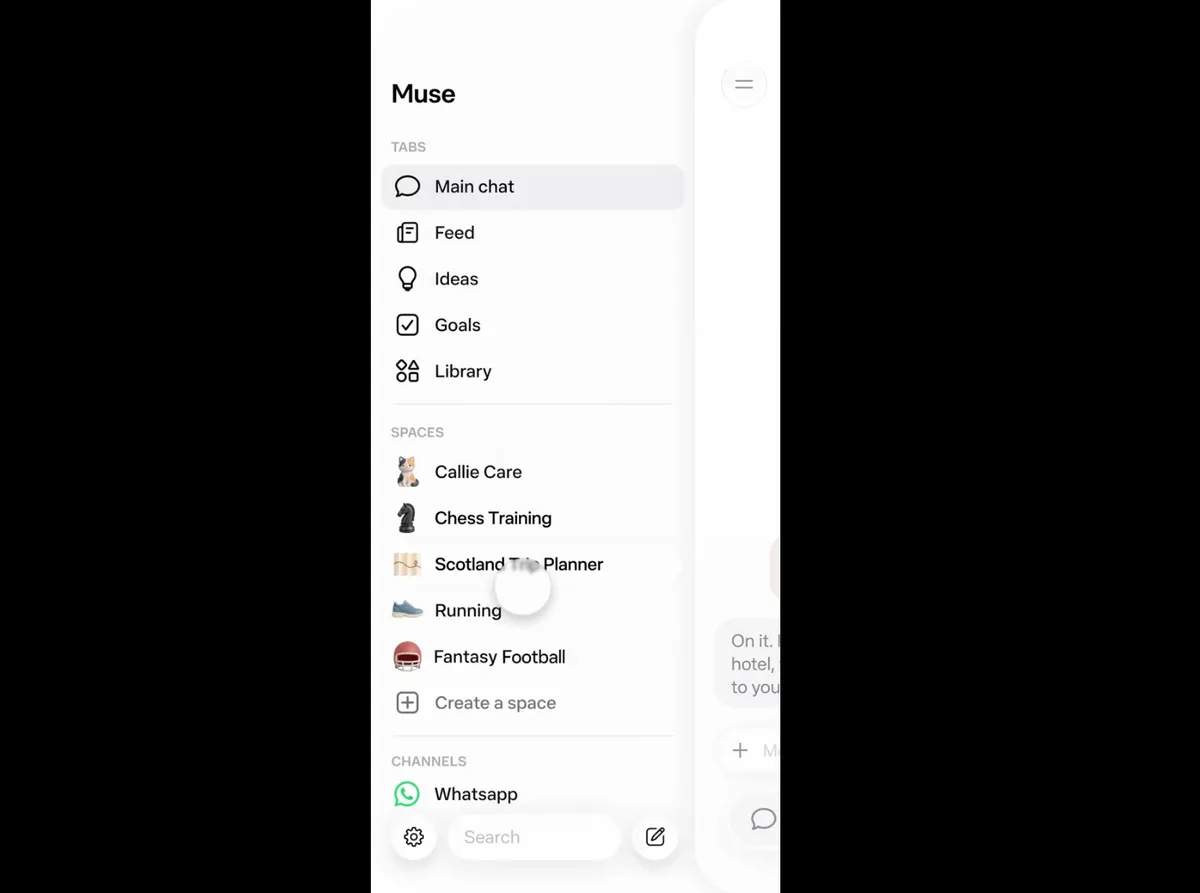
Meta's Muse agent now turns plain-language requests into personal mini-apps called spaces, such as trackers, planners, dashboards and games. Spaces pull data from connected services and refresh in the background, moving the consumer agent beyond chat toward building and running lightweight software.
From the TechCrunch AI article of November 6, 2026 and cited sources: Users describe what they want in chat, and Muse builds a topic-based space in the app's sidebar. [1] [8]
SOURCES[1] TechCrunch: Meta introduces Spaces techcrunch.com[8] iPhone in Canada: Muse custom spaces iphoneincanada.ca
 AT Pulse research deskPublished · Updated · 5 min read · AI-assisted analysis
AI-assisted, not human-edited. Methodology Corrections Who owns this site
- What happened
- Users describe what they want in chat, and Muse builds a topic-based space in the app's sidebar. [1] [8]
- Original source
- TechCrunch AI article, independent perspective
- Brief by
- AT Pulse research desk AI-assisted; publisher and contact on the desk page
- When
- November 6, 2026 article published
- Covered
- Nov 9 edition
- Evidence
- 11 sources across 10 sites
- 1TechCrunch: Meta introduces Spacestechcrunch.com
- 2Meta’s Muse AI can create custom ‘spaces’ for the version…theverge.com
- 3Muse's NEW AI Spaces Are Actually INSANE!reddit.com
- 4DataCamp: Meta Muse features, access, pricingdatacamp.com
- 5TechCrunch: Everything new coming to Musetechcrunch.com
- 6RuntimeWire: Muse voice and video US rolloutruntimewire.com
Reach: not measured yet

Users describe what they want in chat, and Muse builds a topic-based space in the app's sidebar. Examples include a wedding planner, a gift tracker or a trivia game. Users can change the layout and features with more requests, edit content directly, and pin or rearrange spaces. Once connected, services such as Instagram saves and Marketplace listings keep a space updated without the user prompting it. [1] [8]
At launch, spaces work only on the Muse mobile and iPad apps, for existing Muse users. They are personal and cannot be shared with other people; Meta says it is exploring sharing. Meta has not published a list of supported apps, regional availability or pricing. [7] [8] [9]
Spaces fit Meta's plan to keep Muse free for heavy use and earn money from transaction fees over time. Spaces that track prices and listings can show partner data to users every day. The audience is large: Zuckerberg said Muse had 10 million users in the U.S. and Canada less than two months after launch. That figure is company-reported and has not been audited. [1] [5]
For technical readers, spaces seem to combine a saved, goal-focused conversation with a generated interface that refreshes through connectors. There is no API, benchmark or documentation of how spaces are built or how they store state. The open-weight Muse Spark release does not include space generation. [1] [4] [10]
spaces are live in Muse's mobile and iPad apps and draw on connected accounts.
Read the full assessment
Implication: single-purpose tracker and planner apps now face a free rival that the agent builds, and connector partners gain recurring visibility that fits Meta's transaction-fee strategy.
Executive brief
Meta's Muse agent can now build small working apps, called "spaces," from a plain-language request. Examples include a wedding planner, a gift tracker and a trivia game. Once a user connects their apps, these spaces update themselves in the background. So Muse is moving past chat and into making and running lightweight software for consumers. The scale behind it is large: Zuckerberg said Muse agents had 10 million users in the U.S. and Canada less than two months after launch. All of the evidence is Meta's own descriptions and demos. No independent tests of how reliable spaces are have been published.
What changed and event timeline
Muse Spark 1.3 ships
Meta describes it as the flagship model behind Muse, with a 1M-token context window. It also claims about 20% fewer tool calls on agent tasks ().
- Early Sep 2026
Muse agent launches
Muse is a personal agent that acts across a user's accounts and devices. It runs on Muse Spark and uses a cartoon avatar called Jolly ().
Connect expansion
Meta announced real-time avatar video chat, Mac control and a dedicated email address for the agent. It also named connectors with retailers, payment firms, GitHub and Notion ().
Muse Voice reaches all U.S. users
Alexandr Wang announced voice and video calls with the agent ().
Spaces launches
Spaces are topic-based workspaces in the Muse sidebar. Muse builds each one from a chat description, and Zuckerberg showed examples he made (;).
Capabilities and access
- What it does: Muse builds trackers, planners, dashboards and games. Users can change the layout and features with more requests and edit content directly.
- Data sources: Spaces can pull from connected services, including Instagram saves and Marketplace listings (same source).
- Platforms: the Muse mobile and iPad apps, for existing Muse users (ETV Bharat).
Read the full section
- What it does: Muse builds trackers, planners, dashboards and games. Users can change the layout and features with more requests and edit content directly. Spaces can be pinned or rearranged in the sidebar (iPhone in Canada).
- Data sources: Spaces can pull from connected services, including Instagram saves and Marketplace listings (same source).
- Platforms: the Muse mobile and iPad apps, for existing Muse users (ETV Bharat).
- Model: reportedly "specialized" versions shaped by Meta's Muse Wonder model (iPhone in Canada). No exact model version has been published.
- Missing details: Meta has not published a list of supported apps, regional availability or pricing for spaces (MarketScale).
Technical analysis for researchers and developers
- How it works: a space appears to be a saved, goal-focused conversation plus a generated interface. It refreshes in the background through connectors (TechCrunch).
- Sandboxing: Muse runs in a "Muse Secure" cloud VM. It is unconfirmed whether background refreshes for spaces pass through Sentinel.
- Reproducibility: there is no API, benchmark or evaluation for spaces.
Read the full section
- How it works: a space appears to be a saved, goal-focused conversation plus a generated interface. It refreshes in the background through connectors (TechCrunch). Meta has not documented how spaces are built, what format they use or how state is stored.
- Sandboxing: Muse runs in a "Muse Secure" cloud VM. A separate Sentinel agent on the same machine must approve anything that goes out to the internet (DataCamp). It is unconfirmed whether background refreshes for spaces pass through Sentinel.
- Reproducibility: there is no API, benchmark or evaluation for spaces. The open-weight Muse Spark release (816B total parameters, 42B active) does not include space generation (Labellerr).
Claims and evidence
- The agent builds spaces from a description and keeps them current: this is Meta's own product language (TechCrunch).
- 10M users in the U.S. and Canada: Zuckerberg said this on the October earnings call (TechCrunch). It is company-reported and has not been audited.
- The link to Muse Wonder: only one outlet reports it, and no other source corroborates it.
Read the full section
- The agent builds spaces from a description and keeps them current: this is Meta's own product language (TechCrunch). Zuckerberg's BBQ game, event tracker and home dashboard are his own demos, not tests.
- 10M users in the U.S. and Canada: Zuckerberg said this on the October earnings call (TechCrunch). It is company-reported and has not been audited. One outlet describes Muse as U.S.-only at launch, and another reports a Canadian launch in September (iPhone in Canada).
- The link to Muse Wonder: only one outlet reports it, and no other source corroborates it.
Context and prior work
- Model history: Muse Spark, released April 8, 2026, was the first model from Meta Superintelligence Labs.
- Business model: Zuckerberg plans to keep Muse free for a large number of tokens and to earn money from transaction fees over time (TechCrunch).
- Competition: rival agents with similar cartoon personas include OpenAI's dots and SpaceXAI's Grokbot (TechCrunch).
Read the full section
- Model history: Muse Spark, released April 8, 2026, was the first model from Meta Superintelligence Labs. Meta described it as natively multimodal and focused on reasoning (Meta).
- Business model: Zuckerberg plans to keep Muse free for a large number of tokens and to earn money from transaction fees over time (TechCrunch). Spaces that track prices and listings fit that plan.
- Competition: rival agents with similar cartoon personas include OpenAI's dots and SpaceXAI's Grokbot (TechCrunch).
Limitations, safety and contested findings
- Personal use only: spaces cannot be shared at launch, and Meta says it is "exploring" sharing (iPhone in Canada).
- Background refresh and data access: spaces that update on their own need standing access to connected accounts. No independent audit has confirmed this.
- Regional availability: reports conflict, as noted in Claims and evidence.
Read the full section
- Personal use only: spaces cannot be shared at launch, and Meta says it is "exploring" sharing (iPhone in Canada). TechCrunch's headline says "collaborate," but that means a user working with the agent, not with other people.
- Background refresh and data access: spaces that update on their own need standing access to connected accounts. Meta says Muse data is not shared with its ad systems and that users can opt out of training (DataCamp). No independent audit has confirmed this.
- Regional availability: reports conflict, as noted in Claims and evidence.
Business and practitioner implications
- Connector partners: with 1,500+ developer applications to build connectors (TechCrunch), spaces could put brand data in front of users every day without being asked.
- Single-purpose consumer apps: trackers, planners and dashboards now compete with an agent that builds them for free inside an app with 10M users.
- Builders of similar features: spaces show the pattern Meta chose, which is a saved goal, a generated interface and connector-driven refresh.
Read the full section
- Connector partners: with 1,500+ developer applications to build connectors (TechCrunch), spaces could put brand data in front of users every day without being asked. Retailers and services on the connector list should plan for that.
- Single-purpose consumer apps: trackers, planners and dashboards now compete with an agent that builds them for free inside an app with 10M users.
- Builders of similar features: spaces show the pattern Meta chose, which is a saved goal, a generated interface and connector-driven refresh. The unresolved points for anyone copying it are cost, failure modes and permissions, and Meta has published no data on those.
The source trail.
Sources (11)
TechCrunch: Meta introduces Spaces
techcrunch.comMeta’s Muse AI can create custom ‘spaces’ for the version of the app you need right now
Related coverage; assess separately
theverge.comMuse's NEW AI Spaces Are Actually INSANE!
Related coverage; assess separately
reddit.com