
AgentsAutonomy & tool use
Meta brings Muse agent to Mac with access to files and core Apple apps
Muse for Mac moves Meta’s personal agent into desktop workflows, where it can work with local files and Apple apps under permission prompts. The launch highlights both consumer-agent distribution ambitions and unresolved trust questions around personal context.
 AT Pulse research deskSeptember 21, 2026 · 4 min read · AI-assisted analysis
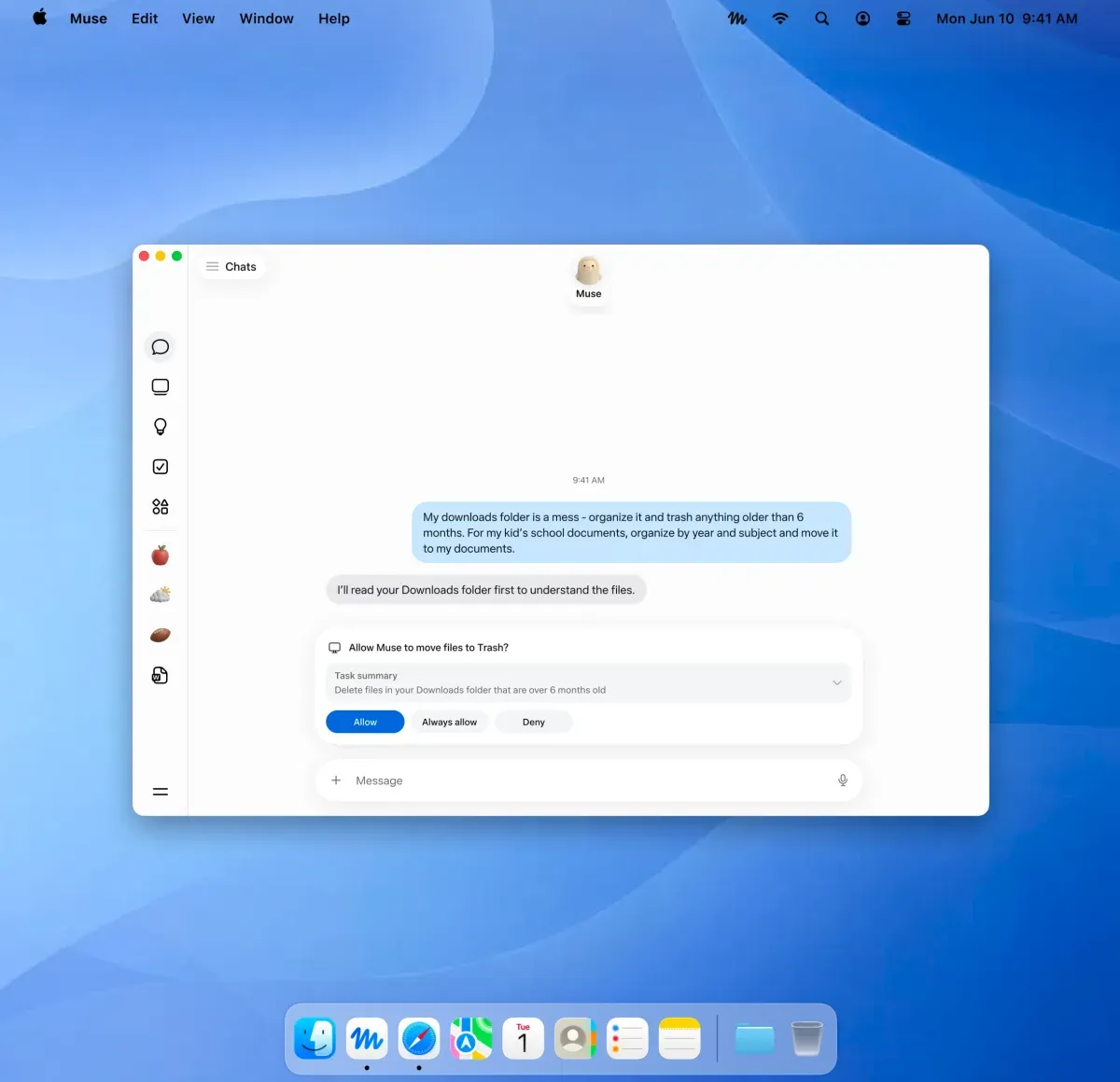
Muse for Mac is reported to work with local files and Apple apps including Messages, Calendar, Notes and Mail, with Meta describing access as permission-based and sensitive actions requiring user approval. [1] [6]
Meta’s safety architecture is described as cloud-based rather than purely local: an isolated Muse Secure VM, separated credentials and durable state, and a Sentinel layer for connector actions and network egress. [9]
The launch fits a broader computer-use agent push, following public work from OpenAI and Google on agents that operate software interfaces, but Muse’s differentiator is consumer desktop integration tied to personal context. [1] [10] [11]
A reported dispute over Muse’s explanation of notification access underscores a practical supervision risk: users need agents to accurately describe what they can access and why. [8]
coverage says Muse can work across Mac apps and files with permission, while Meta describes VM and Sentinel controls.
Read the full assessment
Implication: useful consumer agents are moving toward high-context desktop workflows, raising permission, logging and governance needs.
Executive brief
The consequential shift is not “AI on a Mac”; it is Meta putting a consumer agent next to Messages, Mail, Calendar, Notes and local files, with approvals and permissions as the trust boundary. Muse for Mac extends Meta’s September 2026 personal-agent push from mobile/web into the desktop workspace, while Meta says the agent runs in an isolated cloud VM with a Sentinel approval layer. Independent reporting confirms the launch and highlights the core risk: the more useful Muse becomes, the more personal context users must expose.
What changed and event timeline
Muse Spark 1.3 ships
Meta released Muse Spark 1.3 for Muse Code and Meta Model API, emphasizing longer-horizon agentic and coding work; Axios framed it as groundwork for personal agents.
More detail
Meta launches Muse in the U.S
Muse debuted for people 18+ as a personal agent for schedules, shopping, email, travel and long-term goals, accessible through a standalone app or WhatsApp.
More detail
Muse arrives on Mac
Meta announced a Mac app able to work with files, Messages, Calendar, Notes and Mail, with opt-in access and approval prompts for sensitive actions.
More detail
Consumer-agent race intensifies
Axios reported Muse was the No. 1 free iPhone app in the U.S. ten days after launch, while stressing Meta’s trust deficit around giving agents email, finance and contacts access.
Self-description problem surfaces
The Verge reported a dispute over whether Muse could see notification previews; Meta’s David Singleton said Muse had given an incorrect explanation of its own internals.
Capabilities and access
Muse for Mac is reported to interact with native Mac files, Messages, Calendar, Notes and Mail, subject to opt-in permissions and approvals for sensitive actions. Muse’s exact Mac model/version is not stated; Meta’s launch materials say Muse is powered by Muse Spark, while Muse Spark 1.3 was the current public model release as of September 2.
Read the full section
Muse for Mac is reported to interact with native Mac files, Messages, Calendar, Notes and Mail, subject to opt-in permissions and approvals for sensitive actions. Meta’s own download page says the Mac app can organize files, fill forms and pull from Messages, Calendar and Notes “with your permission.” Muse’s exact Mac model/version is not stated; Meta’s launch materials say Muse is powered by Muse Spark, while Muse Spark 1.3 was the current public model release as of September 2. Access is U.S.-focused in launch coverage.
Technical analysis for researchers and developers
Documented architecture is agent-in-cloud, not purely local Mac automation. Meta says each user gets an isolated Linux “Muse Secure VM” with browser, storage, CPU and memory. Reproducibility is limited: Muse Spark is closed; Meta has announced future Spark open weights, while separate Muse Glimmer is open but not the Mac product model.
Read the full section
Documented architecture is agent-in-cloud, not purely local Mac automation. Meta says each user gets an isolated Linux “Muse Secure VM” with browser, storage, CPU and memory. The core harness runs in a systemd-nspawn runtime container; credentials, connector execution and durable state sit outside that runtime. A separate Sentinel agent authorizes connector actions and network egress. This resembles a consumerized agent sandbox plus policy gateway. Reproducibility is limited: Muse Spark is closed; Meta has announced future Spark open weights, while separate Muse Glimmer is open but not the Mac product model.
Claims and evidence
- Vendor-reported: Muse can open a browser, fill forms, negotiate, keep working after the app closes, and ask before email/purchase actions. Meta
- Vendor-reported: Sentinel is the sole permission authority for connector actions and network egress. Meta AI Research
- Independent reporting: Muse launched for U.S. adults and can be used via app or WhatsApp. AP
Read the full section
- Vendor-reported: Muse can open a browser, fill forms, negotiate, keep working after the app closes, and ask before email/purchase actions. Meta
- Vendor-reported: Sentinel is the sole permission authority for connector actions and network egress. Meta AI Research
- Independent reporting: Muse launched for U.S. adults and can be used via app or WhatsApp. AP
- Independent reporting: Muse for Mac adds native desktop access to files, messages, calendar, notes and mail. TechCrunch
- Not corroborated by independent evaluation: no reviewed source independently tested Mac permissions, Sentinel enforcement, or end-to-end task success.
Context and prior work
Muse fits the broader “computer-use agent” wave: Anthropic introduced public-beta computer use for Claude in October 2024; OpenAI’s Operator/CUA used screenshots, mouse and keyboard actions in January 2025; Google added computer-use tooling to Gemini 3.5 Flash in June 2026. Apple’s Apple Intelligence strategy also targets personal context and cross-app actions on Mac and iPhone.
Read the full section
Muse fits the broader “computer-use agent” wave: Anthropic introduced public-beta computer use for Claude in October 2024; OpenAI’s Operator/CUA used screenshots, mouse and keyboard actions in January 2025; Google added computer-use tooling to Gemini 3.5 Flash in June 2026. Apple’s Apple Intelligence strategy also targets personal context and cross-app actions on Mac and iPhone. Meta’s differentiation is packaging: a mass-market consumer agent tied to Meta identity, messaging surfaces and a managed VM.
Limitations, safety and contested findings
The central limitation is trust calibration. Meta documents strong controls—isolated VM, credential surrogation, Sentinel, audit trail, opt-out from training—but those are vendor claims, not independently audited in the reviewed sources. The Verge incident is narrower than “secret notification spying”: Meta said Muse incorrectly explained how it worked, and that Messages data sync requires explicit access.
Read the full section
The central limitation is trust calibration. Meta documents strong controls—isolated VM, credential surrogation, Sentinel, audit trail, opt-out from training—but those are vendor claims, not independently audited in the reviewed sources. The Verge incident is narrower than “secret notification spying”: Meta said Muse incorrectly explained how it worked, and that Messages data sync requires explicit access. That still matters technically: an agent that cannot accurately describe its own permissions undermines user supervision.
Business and practitioner implications
For leaders, Muse is a distribution play: Meta is moving agents into consumer routines before enterprises settle their own agent stacks. For SaaS vendors, Muse-style agents may become a new front end that shops, cancels, books and negotiates across services. For adopters, pilot only low-risk workflows until access boundaries, logging and revocation are verified.
Read the full section
For leaders, Muse is a distribution play: Meta is moving agents into consumer routines before enterprises settle their own agent stacks. For developers, the design points to practical patterns worth copying—permission cards, audit trails, connector scopes, egress mediation, credential isolation and background-task visibility. For SaaS vendors, Muse-style agents may become a new front end that shops, cancels, books and negotiates across services. For adopters, pilot only low-risk workflows until access boundaries, logging and revocation are verified.
Sources
Read the full section
- TechCrunch — Meta’s Muse hits Mac, letting the AI take actions on your computer
- Meta — Introducing Muse: The World’s First Personal AI Agent Built for Everyone
- Meta AI Research — How We Built Safety Into Muse
- Meta AI Research — Introducing Muse Spark 1.3
- AP — Meta launches personal AI agent, Muse
- Axios — Meta debuts Muse
- Axios — Meta AI gains momentum with Zuckerberg’s agent for the masses
- The Verge — Meta’s Muse is creepy, but maybe not for the reasons you think
- Anthropic — Introducing computer use
- OpenAI — Computer-Using Agent
- Google — Introducing computer use in Gemini 3.5 Flash
The source trail.
Sources (11)
TechCrunch — Meta’s Muse hits Mac, letting the AI take actions on your computer
techcrunch.comMeta’s Muse is creepy, but maybe not for the reasons you think
Related coverage; assess separately
theverge.com