
PolicyLaw, regulation & governance
UK ministers met 137 businesses but no environmental groups on AI datacentre policy, Spotlight on Corruption report finds
A Spotlight on Corruption report, based on 40 freedom of information requests, finds that UK ministers and top officials met 137 businesses about AI Growth Zones between July 2024 and June 2026, but no environmental organisations. It calls for pausing new zones.
From the The Guardian · AI article of October 27, 2026 and cited sources: Business dominated access to senior decision-makers. [1] [2] [6]
SOURCES[1] UK government met 137 businesses over AI datacentres – but… theguardian.com[2] Spotlight on Corruption: Zoned Out spotlightcorruption.org[6] The Register: UK ministers had plenty of time for AI… theregister.com
 AT Pulse research deskPublished · Updated · 5 min read · AI-assisted analysis
AI-assisted, not human-edited. Methodology Corrections Who owns this site
- Original source
- The Guardian · AI article, independent perspective
- Brief by
- AT Pulse research desk AI-assisted; publisher and contact on the desk page
- When
- October 27, 2026 article published
- Covered
- Oct 27 edition
- Evidence
- 7 sources across 6 sites
- 1UK government met 137 businesses over AI datacentres – but…theguardian.com
- 2Spotlight on Corruption: Zoned Outspotlightcorruption.org
- 3The Register: UK gov AI datacenters (Feb 2025)theregister.com
- 4Foxglove: AI Growth Zone job claimsfoxglove.org.uk
- 5BritBrief: UK AI Growth Zones feasibility doubtsbritbrief.co.uk
- 6The Register: UK ministers had plenty of time for AI…theregister.com
Reach: not measured yet

Business dominated access to senior decision-makers. Companies and trade bodies made up 84% of ministerial meetings on AI datacentre policy, and there were no meetings with environmental groups. Ministers met only two community groups, both after their areas had been chosen as zones. Five of 10 affected local and devolved authorities had no contact beyond their application. [1] [2] [6]
The report counts 38 former ministers, senior officials and special advisers who later took jobs at AI companies, including OpenAI and Anthropic. Nine of them came from the Department for Science, Innovation and Technology. [1]
Developers in the zones get faster planning approval, priority grid access and help securing up to 500MW of power per zone. Almost two years after launch, no environmental or social impact assessment has been published. The AI Energy Council's sustainability working group met once between April 2025 and July 2026. [2] [6] [7]
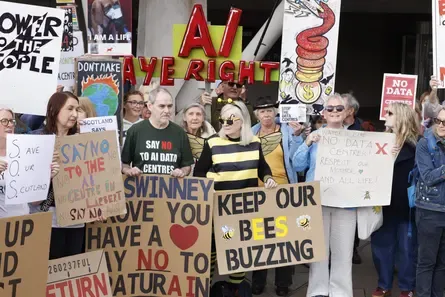
The report follows earlier doubts about the zones' economic case. Headline job figures were traced back to a developer, a 5,000-job estimate was scaled up from one site's evidence, and on-site renewable power plans looked unlikely to deliver. Fourteen local campaigns in Scotland have organised against planned datacentres. [1] [3] [4] [5]
freedom of information records show policy access heavily weighted toward industry, and impact assessments remain unpublished.
Read the full assessment
Implication: datacentre projects in the zones face more local opposition, possible planning delays and possible mandatory reporting of electricity, water and emissions.
Executive brief
A new report says that between July 2024 and June 2026, UK ministers and the most senior civil servants met 137 businesses about AI datacentre policy and no environmental organisations at all. Businesses and trade bodies made up 84% of ministerial meetings on the topic. Ministers met only two community groups, and both meetings came after those communities' areas had already been chosen as AI Growth Zones (Guardian; Spotlight on Corruption). The same report counts 38 former ministers, senior officials and special advisers who took jobs at AI companies. It asks the government to pause new AI Growth Zones until it sets stricter criteria.
What changed and event timeline

Growth zones launched
The AI Opportunities Action Plan created AI Growth Zones, favouring sites with existing power connections of 500MW or more. Culham in Oxfordshire was named first. Analysts doubted the promised "thousands of jobs" ().
Job figures traced to developers
Freedom of information (FOI) records obtained by Foxglove and the FT showed the 4,000-job figure for Cambois came from the developer, QTS. A 5,000-job figure for South Wales was scaled up from the Cambois evidence ().
Power and jobs questioned
A Guardian investigation reported that the Lanarkshire site will need the national grid despite promising on-site renewables. Its developer reportedly holds about a tenth of the land needed for the wind farm, and its 3,400-job claim was disputed ().
Local opposition grows
Fourteen Scottish campaigns against planned datacentres rallied at Holyrood. September is also when the report's count of officials moving to AI companies ends ().
"Zoned Out" published
Spotlight on Corruption's report sets out the imbalance in who met senior decision-makers and calls for a moratorium on new zones and datacentres (;).
Capabilities and access
This is an infrastructure-policy story; no AI model is involved. AI Growth Zones give developers: The government has also considered letting datacentres jump ahead of housing developments in the grid-connection queue. Five zones have been announced, several of them partnered with US technology firms (Guardian).
Read the full section
This is an infrastructure-policy story; no AI model is involved. AI Growth Zones give developers:
- faster planning approval;
- better access to the electricity grid (The Register);
- government help to secure up to 500MW of power per zone (DCD).
The government has also considered letting datacentres jump ahead of housing developments in the grid-connection queue. Five zones have been announced, several of them partnered with US technology firms (Guardian).
Technical analysis for researchers and developers
- Data: 40 FOI requests to 18 government bodies over 12 months, covering July 2024 to June 2026, plus published transparency records (Guardian).
- Who was counted: only ministers, permanent secretaries and directors general. Meetings with junior officials fall outside the headline zero.
- Undercounting: policy was led by a special adviser, Jade Leung, whose meetings face weaker disclosure rules. Business contact is therefore probably undercounted, not overcounted.
Read the full section
How the evidence was gathered:
- Data: 40 FOI requests to 18 government bodies over 12 months, covering July 2024 to June 2026, plus published transparency records (Guardian).
- Who was counted: only ministers, permanent secretaries and directors general. Meetings with junior officials fall outside the headline zero.
- Undercounting: policy was led by a special adviser, Jade Leung, whose meetings face weaker disclosure rules. Business contact is therefore probably undercounted, not overcounted.
- Missing assessments: no environmental or social impact assessment has been published almost two years after the policy launched (Spotlight on Corruption).
Claims and evidence
- 137 businesses vs zero environmental NGOs; 84% of meetings with business: these figures come from Spotlight's own analysis of FOI responses and have not been independently re-tabulated.
- 38 officials moved to AI firms, nine from the Department for Science, Innovation and Technology (DSIT): this is Spotlight's count.
- Local authorities: of 10 affected local and devolved authorities, five had no contact beyond the application, and one got a 15-minute meeting with a junior minister (The Register).
Read the full section
- 137 businesses vs zero environmental NGOs; 84% of meetings with business: these figures come from Spotlight's own analysis of FOI responses and have not been independently re-tabulated. Two outlets report them consistently (The Register; Guardian).
- 38 officials moved to AI firms, nine from the Department for Science, Innovation and Technology (DSIT): this is Spotlight's count. Some went to OpenAI and Anthropic (Guardian).
- Local authorities: of 10 affected local and devolved authorities, five had no contact beyond the application, and one got a 15-minute meeting with a junior minister (The Register).
- Government response: a spokesperson said the government wants to work with environmental groups and communities, and that councils hosting zones in England will keep all the extra business rates the datacentres generate (Guardian).
Context and prior work
Earlier reporting had already challenged the economic case for the zones: The new report adds the question of who was in the room when the policy was made.
Read the full section
Earlier reporting had already challenged the economic case for the zones:
- job figures that came from developers (Foxglove);
- renewable-power plans that do not add up, and grid-connection waits of 8–10 years (BritBrief);
- typical datacentre staffing of 30–50 permanent roles once construction ends (The Register).
The new report adds the question of who was in the room when the policy was made.
Limitations, safety and contested findings
- Inconsistent country comparisons: the Guardian says the report compares the UK with Canada, Germany and Australia.
- Revolving door: the report documents moves into AI jobs but not that any of them influenced specific decisions.
- Little environmental oversight: the AI Energy Council includes Microsoft, Google and AWS but no environmental NGOs.
Read the full section
- Inconsistent country comparisons: the Guardian says the report compares the UK with Canada, Germany and Australia. The report page names Germany, Canada and Ireland (Spotlight on Corruption).
- Revolving door: the report documents moves into AI jobs but not that any of them influenced specific decisions.
- Little environmental oversight: the AI Energy Council includes Microsoft, Google and AWS but no environmental NGOs. Its sustainability working group met once between April 2025 and July 2026 (The Register).
- Conflicting power estimates: government departments appear to disagree on how much electricity the datacentre plans will need (Guardian).
Business and practitioner implications
- Planning risk: opposition is growing, from Brick Lane in London to Auchtertool in Fife, and MP Chi Onwurah points to the US backlash as a warning.
- Disclosure: if the recommendations are adopted, operators could face mandatory reporting of electricity, water and emissions (The Register).
- Due diligence: treat job and power figures from developers as unverified until they are independently checked.
Read the full section
- Planning risk: opposition is growing, from Brick Lane in London to Auchtertool in Fife, and MP Chi Onwurah points to the US backlash as a warning. Projects in the zones should expect more scrutiny and possible delay (Guardian).
- Disclosure: if the recommendations are adopted, operators could face mandatory reporting of electricity, water and emissions (The Register).
- Due diligence: treat job and power figures from developers as unverified until they are independently checked.
The source trail.
Sources (7)
UK government met 137 businesses over AI datacentres – but no environmental groups
Article text retrieved; extracted text may omit tables or interactive elements.
theguardian.com