
ResearchPapers, evidence & method
Google and Stanford launch Polar Peaks, an AI Quests game in which students map neurons
Google Research and Stanford's Accelerator for Learning have released Polar Peaks, the third free AI Quests game. In it, students aged 11 to 14 map neurons to diagnose a character's memory loss, using research behind the complete male fruit-fly connectome.
According to arXiv 2604.07601 (Apr 2026) [10]: Google and Stanford launch Polar Peaks, an AI Quests game in which students map neurons.
SOURCES[10] Google, AI Literacy, and the Learning Sciences — arXiv… arxiv.org
 AT Pulse research deskPublished · Updated · 5 min read · AI-assisted analysis
AI-assisted, not human-edited. Methodology Corrections Who owns this site
- What happened
- Polar Peaks is the third game in the AI Quests series, after quests on flood forecasting and diabetic retinopathy. [1] [2] [5] [7]
- Original source
- Google AI article, company source
- Brief by
- AT Pulse research desk AI-assisted; publisher and contact on the desk page
- Studies
- arXiv 2604.07601 (Apr 2026) [10] date from arXiv ID
- When
- October 26, 2026 article published
- Covered
- Oct 27 edition
- Evidence
- 10 sources across 7 sites
- 1Our newest AI Quest: Mapping the human brainblog.google
- 2AI Quests: Bringing AI literacy to the classroom — Googleblog.google
- 3Quest start: Google launches AI Quests — Android Central…tech.yahoo.com
- 4Introducing AI Quests — Raspberry Pi Foundationraspberrypi.org
- 5How we're supporting the next generation of innovators —…blog.google
- 6AI Quests by Google Research — Webby Awards 2026winners.webbyawards.com
Reach: not measured yet
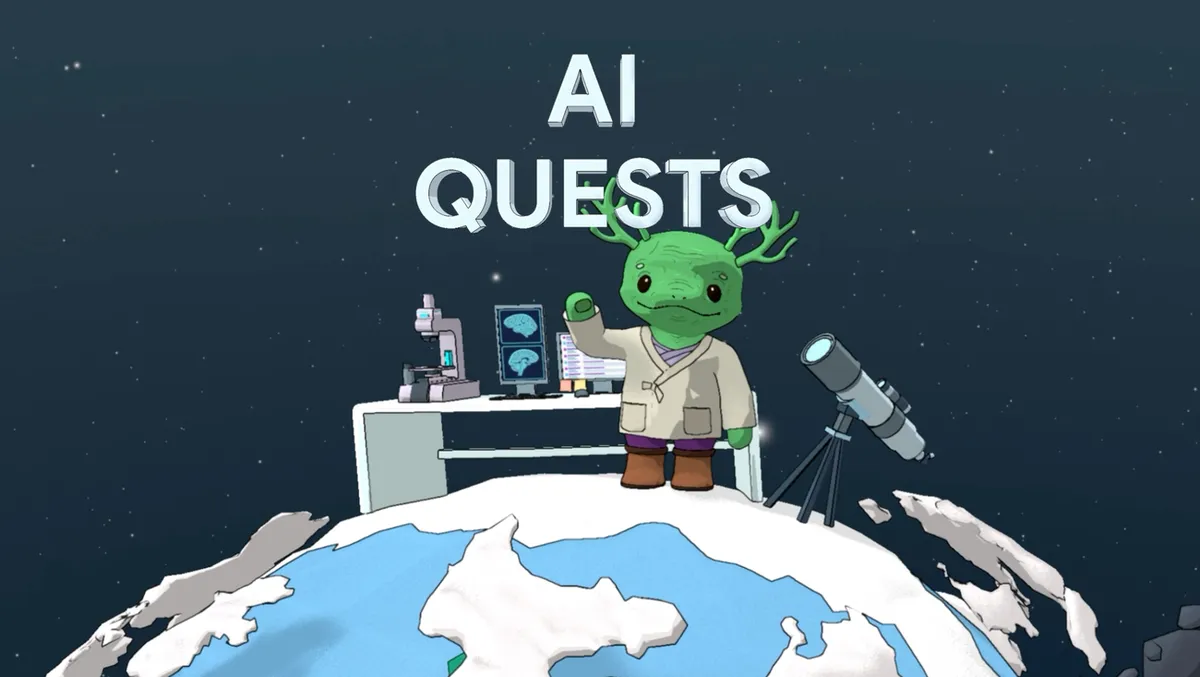
Polar Peaks is the third game in the AI Quests series, after quests on flood forecasting and diabetic retinopathy. Players act as researchers who scan and map neurons, and the game ends with messages from two connectomics scientists. Despite the 'human brain' framing, the underlying research is a fly map. It covers the male Drosophila central nervous system, with more than 166,000 neurons, and was published in Cell. [1] [2] [5] [7]
The game teaches the classic machine-learning workflow: collecting data, checking its quality, training and testing. It does not use generative AI. It is free, runs in a browser and needs no coding or login. It does need an internet connection and fairly capable hardware. [8]
schools get a free, login-free resource that teaches data quality, model testing and human oversight, drawn from real research.
Read the full assessment
Implication: it could widen AI literacy at an early age, but adopting it at scale should depend on data about learning outcomes.
Executive brief
Google Research and the Stanford Accelerator for Learning launched "Polar Peaks," the third game in their free AI Quests series. Students aged 11 to 14 play AI researchers who map neurons. The game is built on the work behind the complete male fruit-fly connectome, which Google calls the largest brain map by neuron count. Google also says students have completed more than 400,000 quests in 10 languages, which makes this a fairly large AI-literacy effort. That figure comes from Google, and no outside study of learning outcomes was found. Teacher training modules are rolling out alongside the game; the one for Polar Peaks is due next month (Google).
What changed and event timeline
AI Quests debuts with flood forecasting
Google launched the series with Stanford. Three quests were planned: floods, diabetic retinopathy and brain mapping. An in-game mentor guides students through data collection, model training and testing (;).
Raspberry Pi adds it to Experience AI
The Raspberry Pi Foundation put AI Quests into its Experience AI lessons, covering data preparation, testing and bias. The announcement included no evaluation data ().
Eye-disease quest launches
The second quest, based on Google's diabetic retinopathy model, came out during CS Education Week. Hundreds of Google volunteers led sessions in classrooms ().
Webby win
AI Quests won the 2026 Webby for AI Education, Learning & Training. The entrant was the studio Phantom, with credits for Google and Stanford staff ().
Male fly connectome published
Google, HHMI Janelia, MRC LMB and Cambridge published a complete map of the male Drosophila central nervous system in Cell: more than 166,000 neurons and 125 million synapses ().
Polar Peaks launches
The third quest is about neuroscience. Teacher modules for quests 1 and 2 are live, and the module for Polar Peaks follows next month ().
Capabilities and access
- Product: Polar Peaks, quest #3 in AI Quests.
- Gameplay: Students scan and map neurons to work out why a character is losing memory, doing data cleaning and model testing along the way.
- Access: Free, web-based, no coding, no login. Google says it collects no personal data, only anonymous gameplay metrics.
Read the full section
- Product: Polar Peaks, quest #3 in AI Quests. It has no model or version number because it is an educational game, not an AI model release.
- Gameplay: Students scan and map neurons to work out why a character is losing memory, doing data cleaning and model testing along the way. At the end, they hear from two connectomics researchers (Google).
- Access: Free, web-based, no coding, no login. Google says it collects no personal data, only anonymous gameplay metrics. It needs an internet connection, and Google recommends Chrome 139+, 4 GB of RAM and an Intel i5 (FAQ).
Technical analysis for researchers and developers
- No generative AI. The FAQ says the quests don't use generative AI (FAQ).
- Three pillars: situated learning, practice that mirrors real AI and data work, and game-based motivation (FAQ).
- The real connectome used flood-filling networks and a reconstruction system called PATHFINDER. Experts at Janelia then proofread the automated output.
Read the full section
- No generative AI. The FAQ says the quests don't use generative AI (FAQ). They simulate the classic machine-learning workflow: collect data, check its quality, train, test.
- Teaching design. Three pillars: situated learning, practice that mirrors real AI and data work, and game-based motivation (FAQ).
- The research behind the game. The real connectome used flood-filling networks and a reconstruction system called PATHFINDER. Experts at Janelia then proofread the automated output. The data is public through Neuroglancer and male-cns.janelia.org (Google Research). The game's message that AI needs human oversight matches how the actual project worked.
- Missing details. The reviewed sources don't say how the in-game models are built or which measures are used to assess student learning.
Claims and evidence
No independent press coverage of the Polar Peaks launch itself was found. The only corroboration is Google's own FAQ, which lists the quest (FAQ).
Read the full section
| Claim | Evidence |
| More than 400,000 quests completed, 10 languages | Reported by Google; no independent audit found (Google) |
| 2026 Webby winner | Confirmed on the Webby site (Webby) |
| ETIH "Best Global K–12" award | Reported by Google only (Google) |
| Largest brain map by neuron count | Stated by Google and backed by the peer-reviewed Cell paper (Google Research) |
| The quests improve AI literacy | No published outcome data in the reviewed sources |
No independent press coverage of the Polar Peaks launch itself was found. The only corroboration is Google's own FAQ, which lists the quest (FAQ).
Context and prior work
- The series grew out of Google's practice of turning its own research programs into classroom material.
- Google's research partnership on fly connectomics goes back more than a decade, including the 2020 Janelia "hemibrain" map (Neuroscience News).
- An April 2026 symposium abstract describes Google's research–practice partnerships on AI literacy (arXiv 2604.07601).
Read the full section
- The series grew out of Google's practice of turning its own research programs into classroom material. Stanford's CRAFT platform also hosts the quests, and Stanford faculty lead Victor R. Lee presented the project as an academia–industry partnership (Android Central via Yahoo).
- Google's research partnership on fly connectomics goes back more than a decade, including the 2020 Janelia "hemibrain" map (Neuroscience News).
- An April 2026 symposium abstract describes Google's research–practice partnerships on AI literacy (arXiv 2604.07601).
Limitations, safety and contested findings
- No independent study of whether the quests improve learning appeared in the reviewed sources. The Raspberry Pi announcement contains no evaluation data (Raspberry Pi Foundation).
- Teacher support for Polar Peaks is incomplete at launch, because its training module comes a month later (Google).
- The game is set in a fantasy world.
Read the full section
- No independent study of whether the quests improve learning appeared in the reviewed sources. The Raspberry Pi announcement contains no evaluation data (Raspberry Pi Foundation).
- Teacher support for Polar Peaks is incomplete at launch, because its training module comes a month later (Google).
- The game is set in a fantasy world. The connectome itself maps a fly's nervous system, not a human brain, despite the "mapping the human brain" headline (Google Research).
- The quests need internet access and fairly capable hardware, which may limit use in schools with weaker infrastructure (FAQ).
Business and practitioner implications
- Schools: A free, no-login, code-free resource for ages 11–14 that teaches about data quality and human oversight.
- Google: It turns Google's research brand (floods, retinopathy, connectomics) into a school pipeline, backed by Google.org's computer-science education funding (Google).
- EdTech builders: Quests built on real research, run with an academic co-designer, and made by an outside studio (Phantom) are a template others can copy.
Read the full section
- Schools: A free, no-login, code-free resource for ages 11–14 that teaches about data quality and human oversight. It is already part of Experience AI (Raspberry Pi Foundation).
- Google: It turns Google's research brand (floods, retinopathy, connectomics) into a school pipeline, backed by Google.org's computer-science education funding (Google).
- EdTech builders: Quests built on real research, run with an academic co-designer, and made by an outside studio (Phantom) are a template others can copy. Buyers should ask for outcome data before adopting at scale.
The source trail.
Sources (10)
Our newest AI Quest: Mapping the human brain
Article text retrieved; extracted text may omit tables or interactive elements.
blog.google