
ModelsArchitectures & capability
Anthropic’s Claude adds statistical text watermarks to supported models, but detection remains restricted
Anthropic says supported Claude models now add statistical text watermarks based on SynthID-Text, with detection limited to eligible organizations. The rollout may aid compliance and provenance workflows, but production details, independent audits and robustness against editing remain unresolved.
 AT Pulse research deskSeptember 16, 2026 · 10 min read · AI-assisted analysis
Anthropic says supported Claude models, currently including Claude Fable 5.1 and Claude Mythos 5.1, embed machine-readable marks across Claude apps, API use and supported cloud routes. [10] [8]
The text mark is described as a statistical pattern in token selection, not hidden characters or ordinary file metadata; Anthropic says its approach is based on a SynthID-Text variant. [9] [10] [15]
Text watermark detection is not generally public: Anthropic says access is in private preview for eligible organizations and certain compliance-obligated enterprises. [10]
Anthropic says supported Claude models embed statistical text marks, and EU transparency rules require machine-readable marking for some synthetic outputs, subject to exceptions.
Read the full assessment
Research on SynthID-Text shows production-scale feasibility, but independent studies report variable detectability after transformations. Implications: enterprises should log model versions and routes, avoid treating detection as proof of authorship, and update compliance policies for drafting, editing, translation and publication workflows.
Executive brief
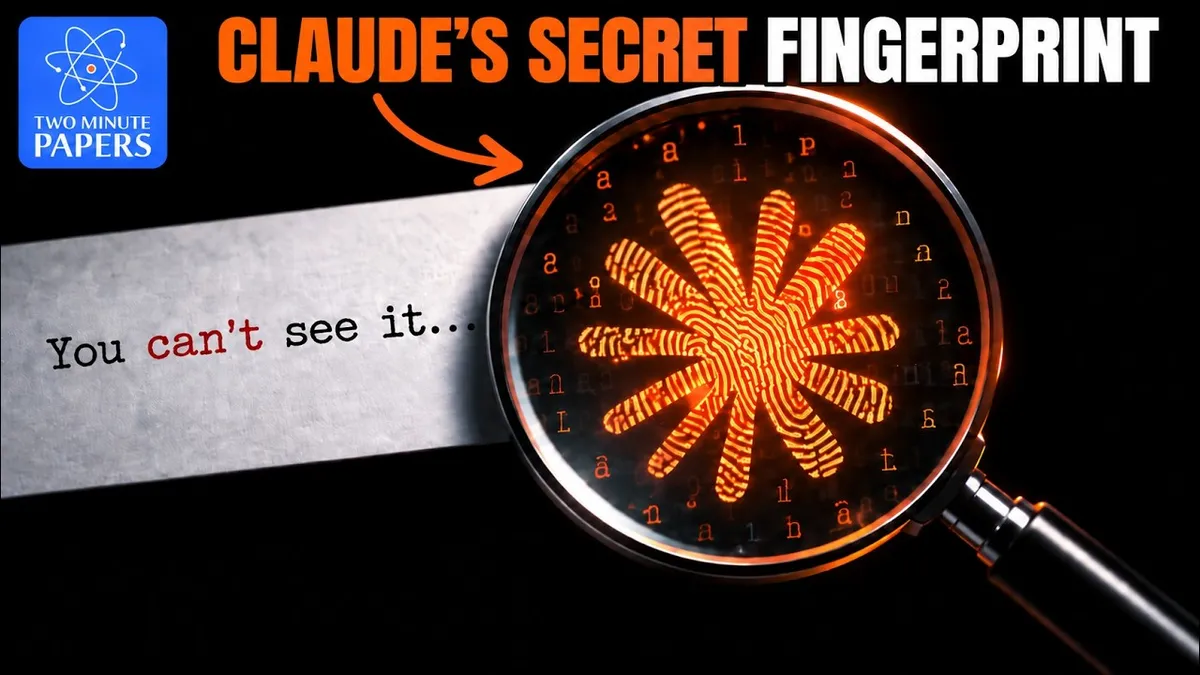
A September 15, 2026 commentary video titled “Claude Is Now Leaving Invisible Fingerprints In Its Text” argues that Anthropic’s Claude is now embedding an invisible, machine-detectable statistical watermark in generated text. Based on live-source review, the core claim is substantially supported but needs narrowing: Anthropic says supported Claude models launched on or after August 2, 2026 carry machine-readable marks, and its current help page names Claude Fable 5.1 and Claude Mythos 5.1 as supported models. Anthropic says the watermark applies across Claude apps, API, Claude Code, Claude Cowork, Claude Tag, and supported cloud routes, worldwide—not only in the EU.
Read the full section
A September 15, 2026 commentary video titled “Claude Is Now Leaving Invisible Fingerprints In Its Text” argues that Anthropic’s Claude is now embedding an invisible, machine-detectable statistical watermark in generated text. Based on live-source review, the core claim is substantially supported but needs narrowing: Anthropic says supported Claude models launched on or after August 2, 2026 carry machine-readable marks, and its current help page names Claude Fable 5.1 and Claude Mythos 5.1 as supported models. Anthropic says the watermark applies across Claude apps, API, Claude Code, Claude Cowork, Claude Tag, and supported cloud routes, worldwide—not only in the EU. How Claude marks AI-generated content | Claude Help Center
The video’s simplified “green/red word” explanation is broadly consistent with the family of LLM watermarking methods, but Anthropic specifically says Claude uses a version of Google DeepMind’s SynthID-Text, a tournament-style statistical watermarking approach published in Nature in 2024. Anthropic has not disclosed production keys, full configuration, thresholds, or independent audit results for Claude’s deployed watermark; therefore, claims about real-world false positives, removal robustness, and impact on quality remain only partly verifiable. How Claude's text watermarking works \ Anthropic
For practitioners, the biggest operational issue is not “hidden characters.” Anthropic says the mark is woven into token choices, survives copy-paste and may persist through some editing; it also says a detected mark indicates only that content may have been processed by Claude, not that Claude originated the ideas or entire text. Detection is currently private preview for eligible organizations and certain compliance-obligated enterprises, not a general public checker. How Claude marks AI-generated content | Claude Help Center
What changed and event timeline
Anthropic publishes implementation guidance
Anthropic’s help page says it signed the EU AI Act Article 50(2) Code of Practice on Transparency of AI-Generated Content and will mark generated text with embedded watermarks and supported generated files with signed provenance metadata.
EU transparency obligations apply
The EU AI Act Article 50 transparency rules became applicable on August 2, 2026, requiring providers of AI systems that generate synthetic audio, image, video, or text to mark outputs in a machine-readable format and make them detectable as artificially generated or manipulated, subject to exceptions.
Commentary video
The video transcript says the video explains text watermarking by analogy to invisible statistical fingerprints, claims light editing does not reliably remove the mark, says detection is not publicly available, and recommends open-weight systems for users who object to watermarking.
More detail
Those are commentary claims from automatic captions, not direct audiovisual review: e.g., the transcript introduces the Anthropic rollout at, explains token preference at, discusses removal at, and says access to checking is limited at.
Current as of September 16, 2026 — supported models identified
Anthropic’s support page currently lists Fable 5.1 and Mythos 5.1 as models with marking support, while stating that older models are “in progress.” A separate Anthropic “Covered Models” page lists Claude Fable 5.1 as generally available and Claude Mythos 5.1 as limited availability, both designated on August 31, 2026.
Capabilities and access
Vendor-reported: Anthropic says new Claude models launched in the EU on or after August 2, 2026 support machine-readable marking at launch; currently supported models include Claude Fable 5.1 and Claude Mythos 5.1. Text vs file marking.
Read the full section
Models and surfaces. Vendor-reported: Anthropic says new Claude models launched in the EU on or after August 2, 2026 support machine-readable marking at launch; currently supported models include Claude Fable 5.1 and Claude Mythos 5.1. Anthropic says marks apply across Claude Platform/API, Claude, Claude Code, Claude Cowork, Claude Tag, AWS, Google Cloud, and Microsoft Foundry when supported models are used. How Claude marks AI-generated content | Claude Help Center
Text vs file marking. Vendor-reported: Claude uses two mechanisms: embedded text watermarks and signed provenance metadata for supported generated files such as .svg, .png, and .jpg. The text mark is not conventional file metadata; Anthropic says it is part of the generated text’s statistical pattern and can travel through copy-paste. How Claude marks AI-generated content | Claude Help Center
Detection access. Vendor-reported: Anthropic says file credentials can be checked with a content checker, but text watermark detection is in private preview, available to eligible organizations such as regulators, law enforcement, media, fact-checkers, independent researchers, educational organizations, EU civil-society groups, and certain enterprises with verification obligations. How Claude marks AI-generated content | Claude Help Center
Technical analysis for researchers and developers
The public technical anchor is not a Claude-specific paper; it is Anthropic’s statement that Claude’s watermark is a version of SynthID-Text, originally published by Google DeepMind. SynthID-Text belongs to probabilistic generation-time watermarking. The video’s red/green-word explanation tracks that intuition, although Anthropic says its implementation is a SynthID-Text variant rather than a simple static green-list scheme.
Read the full section
The public technical anchor is not a Claude-specific paper; it is Anthropic’s statement that Claude’s watermark is a version of SynthID-Text, originally published by Google DeepMind. Anthropic describes the method as changing “the source of randomness” used to choose among words, rather than inserting visible marks, Unicode artifacts, or extra tokens. How Claude's text watermarking works \ Anthropic
SynthID-Text belongs to probabilistic generation-time watermarking. In simplified terms, when a model samples among plausible next tokens, the watermarking processor biases sampling according to a keyed pseudo-random signal. Detection later tests whether the observed sequence contains a statistically unlikely surplus of keyed choices. The video’s red/green-word explanation tracks that intuition, although Anthropic says its implementation is a SynthID-Text variant rather than a simple static green-list scheme. The video transcript’s simplified explanation appears at 00:00:57–00:02:32.
Google’s public SynthID-Text materials are reproducible to a point: Google DeepMind has a reference GitHub implementation with watermarking and detection capabilities, tests, notebook examples, and mean, weighted-mean, and Bayesian scoring functions. The repository explicitly says it is a reference implementation and not intended for production use. GitHub - google-deepmind/synthid-text · GitHub
For implementation teams, the important integration point is sampling. Google’s developer documentation says no additional model training is required; a watermarking configuration can be passed into generation to activate a logits processor. SynthID: Tools for watermarking and detecting LLM-generated Text | Responsible Generative AI Toolkit | Google AI for Developers This means downstream developers cannot assume “same prompt, same model, same temperature” behavior if watermarking changes the decoding path. For deterministic or low-temperature workflows, factual completions, code generation, or exact formatting, the strength of the signal may vary because fewer semantically safe token choices are available; Anthropic makes this limitation explicit for factual passages and proofreading. How Claude's text watermarking works \ Anthropic
Evaluation remains the weak point for Claude specifically. Google’s 2024 Nature paper reports a production-scale SynthID-Text evaluation in Gemini, but the paper is funded and performed by Google DeepMind/Google, and it is not an audit of Anthropic’s deployed Claude watermark. Scalable watermarking for identifying large language model outputs | Nature Independent work on SynthID-Text gives mixed signals: ETH SRI researchers found SynthID-Text detectable in black-box-style testing and more resistant to spoofing than some schemes, but also easier to scrub than other state-of-the-art schemes for naïve adversaries. Probing Google DeepMind’s SynthID-Text Watermark | SRI Lab Another arXiv robustness study reports that paraphrasing, copy-paste modifications, and back-translation can significantly degrade SynthID detectability. Robustness Assessment and Enhancement of Text Watermarking for Google's SynthID
Claims and evidence
- Claude now embeds invisible text watermarks.
- The watermark is not hidden Unicode or file metadata.
- It survives copy-paste and some editing.
Read the full section
| Claim | Evidence status |
| Claude now embeds invisible text watermarks. | Supported, narrowed: Anthropic says supported models generate text with embedded, imperceptible watermarks. Current named models: Fable 5.1 and Mythos 5.1. How Claude marks AI-generated content | Claude Help Center |
| The watermark is not hidden Unicode or file metadata. | Supported by Anthropic: Anthropic describes token-choice statistical watermarking for text; file provenance metadata is separate. How Claude's text watermarking works \ Anthropic |
| It survives copy-paste and some editing. | Vendor-reported; partly plausible from method: Anthropic says it travels with copied text and may persist through some editing; independent SynthID work suggests robustness varies and paraphrasing/translation can degrade detectability. How Claude marks AI-generated content | Claude Help Center |
| It can identify the user who generated the text. | Not supported by Anthropic’s public description: Anthropic frames detection as whether content may have been processed by Claude, not user attribution. How Claude marks AI-generated content | Claude Help Center |
| Public users can check any text for Claude watermarking. | False as of September 16, 2026: Anthropic says text detection is private preview for eligible organizations and certain enterprises. How Claude marks AI-generated content | Claude Help Center |
| A detected mark proves Claude wrote the whole work. | False/overstated: Anthropic says Claude may have proofread, translated, summarized, or converted human-originated material, and a mark is not full provenance. How Claude marks AI-generated content | Claude Help Center |
Context and prior work
Text watermarking predates Anthropic’s rollout. Anthropic itself traces the family of approaches to Scott Aaronson’s 2022 proposal and says Claude’s implementation is based on Google DeepMind’s SynthID-Text. How Claude's text watermarking works \ Anthropic EU official materials say Article 50 transparency obligations apply from August 2, 2026, and the EU Code of Practice supports compliance for marking, detection, and labeling of AI-generated content.
Read the full section
Text watermarking predates Anthropic’s rollout. Anthropic itself traces the family of approaches to Scott Aaronson’s 2022 proposal and says Claude’s implementation is based on Google DeepMind’s SynthID-Text. How Claude's text watermarking works \ Anthropic Google deployed SynthID-Text in Gemini and published the approach in Nature in 2024; its public materials describe SynthID as embedding imperceptible watermarks in AI-generated images, audio, text, or video. SynthID — Google DeepMind
The regulatory driver is explicit. EU official materials say Article 50 transparency obligations apply from August 2, 2026, and the EU Code of Practice supports compliance for marking, detection, and labeling of AI-generated content. Code of Practice on Transparency of AI-generated Content | Shaping Europe’s digital future Anthropic’s global rollout appears broader than the EU minimum because it says marking applies wherever supported Claude models are offered. How Claude marks AI-generated content | Claude Help Center
The field also has a history of failed or contested AI-text detection. OpenAI discontinued its 2023 AI Text Classifier because of low accuracy, and OpenAI’s own limitations page warned against using such classifiers as primary decision tools. New AI classifier for indicating AI-written text | OpenAI OpenAI later said text watermarking could be less robust against global tampering such as translation or rewording with another generative model and could stigmatize legitimate writing assistance by non-native English speakers. Understanding the source of what we see and hear online | OpenAI
Limitations, safety issues and contested findings
The main limitation is unverifiability of the deployed Claude system. An independent September 2026 paper, Watermarks Without Verification, argues that the central governance problem is not watermarking itself but the lack of public verification: no public tool can test deployed systems, and independent researchers must evaluate open-source SynthID implementations rather than Anthropic’s production configuration.
Read the full section
The main limitation is unverifiability of the deployed Claude system. An independent September 2026 paper, Watermarks Without Verification, argues that the central governance problem is not watermarking itself but the lack of public verification: no public tool can test deployed systems, and independent researchers must evaluate open-source SynthID implementations rather than Anthropic’s production configuration. Watermarks Without Verification: AI Text Watermarking After the EU AI Act
False positives and false negatives remain central risks. Anthropic says lack of a detected mark does not mean content was not AI-generated, because text may have been generated by older models, heavily edited, paraphrased, translated, mixed into other writing, too short, or routed through unsupported surfaces. Conversely, a detected mark may reflect proofreading or translation rather than original authorship. How Claude marks AI-generated content | Claude Help Center
The business and academic safety concern is misinterpretation: a watermark is a provenance signal, not a misconduct finding, copyright assignment, authorship proof, or complete chain of custody. Organizations that automate adverse decisions from watermark detection alone would be over-reading the evidence.
Business and practitioner implications
For enterprises using Claude: inventory which Claude models and routes are used in production, especially if outputs are externally published, submitted to regulators, used in marketing, or incorporated into code/documentation. Anthropic says supported models carry marks even via major cloud partners. How Claude marks AI-generated content | Claude Help Center For developers: treat watermarking as part of the decoding stack.
Read the full section
For enterprises using Claude: inventory which Claude models and routes are used in production, especially if outputs are externally published, submitted to regulators, used in marketing, or incorporated into code/documentation. Anthropic says supported models carry marks even via major cloud partners. How Claude marks AI-generated content | Claude Help Center
For developers: treat watermarking as part of the decoding stack. If your product evaluates exact output distributions, reproducibility, code correctness, or regression baselines, record model version, route, sampling parameters, and whether the model is a marked supported model.
For legal, compliance, education, and media teams: do not interpret “Claude watermark detected” as “Claude wrote this entire document.” Policies should distinguish drafting, editing, translation, summarization, and formatting. Anthropic’s own limitation language supports that distinction. How Claude marks AI-generated content | Claude Help Center
For vendors building on Claude: Article 50 obligations may attach at both provider and deployer layers. Anthropic advises builders to independently assess what Article 50 requires of their products and says further technical guidance will follow. How Claude marks AI-generated content | Claude Help Center
Sources
- Anthropic, How Claude marks AI-generated content. How Claude marks AI-generated content | Claude Help Center
- Anthropic, How Claude’s text watermarking works. How Claude's text watermarking works \ Anthropic
- Anthropic, Covered Models. Covered Models | Claude Help Center
Read the full section
- Anthropic, How Claude marks AI-generated content. How Claude marks AI-generated content | Claude Help Center
- Anthropic, How Claude’s text watermarking works. How Claude's text watermarking works \ Anthropic
- Anthropic, Covered Models. Covered Models | Claude Help Center
- Google DeepMind, Scalable watermarking for identifying large language model outputs, Nature, 2024. Scalable watermarking for identifying large language model outputs | Nature
- Google DeepMind, SynthID Text reference implementation. GitHub - google-deepmind/synthid-text · GitHub
- ETH SRI Lab, Probing Google DeepMind’s SynthID-Text Watermark. Probing Google DeepMind’s SynthID-Text Watermark | SRI Lab
- Watermarks Without Verification: AI Text Watermarking After the EU AI Act, arXiv, 2026. Watermarks Without Verification: AI Text Watermarking After the EU AI Act
- European Commission / AI Act Service Desk, Article 50 and Transparency Code materials. Article 50: Transparency obligations for providers and deployers of certain AI systems | AI Act Service Desk
- OpenAI, AI classifier and provenance-limitations materials, for detection-risk context. New AI classifier for indicating AI-written text | OpenAI
The source trail.
Sources (15)
Claude Is Now Leaving Invisible Fingerprints In Its Text
Transcript retrieved via youtube_auto_captions; language en. Timestamped text, not direct audiovisual review. Source: https://www.youtube.com/watch?v=YoEWjZSwoys. Automatic captions/transcription may contain errors.
www.youtube.com