
FundingRounds, leads & terms
Finnish startup Willo readies robotics pilots for wireless 'power zone' after Slush demos
Aalto University spinout Willo, backed by a €2.9M pre-seed round, is preparing pilots with robotics makers for a wireless power zone that runs devices in any position or orientation. It is targeting commercial rollouts within 18–24 months.
From the Tech.eu article of November 27, 2026 and cited sources: Willo's system creates a three-dimensional zone at 6.78 MHz where devices draw power without pads, precise alignment or line of sight, even while moving. [1] [2]
SOURCES[1] Tech.eu – Cutting the cord (Nov 27, 2026) tech.eu[2] PR Newswire – Willo emerges from stealth prnewswire.com
 AT Pulse research deskPublished · Updated · 4 min read · AI-assisted analysis
AI-assisted, not human-edited. Methodology Corrections Who owns this site
- What happened
- Willo's system creates a three-dimensional zone at 6.78 MHz where devices draw power without pads, precise alignment or line of sight, even while moving. [1] [2]
- Original source
- Tech.eu article, independent perspective
- Brief by
- AT Pulse research desk AI-assisted; publisher and contact on the desk page
- When
- November 27, 2026 article published
- Covered
- Nov 29 edition
- Evidence
- 9 sources across 8 sites
- 1Tech.eu – Cutting the cord (Nov 27, 2026)tech.eu
- 2PR Newswire – Willo emerges from stealthprnewswire.com
- 3Tech.eu – Willo secures €2.9Mtech.eu
- 4BeBeez – Willo pre-seedbebeez.eu
- 5EurekAlert! – Chiba University–Willo agreementeurekalert.org
- 6BriefGlance – Willo unveils wireless powerbriefglance.com
Reach: not measured yet
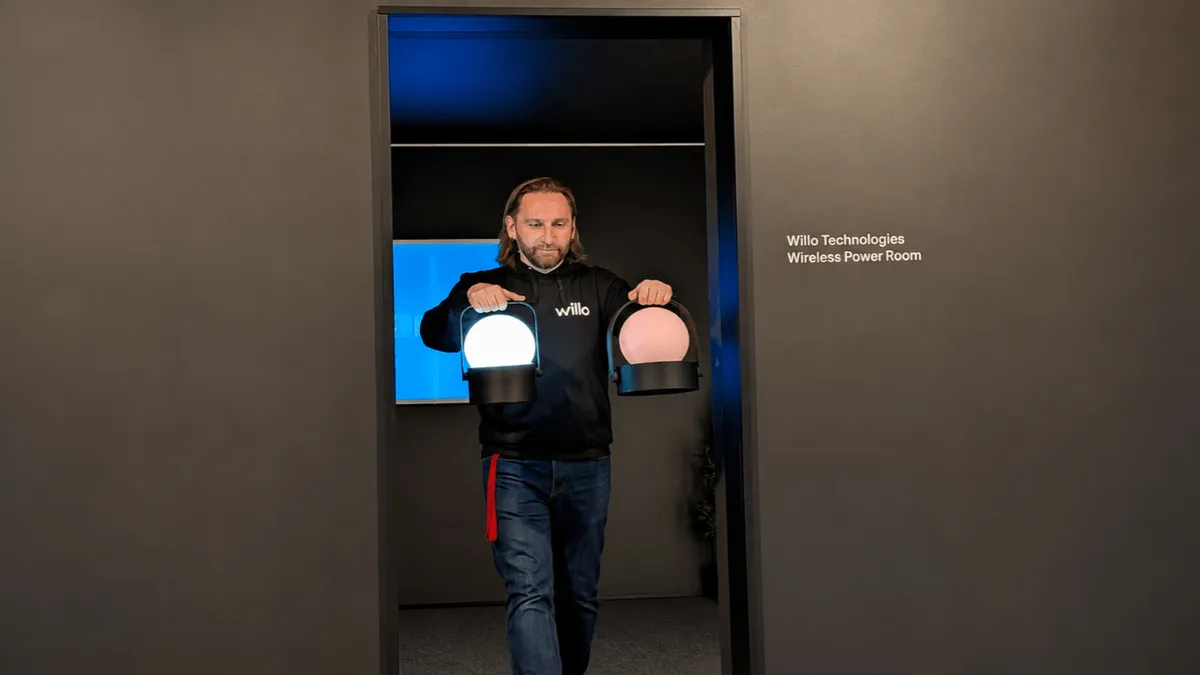
Willo's system creates a three-dimensional zone at 6.78 MHz where devices draw power without pads, precise alignment or line of sight, even while moving. At Slush it powered drones, robotic trucks and lamps, and Willo rates the system at TRL 5. [1] [2]
byFounders led the €2.9M pre-seed round in February 2026. Interface Capital, Unruly Capital, Wave Ventures and angel investors joined, and no valuation was disclosed. [3] [4] [7]
The main engineering challenge is keeping power stable as receivers enter, leave, move or change load. A 12-month project with Hiroo Sekiya's group at Chiba University, known for load-independent megahertz power transfer, is working on this, including how people moving through the zone affect delivery. [5] [9]
Robotics is the first market. Robots that keep returning to the same spots could top up in small zones while they work. Consumer devices would require phone and laptop makers to adopt the technology first. [1]
Demos show several devices powered at once while moving or rotating. If that holds up, mobile robots could charge mid-task, cutting docking time and connector wear.
Read the full assessment
But with no published power, efficiency or range figures, the practical value is still unproven.
Sources are verified; drafting the dossier now.
Executive brief
Willo is a Finnish startup spun out of Aalto University. It says it has wireless power working at Technology Readiness Level 5 (validated in a relevant environment) and is planning pilots with robotics manufacturers. It expects commercial rollouts in 18–24 months (Tech.eu). The pitch is a "3D power zone." Devices draw power from any position or orientation, with no pad, no precise alignment and no line of sight, even while moving. Willo has raised €2.9M at pre-seed and won a CNET Best of CES award. It has not published power, efficiency or range figures, and no independent tests have been found.
What changed and event timeline
Leaves stealth at CES
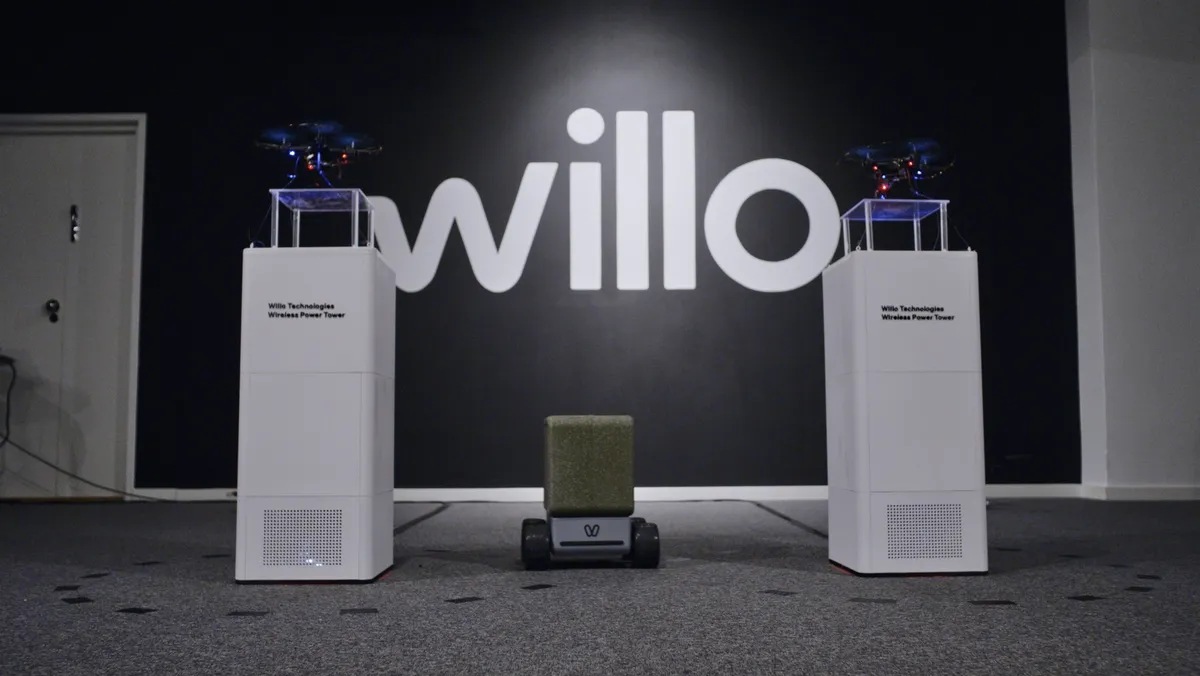
Willo showed powering of several devices at once, including while they rotate. Recording of demos was not allowed, and the announcement gave no range, power or efficiency figures ().
Chiba University agreement
A 12-month joint research project with Professor Hiroo Sekiya's group on keeping power delivery stable as devices and people enter, leave and move through the zone ().
- Late Nov 2026
Mid/late Nov 2026: Slush demos
At Slush in Helsinki, a "PowerBubble" powered drones and robotic trucks, and a "wireless room" ran lamps ().
Capabilities and access
- Frequency: 6.78 MHz, in the internationally designated ISM band. The company says this eases certification (Tech.eu).
- Maturity: the hub-based system is at TRL 5. Willo targets robotics manufacturers and hardware makers as a technology partner.
- Range: one aggregator reports a 15-inch radius at CES (BriefGlance). The official release does not state a range.
Read the full section
- Frequency: 6.78 MHz, in the internationally designated ISM band. The company says this eases certification (Tech.eu).
- Maturity: the hub-based system is at TRL 5. Willo targets robotics manufacturers and hardware makers as a technology partner. There is no product, pricing or SDK.
- Range: one aggregator reports a 15-inch radius at CES (BriefGlance). The official release does not state a range.
- Not disclosed: power level, efficiency and how many receivers can run at once.
- Team: seven people.
Technical analysis for researchers and developers
- Problem: in a shared field, every receiver changes the system's electrical load.
- Likely approach: Chiba was chosen for Sekiya's work on load-independent wireless power transfer at megahertz frequencies, using class-E and class-EF amplifier circuits (EurekAlert!).
- Reproducibility: there are no papers, datasets or benchmarks. Willo says it protects its IP through patents and trade secrets (Tech.eu).
Read the full section
- Problem: in a shared field, every receiver changes the system's electrical load. Power stays stable only if the transmitter tolerates devices arriving, leaving, moving and drawing different amounts of power. Willo calls this its core challenge.
- Likely approach: Chiba was chosen for Sekiya's work on load-independent wireless power transfer at megahertz frequencies, using class-E and class-EF amplifier circuits (EurekAlert!). This points to resonant inductive coupling designed to need little active control. That is an inference; Willo has not documented its design.
- Reproducibility: there are no papers, datasets or benchmarks. Willo says it protects its IP through patents and trade secrets (Tech.eu).
Claims and evidence
- Round and investors: company-announced. Two outlets match on €2.9M, byFounders as lead and the co-investors (Tech.eu; BeBeez). Valuation was not disclosed (Nordic Tech News).
- Investor view: Magnus Hambleton, a partner at lead investor byFounders, praised the team's combination of deep tech and hardware execution.
- CNET award: reported in funding coverage that draws on company materials. A CNET primary listing was not located.
Read the full section
- Round and investors: company-announced. Two outlets match on €2.9M, byFounders as lead and the co-investors (Tech.eu; BeBeez). Valuation was not disclosed (Nordic Tech News). No filing found.
- Investor view: Magnus Hambleton, a partner at lead investor byFounders, praised the team's combination of deep tech and hardware execution. He was commenting on his own portfolio company.
- CNET award: reported in funding coverage that draws on company materials. A CNET primary listing was not located.
- TRL 5, 6.78 MHz and the 18–24 month timeline: company statements only.
- Performance: no independent measurements exist.
Context and prior work
- Today's wireless charging works in two dimensions. Devices sit on pads with millimetre-level alignment.
- Earlier long-range efforts: WiTricity, for example, licensed its magnetic-resonance technology to Nagano Japan Radio (Yole).
- Academic base: Sekiya's lab has worked on high-frequency, load-independent wireless power transfer, including machine-learning-based design methods (Chiba IAAR).
Read the full section
- Today's wireless charging works in two dimensions. Devices sit on pads with millimetre-level alignment.
- Earlier long-range efforts: WiTricity, for example, licensed its magnetic-resonance technology to Nagano Japan Radio (Yole).
- Academic base: Sekiya's lab has worked on high-frequency, load-independent wireless power transfer, including machine-learning-based design methods (Chiba IAAR).
- Willo's view of rivals: CTO Nam Ha-Van argues that competing prototypes still restrict how receivers are positioned and which objects can be in the field.
Limitations, safety and contested findings
- Range: Willo calls the technology early and says operating range should grow over time (Tech.eu).
- People in the field: stable delivery with people present is still being researched in the Chiba project (EurekAlert!).
- Certification: BriefGlance calls regulatory certification a significant hurdle and the CES showing a demo, not a product (BriefGlance).
Read the full section
- Range: Willo calls the technology early and says operating range should grow over time (Tech.eu).
- People in the field: stable delivery with people present is still being researched in the Chiba project (EurekAlert!).
- Certification: BriefGlance calls regulatory certification a significant hurdle and the CES showing a demo, not a product (BriefGlance).
- Missing data: Nordic Tech News points to no independent verification and no output, range or efficiency figures. It reads the next milestone, a reference system for partners to evaluate, as a sign the technology is still pre-commercial (Nordic Tech News).
- Exposure and emissions: no data on human exposure or electromagnetic emissions has been published.
Business and practitioner implications
- Best fit: robots that keep returning to the same spots.
- Consumer devices: Santamala calls this a chicken-and-egg problem.
- For manufacturers evaluating it: ask for measured efficiency, watts per receiver, behaviour with several loads and an exposure assessment before committing.
Read the full section
- Best fit: robots that keep returning to the same spots. Even a small power zone could top them up while they work, cutting docking time and connector wear (Tech.eu).
- Consumer devices: Santamala calls this a chicken-and-egg problem. Phone and laptop makers would have to adopt the technology first, so expect robotics to come first.
- For manufacturers evaluating it: ask for measured efficiency, watts per receiver, behaviour with several loads and an exposure assessment before committing.
- Japan: the Chiba link suggests Willo is courting Japan's robotics and precision-equipment makers.