
FundingRounds, leads & terms
Study of 68 African venture studios finds 73% of their 456 companies have no outside funding round
An analysis of 68 African venture studios finds most of their 456 companies have never raised outside money. Those that do raise larger first rounds and come back for follow-on funding more often than other start-ups.
From the Africa: The Big Deal article of November 24, 2026 and cited sources: Of 456 studio companies, 332 (73%) have no recorded round from an outside investor. [1] [2]
SOURCES[1] Venture studios: an under-leveraged first-round pipeline… thebigdeal.substack.com[2] African Venture Studio Report 2026: The first external… african-venture-studio-report.github.io
 AT Pulse research deskPublished · Updated · 5 min read · AI-assisted analysis
AI-assisted, not human-edited. Methodology Corrections Who owns this site
- What happened
- Of 456 studio companies, 332 (73%) have no recorded round from an outside investor. [1] [2]
- Original source
- Africa: The Big Deal article, independent perspective
- Brief by
- AT Pulse research desk AI-assisted; publisher and contact on the desk page
- When
- November 24, 2026 article published
- Covered
- Nov 24 edition
- Evidence
- 5 sources across 5 sites
- 1Venture studios: an under-leveraged first-round pipeline…thebigdeal.substack.com
- 2African Venture Studio Report 2026: The first external…african-venture-studio-report.github.io
- 3TechCabaltechcabal.com
- 4Delta40 secures $20m to prove the venture studio model in…thecondia.com
- 5Venture Studios in Africa — FMOfmo.nl
RisingHow it’s measured
Substack · 8 likes · 1 comment
Reach blends public engagement (views, likes, comments, shares, stars) from the platforms where the story or its original source lives: YouTube, Hacker News, GitHub, Substack and similar. A video and the article written from its transcript share one score, taken from the video. Platforms with no data are left out rather than counted as zero, and the age of a story never lowers its score.
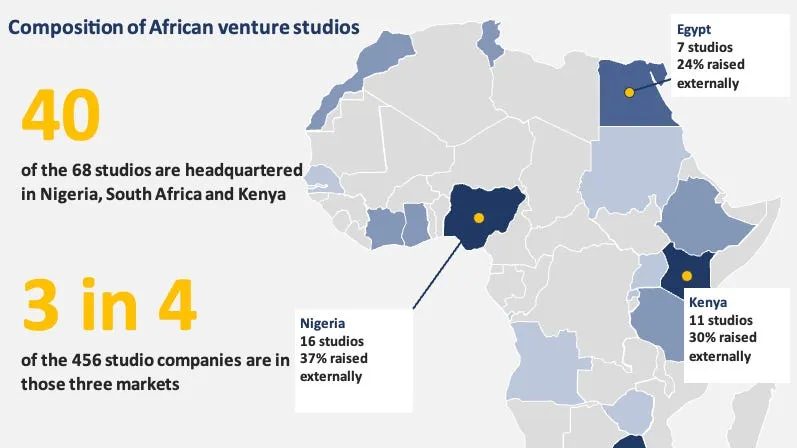
Of 456 studio companies, 332 (73%) have no recorded round from an outside investor. Of the investors who have backed a studio company's first outside round, 71% have done so only once, and none has done it more than eight times. Few investors are competing for these deals. [1] [2]
Studio companies that do raise externally outperform other start-ups. Their median first outside round was $500k, against $200k. Within two years, 48% raised again, against 28%. Without Resilience17, which accounts for 21 of the 80 companies in that cohort, the studio rate drops to 39%. [1] [2]
Companies from studios that run their own fund reach a first outside round about three times as often as other studio companies (52% against 17%), and 69% of those raise again. The authors say this may reflect stronger company selection rather than a causal effect. [2] [1]
Development funders are central to the studio model. GIZ and DEG provide most first-cheque grants, and lenders such as British International Investment supply later debt. A separate FMO, GIZ and Briter white paper reports a higher follow-on rate of one in two. It used a different sample and different definitions, and it was co-produced by funders that back studios. [1] [5]
The data show that studio companies with outside funding outperform their peers on round size and follow-on rates.
Read the full assessment
The implication, which the authors stop short of calling causal, is that investors could find first-round deals at studios, especially fund-backed ones, with little competition.
Executive brief
African venture studios hold 456 portfolio companies, and 73% of them (332) have no recorded round from an outside investor. Among the investors who have written a first round into a studio company, 71% have done it only once (Africa: The Big Deal guest post; African Venture Studio Report 2026). Studio companies that do raise outside money tend to keep raising. A median first outside round was $500k, against $200k for other start-ups, and 48% raised again within two years, against 28%. The figures come from an analysis of 68 studios by three fellows of the Dream VC Investor Accelerator, built on Africa: The Big Deal's deal database.
What changed and event timeline
Factor[e] launches Delta40
Factor[e] Ventures set up Delta40, a studio based in Kenya. The two are now among the leading studios by count of externally funded companies ().
Delta40 announces $20m
The company-announced raise drew 54 investors, including FMO, GIZ, Soros Economic Development Fund and Rockefeller Foundation. No valuation or lead investor was disclosed ().
DFI-backed white paper
FMO, GIZ SAIS and Briter published a white paper on more than 40 studios. It reports that one in two studio companies raised follow-on funding, against one in five from incubators ().
Data cutoff
The African Venture Studio Report's dataset runs to this date. It covers 68 studios and their 456 companies ().
Findings published on Africa: The Big Deal
A guest post adapts the report and argues that studios are an under-used first-round pipeline ().
Capabilities and access
- Report: the full African Venture Studio Report 2026: The first external cheque is publicly available on GitHub Pages.
- Data source: Africa: The Big Deal deal and investor records from January 2019 to September 2026, excluding exits.
- Minimum round size recorded: $1m in 2019, $500k in 2020 and $100k from 2021 (guest post).
Read the full section
- Report: the full African Venture Studio Report 2026: The first external cheque is publicly available on GitHub Pages.
- Data source: Africa: The Big Deal deal and investor records from January 2019 to September 2026, excluding exits.
- Minimum round size recorded: $1m in 2019, $500k in 2020 and $100k from 2021 (guest post).
- Studio directory: compiled by the authors. It adds 27 studios that did not appear in earlier published directories (report site).
- Sample: 49 of the 68 studios publish their portfolios. Only those companies were matched to deal records.
Technical analysis for researchers and developers
- Definition of "external": any round with an investor other than the studio or its own fund. Studio cheques, typically $60k–$150k, are excluded.
- Cohort design: follow-on rates use the 80 companies whose first outside round closed between January 2021 and September 2024, so each has a full two-year window.
- Sensitivity check: Resilience17 holds 21 of those 80.
Read the full section
- Definition of "external": any round with an investor other than the studio or its own fund. Studio cheques, typically $60k–$150k, are excluded.
- Cohort design: follow-on rates use the 80 companies whose first outside round closed between January 2021 and September 2024, so each has a full two-year window.
- Sensitivity check: Resilience17 holds 21 of those 80. Without it, the studio follow-on rate falls from 48% to 39%, still above 28% for non-studio start-ups.
- Causality: the authors say the results show where the advantage sits, not what causes it. Studios with funds may simply pick stronger companies.
- Measurement bias: rounds below the database thresholds are rarely recorded. Companies at newly identified studios show 13% external-round rates against 34% at studios already in directories, which suggests a visibility effect (report site).
All figures are from the guest post unless otherwise linked.
Claims and evidence
- First outside rounds: 124 of 456 companies (27%) have raised externally, and 70 of those raised again (guest post).
- Studios with their own fund: their companies reach a first outside round about three times as often, 52% against 17% (report site).
- Debt: debt makes up a fifth of studio-company capital ($502m), mostly in energy and mobility.
Read the full section
- First outside rounds: 124 of 456 companies (27%) have raised externally, and 70 of those raised again (guest post).
- Studios with their own fund: their companies reach a first outside round about three times as often, 52% against 17% (report site). Their follow-on rate is 69%.
- Debt: debt makes up a fifth of studio-company capital ($502m), mostly in energy and mobility. Thirteen rounds at Series B or later total $1.13bn, 46% of all capital raised (guest post).
- Conflicting figures: the FMO/Briter paper reports follow-on funding for one in two studio companies and says 90% moved on to commercial deals (FMO). That paper was co-produced by DFIs that fund studios, including Delta40, and it uses a different sample and definitions.
- Delta40: its reported 5.5x leverage on deployed capital is self-reported (Condia).
- Corroboration: no independent press coverage of the new report was found.
Context and prior work
Briter has estimated about 50 active studios in Africa, with 11 in Nigeria. The new report counts 68 studios, 40 of them in Nigeria, South Africa and Kenya. Development funders are central to the model: GIZ and DEG supply most first-cheque grants, and lenders such as Lendahand, Trine and British International Investment provide later debt (guest post).
Read the full section
Briter has estimated about 50 active studios in Africa, with 11 in Nigeria. FMO's paper says 75% of studios are headquartered on the continent (FMO). The new report counts 68 studios, 40 of them in Nigeria, South Africa and Kenya. Those three countries hold 75% of studio companies. Development funders are central to the model: GIZ and DEG supply most first-cheque grants, and lenders such as Lendahand, Trine and British International Investment provide later debt (guest post).
Limitations, safety and contested findings
- Coverage: 19 of the 68 studios do not publish portfolios, so their companies are not counted.
- Definition of "studio company": it includes companies a studio only invested in, not just those it built.
- Young companies: many have not existed long enough to raise. The median time to a first outside round is two years.
Read the full section
- Coverage: 19 of the 68 studios do not publish portfolios, so their companies are not counted.
- Definition of "studio company": it includes companies a studio only invested in, not just those it built.
- Young companies: many have not existed long enough to raise. The median time to a first outside round is two years.
- Concentration: eight studios account for 81 of the 124 externally funded companies. Results depend heavily on Resilience17.
- Scope: the authors say this is not an assessment of studio quality or returns.
- Status of the work: it is a fellowship capstone project and does not represent the views of Dream VC or the authors' employers (report site).
Business and practitioner implications
- For investors: studios that run their own fund or have a committed partner fund are the strongest first-round pipeline.
- Plan for later stages: African investors take 59% of pre-seed investor slots but only 4% at Series C and later.
- For studios: plan each company's route to its first outside cheque before the build starts, and publish launch years so investors can see which companies are approaching it (guest post).
Read the full section
- For investors: studios that run their own fund or have a committed partner fund are the strongest first-round pipeline. No investor has backed more than eight studio first rounds, so few are competing for these deals.
- Plan for later stages: African investors take 59% of pre-seed investor slots but only 4% at Series C and later. Companies will need investors from outside Africa to grow, and the authors suggest bringing a follow-on partner in early.
- For studios: plan each company's route to its first outside cheque before the build starts, and publish launch years so investors can see which companies are approaching it (guest post).