
ValuationsMarks, multiples & secondaries
Ray Dalio says the AI bubble will burst when holders must sell paper wealth for cash, speaking days after Anthropic's IPO
Days after Anthropic's Nasdaq listing, Ray Dalio told the Sourcery podcast that bubbles burst when paper wealth must be sold for cash, for example to cover debt, rising rates or wealth taxes. He also argued that human judgment should be codified, backtested and paired with AI.
From the Sourcery video of November 23, 2026 and cited sources: Dalio does not define a bubble as prices running ahead of discounted future cash flows. [1] [6] [9]
SOURCES[1] I Finally Interview Ray Dalio youtube.com[6] Fortune: Dalio on AI bubble, wealth is not money (Aug 2026) fortune.com[9] ThinkAdvisor/Bloomberg: Dalio sees AI bubble bursting thinkadvisor.com
 AT Pulse research deskPublished · Updated · 4 min read · AI-assisted analysis
AI-assisted, not human-edited. Methodology Corrections Who owns this site
- What happened
- Dalio does not define a bubble as prices running ahead of discounted future cash flows. [1] [6] [9]
- Original source
- Sourcery video, independent perspective
- Brief by
- AT Pulse research desk AI-assisted; publisher and contact on the desk page
- When
- November 23, 2026 video published
- Covered
- Nov 24 edition
- Evidence
- 11 sources across 9 sites; transcript sourced
- 1I Finally Interview Ray Dalioyoutube.com
- 2Initial public offering of Anthropic (Wikipedia)en.wikipedia.org
- 3Fortune: Dalio AI bot (Nov 2025)fortune.com
- 4Built In: SpaceX IPObuiltin.com
- 5Bloomberg: SpaceX targets more than $2 trillionbloomberg.com
- 6Fortune: Dalio on AI bubble, wealth is not money (Aug 2026)fortune.com
RisingHow it’s measured
YouTube video · 15K views · 271 likes
Reach blends public engagement (views, likes, comments, shares, stars) from the platforms where the story or its original source lives: YouTube, Hacker News, GitHub, Substack and similar. A video and the article written from its transcript share one score, taken from the video. Platforms with no data are left out rather than counted as zero, and the age of a story never lowers its score.
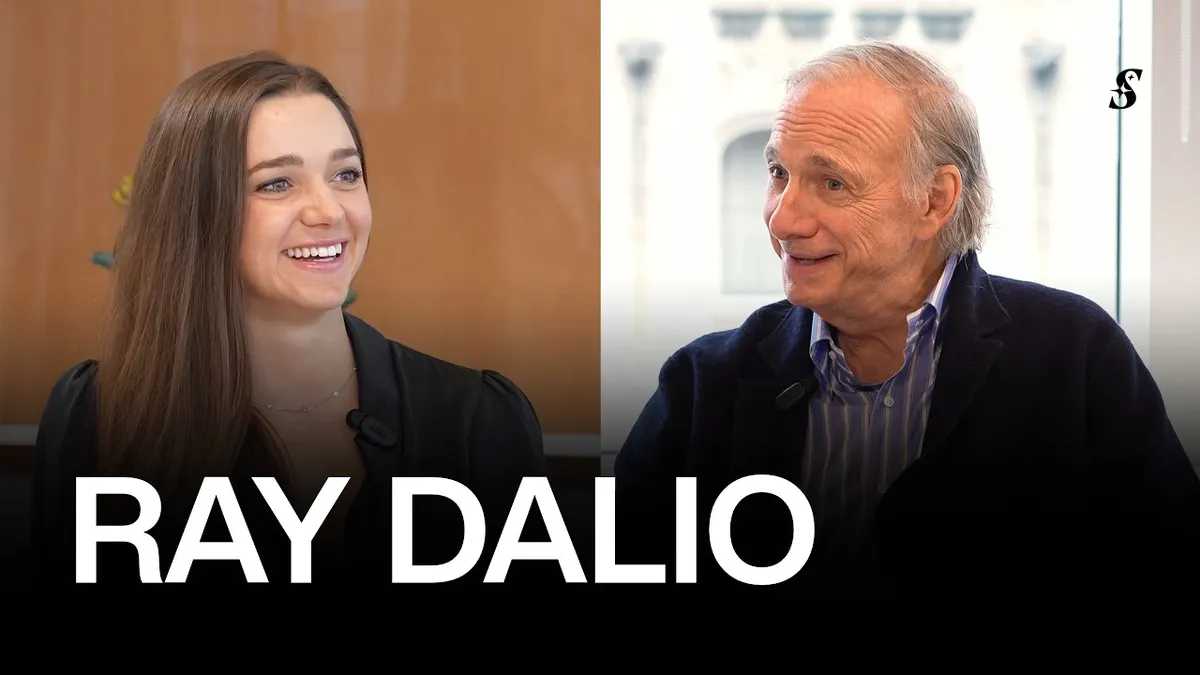
Dalio does not define a bubble as prices running ahead of discounted future cash flows. In his account, bubbles burst when owners must turn wealth into money. Debt payments, higher interest rates or wealth taxes force them to sell. Ownership by weak hands and heavy reliance on AI then push the cycle into reverse. He has made the same argument earlier in 2026. [1] [6] [9]
The interview followed a run of very large listings. SpaceX debuted at about $2 trillion. Anthropic priced at $83 a share, raising roughly $81 billion at a valuation of about $1.5 trillion. Dalio says events like these create wealth on paper that is worth little until someone sells it. [1] [2] [4] [7]
Dalio says people making decisions by weighing things in their heads is now obsolete. He favors writing down decision criteria, coding them and backtesting them against past conditions, including bubbles. He is building a tool, Digital Ray, to pass on his own criteria. Its only quality measure so far is his own estimate that it is about 80% as good as talking with him. [1] [3]
Anthropic priced at a valuation near $1.5 trillion, and Dalio argues that gains like this matter only once they are converted to cash.
Read the full assessment
Implication: share sales when lockups expire, interest-rate moves and heavy concentration in AI are the pressure points to watch.
Executive brief
Ray Dalio says the AI bubble will burst when people who hold paper wealth need cash, not when the technology fails. He made the case on the Sourcery podcast (1403s). The episode was published four days after Anthropic's Nasdaq debut. That offering was priced at about $1.5 trillion and raised roughly $81 billion, which press reports call the largest IPO on record (Wikipedia). Dalio, 77, also says the old way of making decisions, where people weigh things in their heads, is "obsolete." He wants human judgment paired with AI systems that are backtested against history (1562s). The episode is commentary and contains no new data.
What changed and event timeline
Digital Ray enters beta
Dalio sent out beta invites for an AI chatbot trained on his books and speeches. It also scrapes news to stay current.
SpaceX lists at about $2 trillion
SpaceX debuted on Nasdaq and was billed as the largest IPO to that date. Bloomberg had reported a target above $2 trillion, citing unnamed sources.
More detail
"Wealth is not money."
On The Diary of a CEO podcast, Dalio compared the market to 1929 and 2000. He named heavy stock issuance and rising interest rates as the likely triggers for a burst.
19: Anthropic prices and lists
Shares priced at $83, then opened at $111.50 under the ticker ANT and closed at $97. Reported valuation was about $1.5 trillion at the offer price.
Sourcery interview published
Host Molly O'Shea asks about the five forces, the US elections, the Anthropic IPO, AI bubbles and Bridgewater's culture.
Capabilities and access
- Per Fortune, it is trained on Dalio's books and public speeches and uses a news-scraping algorithm for current events. That rating is his own.
- Underlying model and version: not disclosed.
- Dalio's description: in the interview he calls it a "machine" built to pass his decision criteria on to others (1596s).
Read the full section
- Digital Ray: a beta chatbot. Per Fortune, it is trained on Dalio's books and public speeches and uses a news-scraping algorithm for current events. Dalio rates it about 80% as good as talking with him (Fortune). That rating is his own.
- Underlying model and version: not disclosed.
- Dalio's description: in the interview he calls it a "machine" built to pass his decision criteria on to others (1596s).
Technical analysis for researchers and developers
- Method: Dalio describes the Bridgewater approach as writing decision criteria down, turning them into code, and backtesting them across past environments, including the conditions that produce bubbles.
- Bubble model: a liquidity trigger rather than a discounted-cash-flow test. Debt service, rising rates or wealth taxes force sales.
- Evaluation: no benchmarks, backtest results or architecture for Digital Ray are published.
Read the full section
- Method: Dalio describes the Bridgewater approach as writing decision criteria down, turning them into code, and backtesting them across past environments, including the conditions that produce bubbles. He argues no person can do this unaided (1671s).
- Bubble model: a liquidity trigger rather than a discounted-cash-flow test. Debt service, rising rates or wealth taxes force sales. Ownership by "weak hands" and concentration ("everything depends on AI") then reverse the cycle (1503s).
- Evaluation: no benchmarks, backtest results or architecture for Digital Ray are published.
Claims and evidence
- Anthropic IPO figures ($83 price, 980 million shares, about $81 billion raised, about $1.5 trillion valuation): these come from the priced offering, as reported by CNBC and The Washington Post (Wikipedia).
- Host's framing of the public benefit corporation as new: misleading. Anthropic already operated as a PBC.
- "Nearly 60%" of Americans read below sixth-grade level (894s): disputed.
Read the full section
- Anthropic IPO figures ($83 price, 980 million shares, about $81 billion raised, about $1.5 trillion valuation): these come from the priced offering, as reported by CNBC and The Washington Post (Wikipedia). The host's estimate of $1–2 trillion was speculation made before the listing (1220s).
- Host's framing of the public benefit corporation as new: misleading. Anthropic already operated as a PBC. What it announced on 2026-10-18 was a 5% share allocation to its Public Benefit Fund (Wikipedia).
- "Nearly 60%" of Americans read below sixth-grade level (894s): disputed. The commonly cited figure is 54%, and the research group behind it (APM) has withdrawn the grade-level comparison (Snopes).
Context and prior work
- Repeated thesis: Dalio has made the same wealth-versus-money argument before, to Bloomberg in June (ThinkAdvisor) and on the August podcast (Fortune).
- Earlier stance: in November 2025 he advised investors, "Don't sell just because there's a bubble" (Fortune).
- 1920s analogy: he points to electricity, radio, cars and aircraft as a great technology mistaken for a great investment (1428s).
Read the full section
- Repeated thesis: Dalio has made the same wealth-versus-money argument before, to Bloomberg in June (ThinkAdvisor) and on the August podcast (Fortune).
- Earlier stance: in November 2025 he advised investors, "Don't sell just because there's a bubble" (Fortune).
- 1920s analogy: he points to electricity, radio, cars and aircraft as a great technology mistaken for a great investment (1428s).
- Five-forces framework: monetary, political, geopolitical, nature and technology (124s). It comes from his study of the last 500 years.
Limitations, safety and contested findings
- No firm timing: Dalio gives no date for a burst.
- Risk to critical thinking: he expects a large share of people to "almost stop thinking" and simply ask AI what to do (1721s).
- Unchecked political claims: his remarks on politics, such as debt-limit fights "December 11th or thereabouts," were not corroborated by the reviewed sources.
Read the full section
- No firm timing: Dalio gives no date for a burst. In 2026 he has said bubble conditions exist but the "pricking" has not started (Yahoo Finance).
- Risk to critical thinking: he expects a large share of people to "almost stop thinking" and simply ask AI what to do (1721s).
- Unchecked political claims: his remarks on politics, such as debt-limit fights "December 11th or thereabouts," were not corroborated by the reviewed sources.
- Sponsored episode: sponsors include Brex, Harvey, Mercor and Public.
Business and practitioner implications
- Post-IPO supply: Anthropic and SpaceX shareholders who sell to raise cash are the conversion mechanism Dalio flags.
- Concentration risk: if "everything depends on AI," portfolio and vendor concentration are the exposure to manage.
- Decision systems: codify your criteria and backtest them before you automate.
Read the full section
- Post-IPO supply: Anthropic and SpaceX shareholders who sell to raise cash are the conversion mechanism Dalio flags. Watch selling when lockups expire alongside interest rates.
- Concentration risk: if "everything depends on AI," portfolio and vendor concentration are the exposure to manage.
- Decision systems: codify your criteria and backtest them before you automate. Treat chatbots that copy a person's thinking, like Digital Ray, as unevaluated until they publish evidence.
The source trail.
Sources (11)
I Finally Interview Ray Dalio
Transcript retrieved via youtube_auto_captions; language en. Timestamped text, not direct audiovisual review. Source: https://www.youtube.com/watch?v=X5FuYnLtB6k. Automatic captions/transcription may contain errors.
www.youtube.com