
EcosystemsRegions, accelerators & hubs
SaaStr gives five go-to-market jobs to Meta's Muse agent instead of building them into its in-house 10K agent
SaaStr uses Meta's consumer agent Muse for five jobs: competitor mapping, an answer-engine visibility audit, a sponsor-renewal benchmark, daily monitoring of competitors' sponsor pages and a clip campaign. Core systems stay with its Replit-built agent because Muse already includes a VM, browser and scheduler.
From the SaaStr article of November 23, 2026 and cited sources: SaaStr splits the work. [1] [2]
SOURCES[1] SaaStr: How SaaStr Uses Muse for GTM saastr.com[2] Linked video: How SaaStr Uses Muse for GTM: 5 Jobs We… youtube.com
 AT Pulse research deskPublished · Updated · 5 min read · AI-assisted analysis
AI-assisted, not human-edited. Methodology Corrections Who owns this site
- Original source
- SaaStr article, independent perspective
- Brief by
- AT Pulse research desk AI-assisted; publisher and contact on the desk page
- When
- November 23, 2026 article published
- Covered
- Nov 24 edition
- Evidence
- 10 sources across 10 sites
RisingHow it’s measured
YouTube video · 37.9K views · 22 likes
Reach blends public engagement (views, likes, comments, shares, stars) from the platforms where the story or its original source lives: YouTube, Hacker News, GitHub, Substack and similar. A video and the article written from its transcript share one score, taken from the video. Platforms with no data are left out rather than counted as zero, and the age of a story never lowers its score.
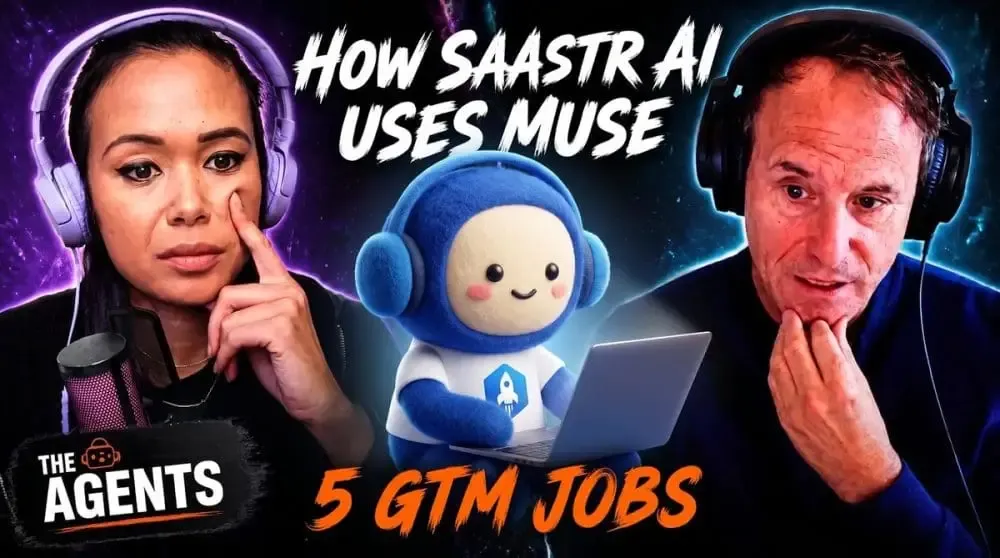
SaaStr splits the work. Its custom agent 10K keeps first-party systems such as Salesforce, billing and outbound replies. Muse gets browser tasks, recurring scheduled jobs and one-off research. Lemkin says Muse can't do anything that's impossible elsewhere. He picks it for quick setup and because tasks keep running on their own; he says the clip campaign took about five minutes to set up. [1] [2]
SaaStr gave Muse its full customer history and asked for three or four competitors, with domains, for each customer. That list now feeds SaaStr's outbound agents, and the company calls competitor and look-alike targeting its top outbound play. It gives no performance figures. [1] [2]
In an answer-engine audit, Muse sent about 50 prompts of its own to ChatGPT, Gemini and other chatbots while logged out. SaaStr says it appeared in 46 of them. This is SaaStr's own figure from one run, and the prompts and scoring were not published. The audit also found chatbots repeating inconsistent attendance figures taken from SaaStr's own sites. SaaStr's advice is to standardize published facts, add llms.txt and keep asking about 10 outside agents which vendor they would recommend in your category. [1] [2]
How customer data is protected remains an open question. In the chat, SaaStr told Muse not to train on its customer list, but Meta's documented control is an account-level opt-out, and no source says an in-chat instruction is binding. One comparison reports that policy, not technical controls, limits Meta staff access to user data. Meta's promised encrypted Confidential VM has not shipped yet. [2] [3] [7] [10]
The evidence: one B2B company documents using a consumer-launched agent for go-to-market research and recurring monitoring.
Read the full assessment
The implication: hosted agents may handle side tasks that teams don't want to build themselves, but default data-training and staff-access terms need checking before customer lists go in.
Executive brief
SaaStr, the B2B media and events company, says its strongest outbound campaign right now came from Meta's consumer agent, Muse. Muse took SaaStr's full customer history and returned three or four competitors for each customer. In a SaaStr post (Nov 23, 2026), Jason Lemkin lists five go-to-market jobs SaaStr gives Muse instead of its own Replit-built agent, "10K". In each case the reason is that Muse comes with a cloud VM, a browser and scheduled tasks. Meta pitched Muse at errands such as bookings and bills, so this is an early example of B2B use. The results are SaaStr's own account. No outside source has checked them.
What changed and event timeline
Lemkin suggests GTM uses
On X, Lemkin advised giving Muse any go-to-market task that isn't getting done. The SaaStr post embeds that tweet ().
Muse launches in the UK
It opened to adults 18 and over. AI training on user interactions is on by default and can be turned off in Settings ().
SaaStr publishes its five Muse jobs
The post lists competitor mapping, an answer-engine visibility audit, a sponsor-renewal benchmark, daily monitoring of competitors' sponsor pages, and a clip campaign. It also sets out how work is split between Muse and 10K ().
Capabilities and access
- Meta calls it its most capable model for real-world agent work (Meta).
- Runtime: each user gets a Linux VM with storage, a terminal and Chromium, plus one-off, interval or cron schedules (Zima explainer).
- Access: web (muse.ai), iOS, Android and WhatsApp. Plans are Free, Power at $20 a month and Maximum at $100 a month (TechCrunch).
Read the full section
- Model: Muse Spark. Meta calls it its most capable model for real-world agent work (Meta).
- Runtime: each user gets a Linux VM with storage, a terminal and Chromium, plus one-off, interval or cron schedules (Zima explainer). One comparison says Muse has no schedule screen and no event triggers (Pinggy).
- Access: web (muse.ai), iOS, Android and WhatsApp. Plans are Free, Power at $20 a month and Maximum at $100 a month (TechCrunch).
Technical analysis for researchers and developers
Meta's own description of the security architecture: Meta cites no numerical evaluations. SaaStr's AEO (answer-engine optimization) audit worked like this: Muse wrote about 50 of its own prompts and sent them to ChatGPT, Gemini and other chatbots while logged out, so no account history could skew the answers. Neither the prompt set nor the scoring was published, so the audit can't be reproduced.
Read the full section
Meta's own description of the security architecture:
- Sandboxing: the agent runs in a systemd-nspawn container, with eBPF tracking of "tainted" egress (outbound traffic that touches user data).
- Sentinel: a separate process on the same host controls all network egress and connector actions, and asks the user when approval is needed.
- Credentials: the agent holds only surrogate credentials. Sentinel swaps in the real ones at the network boundary.
- Browser input: the agent sees accessibility-tree snapshots, not the raw page code (DOM).
Meta cites no numerical evaluations. SaaStr's AEO (answer-engine optimization) audit worked like this: Muse wrote about 50 of its own prompts and sent them to ChatGPT, Gemini and other chatbots while logged out, so no account history could skew the answers. Neither the prompt set nor the scoring was published, so the audit can't be reproduced.
Claims and evidence
- Muse surfaced SaaStr in 46 of 50 cold prompts. Self-reported, from one run.
- The competitor list is SaaStr's best-performing outbound play. No metric is given (32:14).
- SaaStr's sponsor renewal rate is "well above" competing events. No figure is given.
Read the full section
- Muse surfaced SaaStr in 46 of 50 cold prompts. Self-reported, from one run. Amelia Lerutte (SaaStr's Chief AI Officer) says in the video that the year-specific answers should be taken "with a grain of salt" (39:40, 40:00).
- The competitor list is SaaStr's best-performing outbound play. No metric is given (32:14).
- SaaStr's sponsor renewal rate is "well above" competing events. No figure is given. Muse estimated it by comparing sponsor logos on the 2025 and 2026 event pages (41:44).
- SaaStr runs an "eight-figure business" with three humans and 20+ agents. Self-reported (SaaStr).
- Tool count differs between sources. The post says 10K connects to "more than 30 tools". In the video, Lerutte says there are 36+ more tools beyond the ones shown on screen (03:11).
Context and prior work
- Meta frames Muse as a step toward "personal superintelligence", led by Alexandr Wang (Axios). Third-party comparisons put it alongside other always-on agents such as Grok's bot, Instinct and OpenClaw (Pinggy).
- SaaStr's own playbook is a central custom agent, 10K, plus best-of-breed outbound tools. Lemkin says in the video that Muse "broke" SaaStr's rule of removing an agent for every one added (29:23).
Limitations, safety and contested findings
- Training data: Lerutte told Muse in the chat not to train on SaaStr's customer list (32:28).
- Staff access: Pinggy reports that Meta staff access to user data is limited by policy, not technically prevented (Pinggy).
- Trust: TechCrunch cites Meta's FTC privacy history as a reason for caution (TechCrunch).
Read the full section
- Training data: Lerutte told Muse in the chat not to train on SaaStr's customer list (32:28). Meta's documented control is an account-level opt-out (CNBC); no source says an in-chat instruction is binding.
- Staff access: Pinggy reports that Meta staff access to user data is limited by policy, not technically prevented (Pinggy). Meta has promised an encrypted "Confidential VM" but not yet shipped it (Meta).
- Trust: TechCrunch cites Meta's FTC privacy history as a reason for caution (TechCrunch).
- Maturity: Lemkin says scheduled tasks were "a little bumpy" at launch (33:58).
Business and practitioner implications
- Division of labour: SaaStr keeps first-party systems (Salesforce, billing, outbound replies) in 10K. It gives Muse browser work, scheduled jobs and one-off research (SaaStr).
- Convenience, not unique capability: Lemkin says nothing they do in Muse is impossible elsewhere.
- For AEO, publish checkable facts: SaaStr found chatbots repeating inconsistent attendance figures from its own sites.
Read the full section
- Division of labour: SaaStr keeps first-party systems (Salesforce, billing, outbound replies) in 10K. It gives Muse browser work, scheduled jobs and one-off research (SaaStr).
- Convenience, not unique capability: Lemkin says nothing they do in Muse is impossible elsewhere. The appeal is setup speed and persistence; he says the clip campaign took about five minutes (37:18).
- For AEO, publish checkable facts: SaaStr found chatbots repeating inconsistent attendance figures from its own sites. The advice is to standardize facts, add llms.txt, and regularly ask a "bank of 10" third-party agents which vendor they'd recommend in your category (45:17).
- Before uploading customer data: check the training opt-out setting and the data-access terms.
The source trail.
Sources (10)
SaaStr: How SaaStr Uses Muse for GTM
saastr.comLinked video: How SaaStr Uses Muse for GTM: 5 Jobs We Didn’t Want to Build Into Our Own Agents
linked video auto captions
www.youtube.com