
AgentsAutonomy & tool use
OpenAI and Cisco open-source Shirudo, a Linux runtime where AI agents write eBPF shields to block exploits on live systems
OpenAI and Cisco released Shirudo, an open-source, pre-release Linux runtime in which AI agents write signed eBPF shields that block exploits on running systems until real patches land, aiming to shrink exposure windows as vulnerability discovery accelerates.
From the OpenAI News article of November 23, 2026 and cited sources: Shirudo, released under BSD-2-Clause, lets Codex-driven agents generate temporary eBPF mitigations, called shields, for kernel paths and, through signed Java agents, for applications. [1] [3] [4]
SOURCES[1] OpenAI: OpenAI and Cisco introduce Shirudo openai.com[3] Isovalent: Cisco and OpenAI Shirudo isovalent.com[4] Shirudo GitHub github.com
 AT Pulse research deskPublished · Updated · 4 min read · AI-assisted analysis
AI-assisted, not human-edited. Methodology Corrections Who owns this site
- What happened
- Shirudo, released under BSD-2-Clause, lets Codex-driven agents generate temporary eBPF mitigations, called shields, for kernel paths and, through signed Java agents, for applications. [1] [3] [4]
- Original source
- OpenAI News article, company source
- Brief by
- AT Pulse research desk AI-assisted; publisher and contact on the desk page
- When
- November 23, 2026 article published
- Covered
- Nov 24 edition
- Evidence
- 9 sources across 8 sites
- 1OpenAI: OpenAI and Cisco introduce Shirudoopenai.com
- 2Linked video: OpenAI and Cisco introduce Shirudoyoutube.com
- 3Isovalent: Cisco and OpenAI Shirudoisovalent.com
- 4Shirudo GitHubgithub.com
- 5LWN: Shielding running kernels against exploits with BPFlwn.net
- 6LWN: netkit and user-space BPF patchinglwn.net
RisingHow it’s measured
YouTube video · 989 views · 20 likes
Reach blends public engagement (views, likes, comments, shares, stars) from the platforms where the story or its original source lives: YouTube, Hacker News, GitHub, Substack and similar. A video and the article written from its transcript share one score, taken from the video. Platforms with no data are left out rather than counted as zero, and the age of a story never lowers its score.
Shirudo, released under BSD-2-Clause, lets Codex-driven agents generate temporary eBPF mitigations, called shields, for kernel paths and, through signed Java agents, for applications. Shields apply without a restart while the real patch rolls out. It is still pre-release and needs Shirudo's own kernel patches plus TPM 2.0. It has been validated only on x86-64. [1] [3] [4]
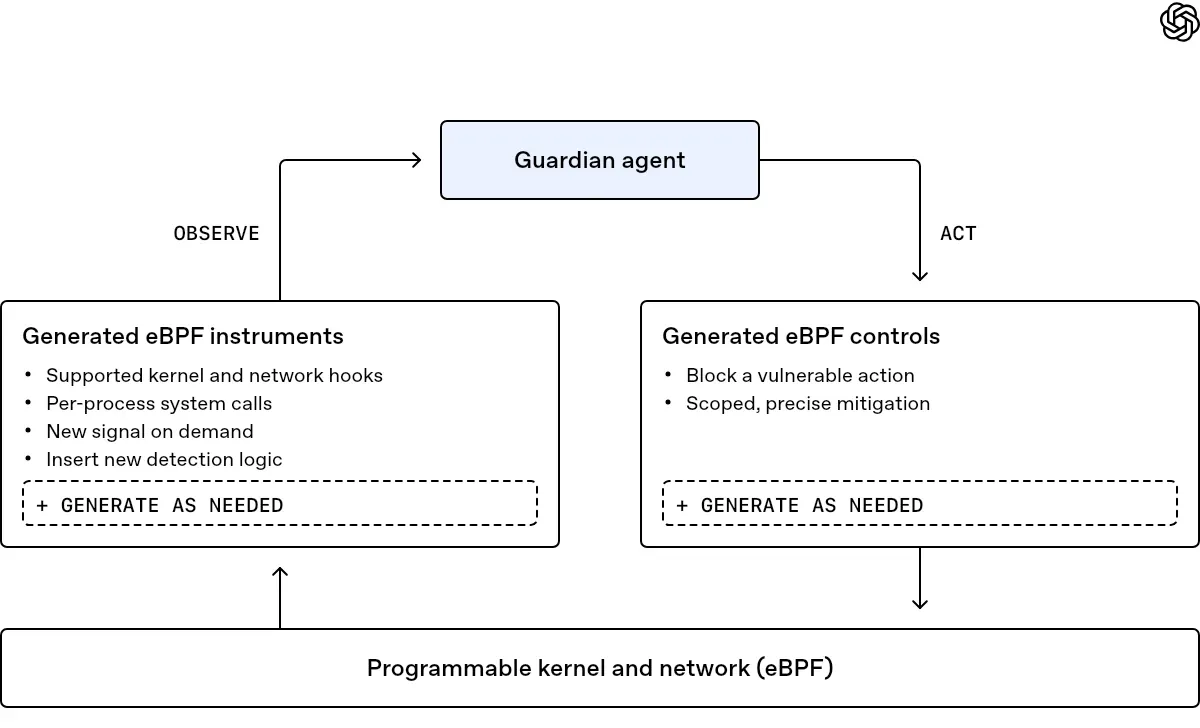
The design rewrites Isovalent's Tetragon for agents and drops the policy language, so agents write BPF code directly. Each shield ships as a signed micropatch from an append-only registry. A BPF keyring sealed at boot stops even root from loading unsigned programs, and every load or unload is recorded in the TPM as an audit hash chain. [2] [3] [5]
The evidence is early. A Java4Shell exploit against a live Elasticsearch service was blocked in a controlled test, shown only in vendor logs. In an internal run on about 500 kernel CVEs from June to September, more than 317 AI-generated mitigations passed health checks and reproducers. Only about 30 were described as verified, and many still needed human judgment on whether they removed too much functionality. [2] [3]
The approach is contested. Kernel developers questioned whether BPF verification is enough for patching user-space applications, and a conference attendee asked why the kernel should be trusted if root cannot be. Trade press noted that vendors such as Rimini Street, VMware, Palo Alto Networks and Rapid7 already sell compensating controls. Shirudo's differences are that it is open source and generates shields at machine speed. [2] [6] [8]
The evidence so far is one controlled demo and an internal CVE experiment with few fully verified mitigations. If shields prove reliable, teams could cover exploit windows without waiting for reboots.
Read the full assessment
Adoption, however, requires patched kernels, TPM 2.0 and human review.
Executive brief
OpenAI and Cisco open-sourced Shirudo on November 23, 2026. It is a Linux runtime that lets AI agents write temporary eBPF "shields" that block an exploit on a running system while the real patch is still being rolled out, with no restart (OpenAI). The one public demonstration was a controlled test: a Codex-generated shield stopped a Java4Shell exploit against a live Elasticsearch service (Isovalent). The project's GitHub page says it is still pre-release (GitHub). Its own engineers reported that many AI-generated mitigations still need human judgment.
What changed and event timeline
"Shields" debut at a kernel summit
John Fastabend of Isovalent described per-kernel BPF shields built from Tetragon telemetry at the LSFMM+BPF summit ().
Pushback on user-space patching
Daniel Borkmann proposed live-patching applications with BPF. Kernel developers Song Liu and Andrii Nakryiko questioned whether verification would be enough and whether the approach was feasible ().
Shirudo presented at Linux Plumbers
Borkmann and Fastabend presented it as "BPF live-patching infrastructure for the agentic era" (;).
OpenAI and Cisco launch
Open-source release under BSD-2-Clause, with the Java4Shell demo and a webinar scheduled for December 15 ().
The press is skeptical
The Register noted that compensating controls are not new and that both vendors have commercial incentives ().
Capabilities and access
- Code and docs: the GitHub repo, docs, a VM quickstart and an Isovalent lab.
- Requirements: a kernel with the signed-loader ABI plus Shirudo's own kernel patches, and TPM 2.0.
- Shields: these cover kernel paths and, through signed Java agents, applications.
Read the full section
- Code and docs: the GitHub repo, docs, a VM quickstart and an Isovalent lab.
- Requirements: a kernel with the signed-loader ABI plus Shirudo's own kernel patches, and TPM 2.0. It is validated on x86-64; arm64 host tests exist and riscv64 is pending (GitHub).
- Shields: these cover kernel paths and, through signed Java agents, applications.
- AI model: shields are generated with "Codex". No model version is disclosed (Isovalent).
Technical analysis
- Rewrite of Tetragon "for agents": there is no policy language (DSL). Agents write BPF code directly (Isovalent; talk).
- Micropatches: each is a signed light-skeleton loader plus metadata, built from a manifest and pulled from an append-only registry tree with sequence numbers (talk).
- Boot-time security: a dedicated BPF keyring is sealed at boot, so even root cannot load unsigned programs or tamper with protections (talk).
Read the full section
- Rewrite of Tetragon "for agents": there is no policy language (DSL). Agents write BPF code directly (Isovalent; talk).
- Micropatches: each is a signed light-skeleton loader plus metadata, built from a manifest and pulled from an append-only registry tree with sequence numbers (talk).
- Boot-time security: a dedicated BPF keyring is sealed at boot, so even root cannot load unsigned programs or tamper with protections (talk).
- Audit trail: every load or unload is measured into the TPM as a hash chain (talk).
- Telemetry: data flows from BPF arena maps through LuaJIT to OpenTelemetry (talk).
- Kernel work so far: a signed-loader rework and ML-DSA (post-quantum signature) support (talk).
Claims and evidence
- Java4Shell blocked on Elasticsearch 9.5.5: a Base64 input check was injected into the running Java process. No independent reproduction has been published.
- CVE experiment: the team reviewed about 500 kernel CVEs from June to September.
- "Mean time to exploit has gone negative": this is the vendors' framing, not a measured figure (talk; The Hacker News).
Read the full section
- Java4Shell blocked on Elasticsearch 9.5.5: a Base64 input check was injected into the running Java process. Only the vendors' logs show this, and there is no performance data (Isovalent). No independent reproduction has been published.
- CVE experiment: the team reviewed about 500 kernel CVEs from June to September. According to the talk's auto-captions (which may contain errors), more than 317 got LLM mitigations that passed health checks and reproducers, but only about 30 were described as "verified" (talk).
- "Mean time to exploit has gone negative": this is the vendors' framing, not a measured figure (talk; The Hacker News).
Context and prior work
- Cloudflare precedent: the talk cites Cloudflare using BPF LSM to cover its fleet against the "copy fail" CVE in 26–30 hours, against its normal 4-week reboot cycle (talk).
- Not a new concept: Rimini Street, VMware, Palo Alto Networks and Rapid7 already sell compensating controls.
- Roots: the work grows out of Tetragon and the 2026 LSFMM+BPF discussions (LWN).
Read the full section
- Cloudflare precedent: the talk cites Cloudflare using BPF LSM to cover its fleet against the "copy fail" CVE in 26–30 hours, against its normal 4-week reboot cycle (talk).
- Not a new concept: Rimini Street, VMware, Palo Alto Networks and Rapid7 already sell compensating controls. Shirudo's differences are that it is open source and generates shields at machine speed (The Register).
- Roots: the work grows out of Tetragon and the 2026 LSFMM+BPF discussions (LWN).
Limitations, safety and contested findings
- What BPF can't fix: some bugs, such as race conditions, can't be patched through BPF today.
- Too much blocking: human judgment is still needed to check whether a mitigation cuts away too much functionality (talk).
- Root distrust challenged: an audience member asked why a kernel that can't be trusted against root exploits would itself be safe.
Read the full section
- What BPF can't fix: some bugs, such as race conditions, can't be patched through BPF today. Shields mostly override functions to return errors rather than replacing them (talk).
- Too much blocking: human judgment is still needed to check whether a mitigation cuts away too much functionality (talk).
- Root distrust challenged: an audience member asked why a kernel that can't be trusted against root exploits would itself be safe. A participant called the result a "cat and mouse game until we fix Linux" (talk).
- User-space patching disputed: kernel developers questioned whether BPF verification is enough there (LWN).
Business and practitioner implications
- Not ready for production fleets: it needs patched kernels, TPM 2.0 and a pre-release runtime (GitHub).
- Treat shields as a stopgap: use them for exposure windows, and keep human approval in place, as the vendors themselves advise (The Register).
- Strategic angle: both vendors benefit if it spreads, since it drives Codex demand for OpenAI and eBPF adoption for Cisco/Isovalent (The Register).
Read the full section
- Not ready for production fleets: it needs patched kernels, TPM 2.0 and a pre-release runtime (GitHub).
- Treat shields as a stopgap: use them for exposure windows, and keep human approval in place, as the vendors themselves advise (The Register).
- Strategic angle: both vendors benefit if it spreads, since it drives Codex demand for OpenAI and eBPF adoption for Cisco/Isovalent (The Register). The stated goal of shipping tested shields alongside vulnerability disclosures would change how patches are triaged (OpenAI).
The source trail.
Sources (9)
OpenAI: OpenAI and Cisco introduce Shirudo
openai.comLinked video: OpenAI and Cisco introduce Shirudo
linked video auto captions
www.youtube.com